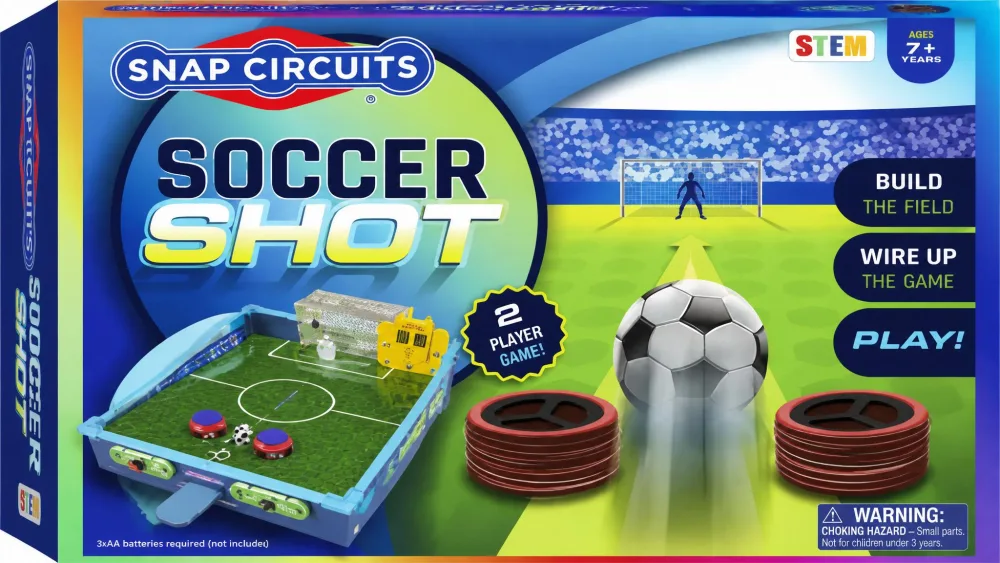
Snap Circuits Soccer Shot Review: Is This 2-Player STEM Game Worth It?
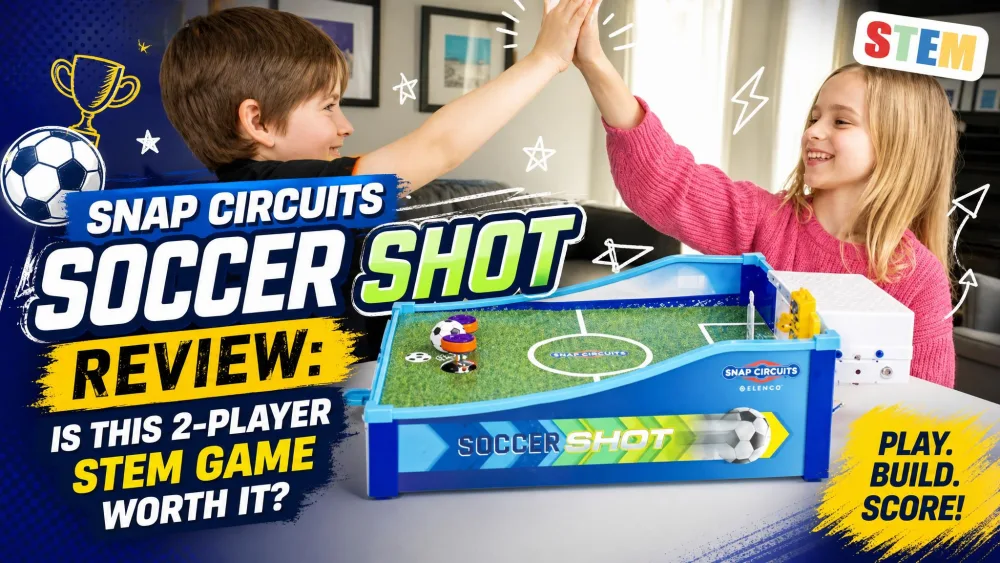
The Snap Circuits Soccer Shot is a build-it-yourself, 2-player tabletop soccer STEM game, and the part that surprised us most happened before anyone scored a goal. We spread the parts across the kitchen table one rainy afternoon expecting a quick setup, then spent the day snapping together every circuit, sensor, and motor by hand. By dinner the kids weren't asking to play a game they'd bought. They were asking to play a game they'd built.
That difference shapes whether this kit is worth it. Here's what the build is like, how it plays, what it teaches, and who should skip it.
NoteWe built and played the Soccer Shot ourselves over several sessions at home, with kids in the 7-and-up range doing the assembly and the matches. Everything below is what we saw at our table.
What Is Snap Circuits Soccer Shot?
Snap Circuits Soccer Shot is a tabletop penalty-kick game from Elenco, the maker behind the Snap Circuits line that parents and teachers have leaned on for over 20 years.
The twist is that it isn't a finished toy. It's a kit of real components, a motorized kicker, a movable goalie, infrared goal sensors, and a digital scoreboard, that kids assemble into a working two-player game. So it sits in an unusual spot: part building kit, part competitive game.
What's in the Box
Inside the box is everything needed to build one complete electronic soccer game: the circuit parts, the motors and sensors, the scoreboard, the soccer ball, and a step-by-step manual. No soldering or tools are required. The game runs on 3 AA batteries, and they aren't included; we didn't have any the first afternoon, which turned an exciting unboxing into a trip to the cupboard.
Parent tipBuy a fresh set of 3 AA batteries before you hand this over, especially as a gift. There's nothing worse than finishing the build and realizing you can't switch it on.
Once we tipped everything out, the parts sorted into two groups. The electronics side holds the real circuit pieces, the snap wires, battery holder, switches, motors, and the infrared LED-and-sensor pair that handles goal detection. The game-build side holds the structural parts that turn those circuits into a stadium: the field, goal panels, control bars, goalies, and a cardboard backdrop. One box holds everything to build one complete game, with nothing extra to buy beyond the batteries.
Building the Game: The STEM Experience
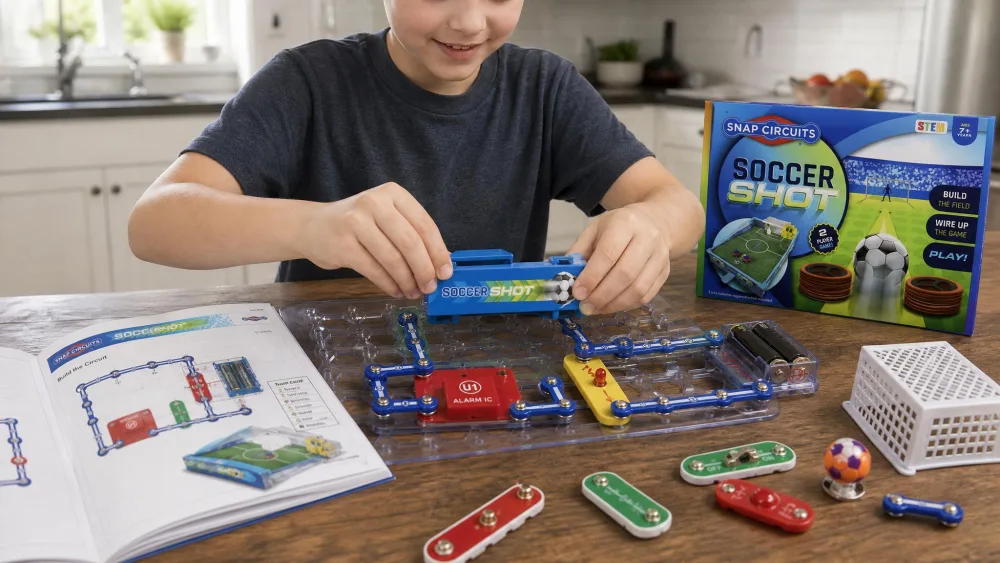
Where most games start when you open the lid, this one starts when you build it. Kids assemble the entire game from scratch, snapping together every sensor and circuit before the first match.
How Hard Is the Build? (Age & Skill, 7+)
The Soccer Shot is rated for ages 7+, and the build runs roughly 1-2 hours before the first game. In our experience the assembly is part of the fun rather than a chore, because it leans on problem-solving and watching the machine come alive.
Because the parts snap together with no tools or soldering, the friction is about following the manual carefully, not handling anything sharp. The 7+ floor has a fair caveat, though: a child right at age seven may need an adult for the trickier steps, while older kids run it themselves.
What Kids Learn (Circuits, Sensors, Mechanics)
This is where the kit earns the STEM label honestly. As they build, kids work with real electronics. The motorized kicker teaches motors and mechanics, the infrared goal detection introduces sensors, and the adjustable shot speed shows how a circuit changes behavior.
Best of all, it's screen-free. The learning is tactile, and it sticks far better than a tablet tutorial: a child connects a sensor, then watches it register a goal a minute later. That cause-and-effect loop is the heart of hands-on circuit learning.
The kids weren't asking to play a game they'd bought. They were asking to play a game they'd built.
How the Game Plays
Once the building is done, the Soccer Shot becomes a competitive game, and this half decides replay value.
Penalty-Kick Gameplay & Scoring (First to 9 Goals)
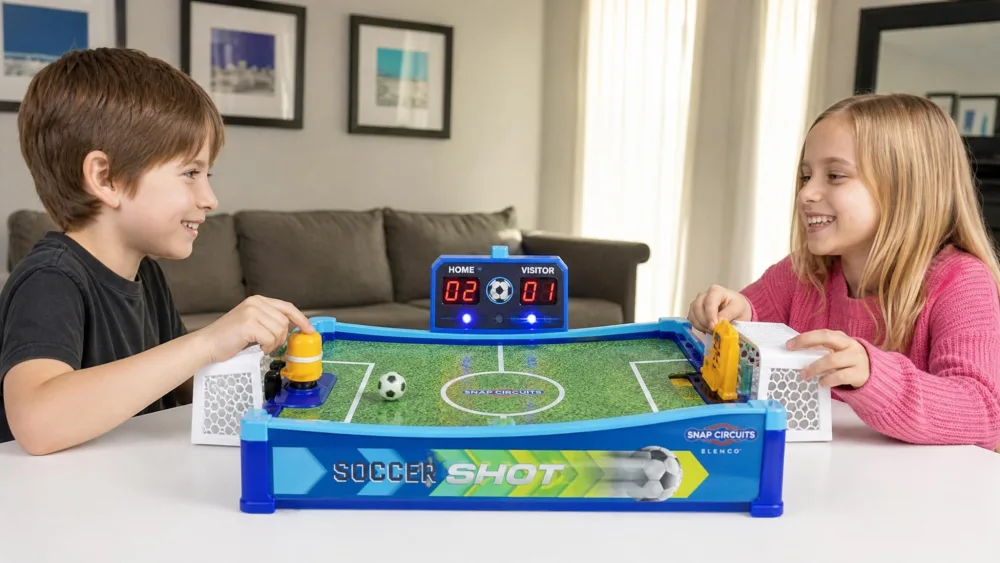
The format is tabletop penalty kicks for 2 players, head-to-head. One player works the motorized kicker to shoot; the other slides the goalie to block. A match is a race to nine goals, and the first to score nine goals wins.
In play it's tenser than we expected. The action is skill-based rather than luck, so a kid who reads the goalie and times the kick well genuinely outplays a button-masher. Matches stayed close enough that the loser almost always wanted a rematch, the best sign a two-player game has legs.
Features: Variable Shot Speed, Motion Detection, Digital Scoreboard
A few features keep matches from going stale. The variable shot speed lets you dial difficulty up or down, so a parent can give a younger sibling a fair shot or crank it for a challenge. Motion detection and the infrared sensors register each goal automatically and trigger cheering sound effects.
That feedback loop matters more than it sounds. The scoreboard ticks up on its own, the kids reacted to the noise and the rising score every time, and it lends a quiet tabletop game some stadium energy.
Who It's Best For
This kit is for families who value the building as much as the playing. A child who lights up at "how does this work?" gets far more out of it than one who wants a game off the shelf. Because it's screen-free and competitive, it also suits households trying to cut tablet time without losing the head-to-head fun kids want.
It's pitched as years of replayable fun for kids, teens, and adults, not a one-and-done build. We'd steer gift-buyers toward kids who already like construction toys; that child treats the 1-2 hour build as the best part, not the obstacle. It's a weaker fit for larger groups or anyone wanting instant play with zero setup.
Price and Where to Buy
The Soccer Shot lists at around $119.99 MSRP, though prices move by retailer, and we've seen it closer to the $110-$120 range. It launched in spring 2026, so compare a couple of sellers first. At roughly the $120 mark it's a premium STEM kit, so weigh the build-and-replay value against the cost.
Pros and Cons
After building and playing it ourselves, here's how the trade-offs shake out.
Pros
- Build-it-yourself STEM: kids assemble real circuits, motors, and sensors before they play
- Completely screen-free, with tactile electronics learning baked into the setup
- Genuine head-to-head replay value; adjustable shot speed keeps matches competitive across ages
- Backed by Elenco's long-trusted Snap Circuits brand
Cons
- Strictly 2-player, so it doesn't suit larger groups
- A single game mode (penalty kicks) rather than an open-ended kit
- The 1-2 hour build means no instant play out of the box
- At around $119.99, it's a premium price for one game
How It Compares to Other Snap Circuits Kits
The key distinction across the line is purpose. Soccer Shot builds one specific game, while the classic sets are open-ended kits that build hundreds of different circuits. One is a competitive toy with STEM inside; the others are electronics labs.
| Kit | Age | Focus | Projects | Price (approx) | Best for |
|---|---|---|---|---|---|
| Snap Circuits Soccer Shot | 7+ | Game (2-player PK soccer) | 1 game | ~$119.99 | Head-to-head soccer plus STEM |
| Snap Circuits Jr. SC-100 review | 8+ | Open-ended circuits | 100+ | ~$44.99 | A first electronics kit |
| Snap Circuits Beginner review | 5+ | Open-ended circuits | 20+ | ~$35.49 | The youngest builders (5-9) |
| Snap Circuits Classic SC-300 review | 8+ | Open-ended circuits | 300+ | ~$98.99 | Core electronics learning |
| Snap Circuits Pro SC-500 review | 8+ | Open-ended circuits | 500+ | ~$148.49 | A deeper electronics range |
| Snap Circuits Extreme SC-750R review | 8+ | Open-ended circuits | 750+ | ~$219.99 | The most experiments |
If your child wants endless circuit experiments, a Classic or Pro set delivers more projects per dollar. If they want a game they can build and battle over, Soccer Shot is the only kit here that ends in a head-to-head match.
Frequently Asked Questions
What age is Snap Circuits Soccer Shot for?
It's rated for ages 7+. A child right at seven may need an adult for the trickier build steps; older kids handle the assembly on their own.
Do you have to build the circuits before you can play?
Yes. Kids snap together every circuit, sensor, and motor first; the finished build is the game, and assembly takes roughly 1-2 hours.
How many players can play?
Two, head-to-head. One runs the motorized kicker to shoot; the other slides the goalie to defend.
Does it need batteries or a screen?
It needs 3 AA batteries (not included), but no screen. It's built with real electronics and no screens are required, so the action happens on the tabletop.
How do you win?
A match is a race to nine goals. The first to score nine goals wins, with infrared sensors counting each one automatically.
How is it different from other Snap Circuits sets?
Most Snap Circuits kits are open-ended labs that build many circuits. Soccer Shot builds one competitive game instead, trading project variety for head-to-head play.
Final Verdict