10 Best Chemistry Sets for Kids in 2026 (Tested by Age)
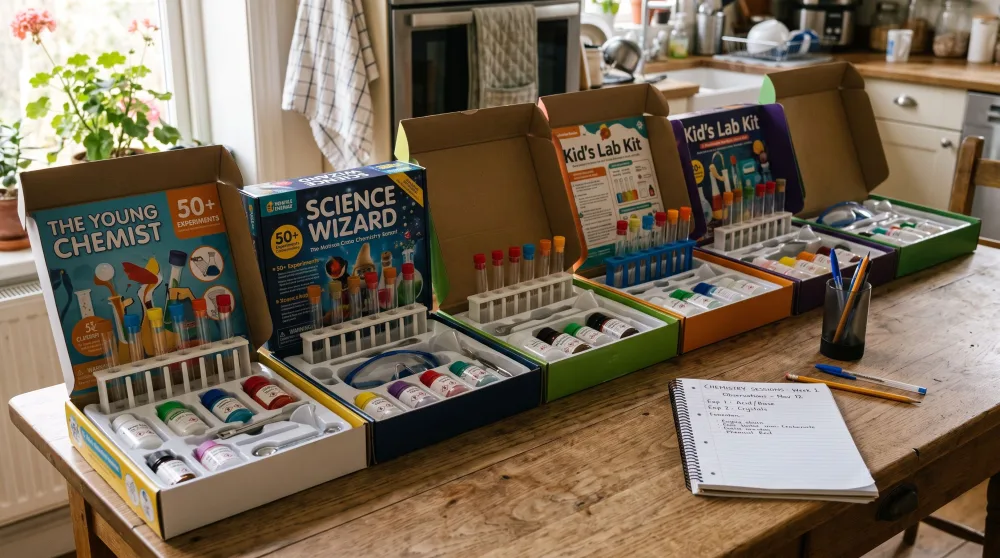
A box promises 100 experiments, and by Thursday your kid has done four of them and wandered off. That usually comes down to instructions written for an adult, quantities sized for exactly one pass, or a kit aimed at an age band your child has not reached. We worked through these kits at our own kitchen table, with a four-year-old at one elbow and a nine-year-old at the other. Below are ten kits grouped by age, from picture-led sets a preschooler can follow to real chemistry for a ten-year-old. Every pick lists the age range, the experiment count, and how much adult supervision it genuinely needs.
Our Top 3 Chemistry Sets at a Glance
Here are our three top picks, set against the five other kits worth considering. Compare the age bands and experiment counts first, then read the full write-ups below.
| Chemistry set | Best for | Age range | Number of experiments | Price band |
|---|---|---|---|---|
| National Geographic Amazing Chemistry Set | Best overall | 8-12 | 100+ (15 in-box plus 85 bonus) | $$ (~$39.99) |
| National Geographic Chemistry Set with 45 Experiments | Best for big reactions | 8-12 | 45 | $$ (~$34.99) |
| Thames & Kosmos Ooze Labs Chemistry Station | Best lab setup | 8+ | 20 | $$ (~$39.95) |
| Doctor Jupiter Ultimate Science Experiments Kit | Best for experiment variety | 8-12 | 135+ | $ (~$29.99) |
| National Geographic Magic Chemistry Set | Best budget starter | 8-12 | 10 | $ (~$16.99) |
| Thames & Kosmos Chem C500 | Best for real chemistry | 10+ | 28 | $ (~$19.95) |
| Playz Extreme Chemistry | Best for messy fun | 8-12 | 52+ | $$ (~$34.99) |
| National Geographic Junior Chemistry Set | Best for ages 4-6 | 4-6 | 50 | $$ (~$27.99) |
How We Chose These Chemistry Sets
We started with the kits parents actually buy, then judged each on five things: how clear the instruction manual is for the child rather than the adult, whether the supplied quantities stretch past a single pass, how much works without a trip to the store, what safety gear comes in the box, and whether the experiments hold attention once the novelty fades.
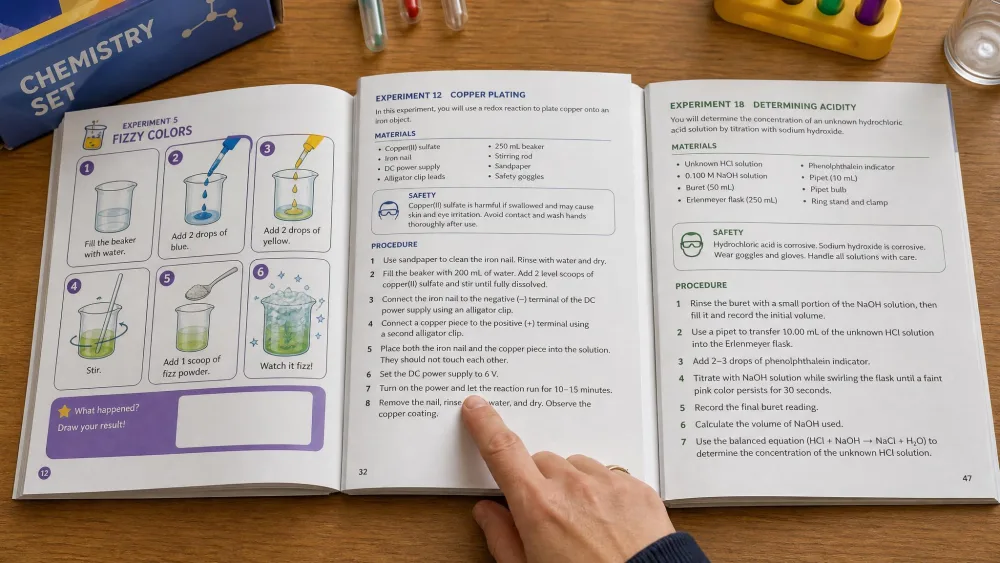
That last point separates the good kits from the disappointing ones. Across every set here, the same pattern showed up: kits with picture-led instructions get used solo, and kits with text-heavy manuals turn into parent-led activities. Neither is wrong, but you should know which you are buying, because a nine-year-old who expected independence loses interest fast when every step needs an adult. It is the single most useful thing to check before you pay, and it is the thing the box never tells you.
We also weighted age fit heavily. A kit labelled 8 to 12 rarely suits both ends of that band, so each review tells you where in the range it lands.
NoteWe buy these kits the way you do, with our own money and no vendor samples, and we keep the ones our kids ask to repeat.
The 10 Best Chemistry Sets for Kids
1. National Geographic Amazing Chemistry Set — Best Overall
Why We Picked It
The first two days with this kit go fast. A child who opens it in the morning will get through roughly five experiments before the second evening, because each one finishes quickly enough that the obvious next move is to start another. Then the pace settles down to one or two a sitting, which is where it stays. That is not the kit running out of steam so much as the novelty converting into a habit, and it is worth knowing in advance so the slowdown does not read as disappointment.
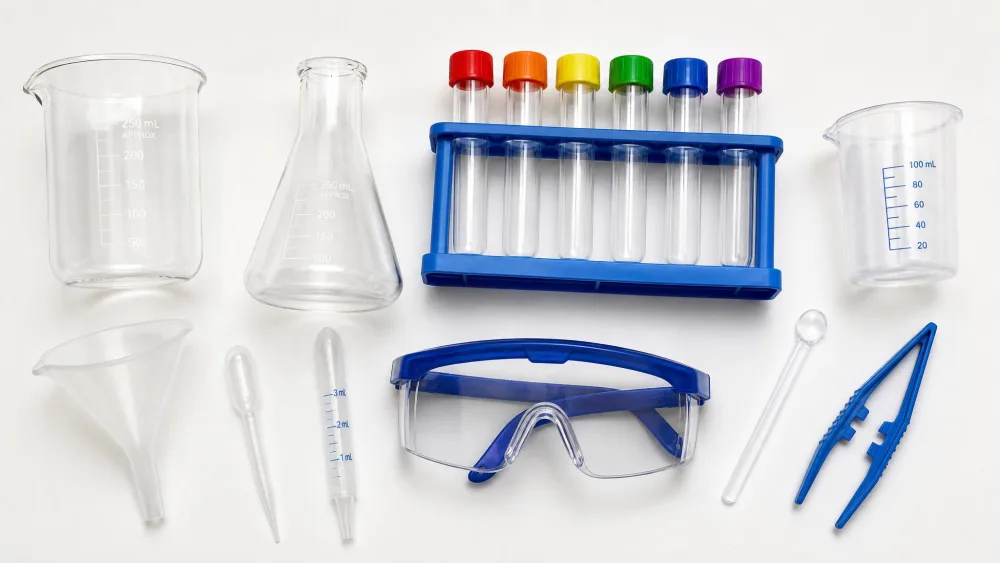
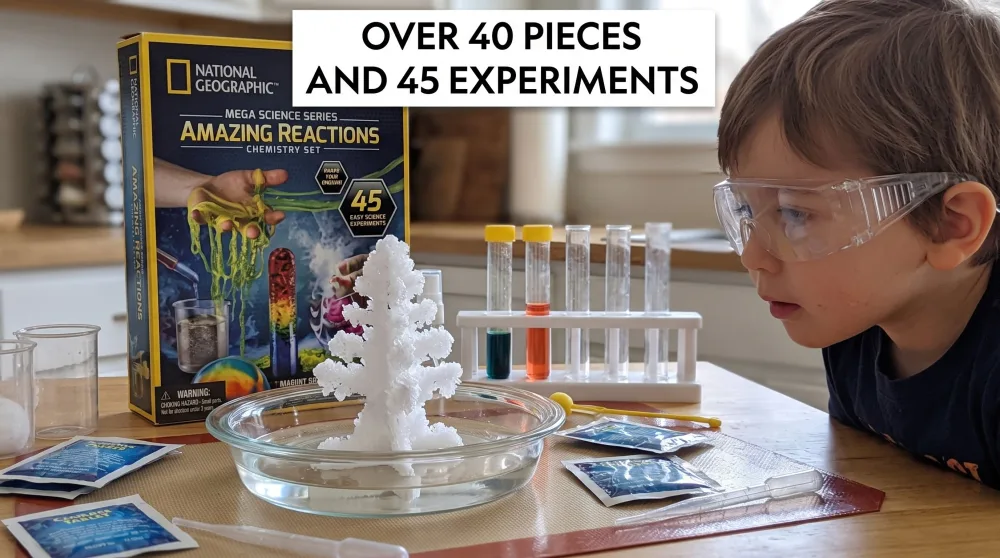
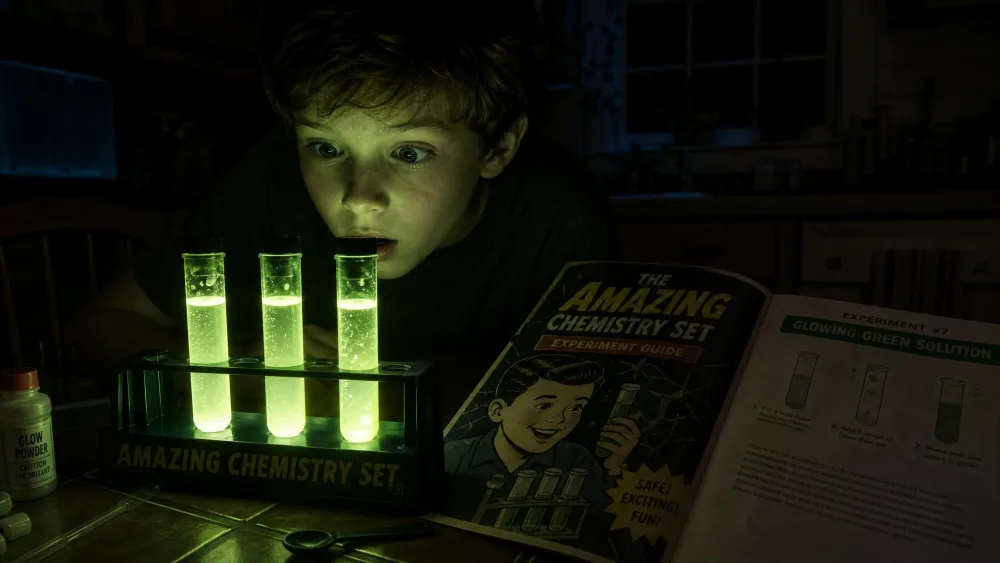
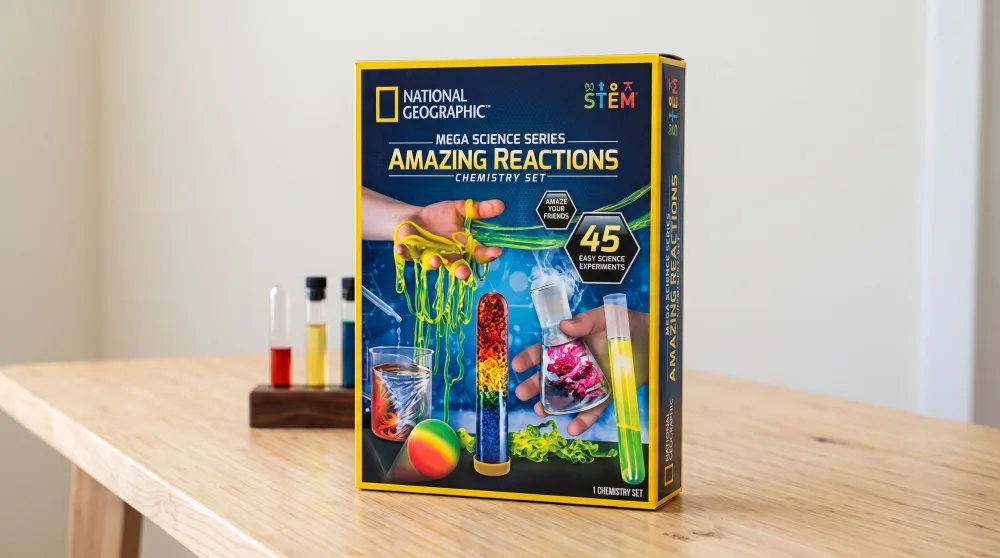
The National Geographic Amazing Chemistry Set is the kit we hand people who want one recommendation and nothing more. The listing counts over 100 experiments, and the breakdown matters: 15 chemistry experiments arrive with every material included, and a bonus guide adds 85 more that run on things already in your kitchen. The in-box experiments are the showy ones, including a growing crystal tree, colour-changing solutions and glowing test tubes, and the real lab tools such as beakers and pipettes make it feel like equipment rather than a toy. Two honest notes: it reads best as a shared activity rather than a hand-it-over kit, and the tools feel lighter than the box art suggests.
Pros and Cons
Pros
- 15 in-box experiments with every material supplied
- 85 bonus experiments using household ingredients
- Real lab tools including test tubes, beakers and pipettes
- Award-winning line with a clear illustrated guide
Cons
- Tools feel lighter than the packaging suggests
- Works best as a parent-and-child activity, not a solo kit
- The 100+ count is not 100 stand-alone in-box experiments
Best For (Age and Supervision)
Best for ages 8-12, landing squarely in the middle of that band. Plan to sit with your child for the measuring and pouring, especially early on. Once the bonus guide takes over, an older child can run most activities with you nearby. It is not the pick if you want something a child will disappear with alone for an hour.
2. National Geographic Chemistry Set with 45 Experiments — Best for Big Reactions
Why We Picked It
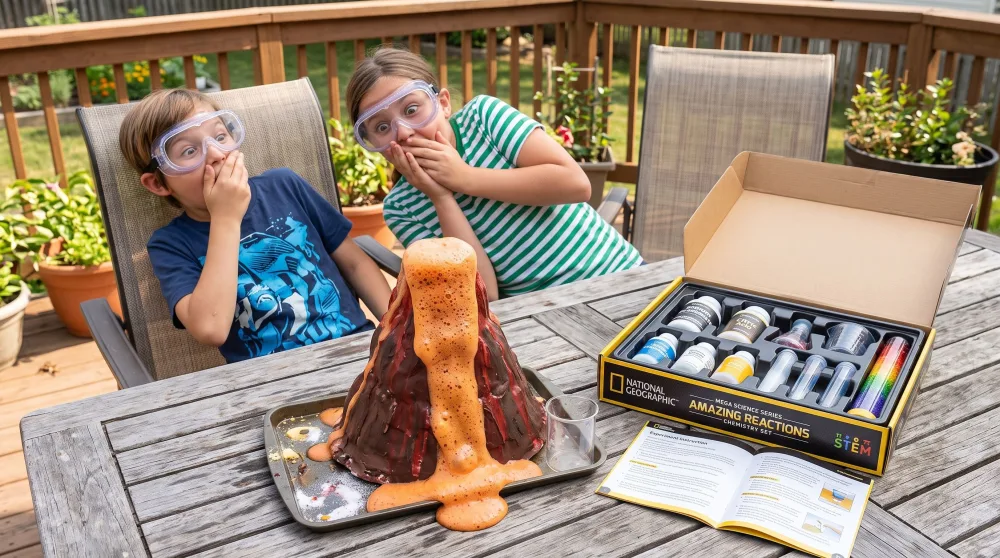
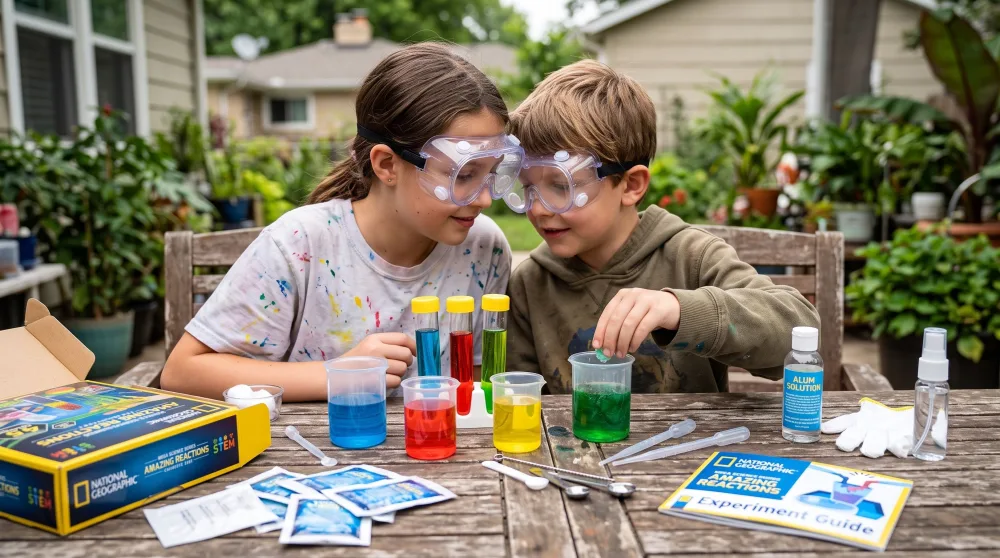
The chemicals here are mild enough that this becomes a patio kit, spread out on an old table with several children around it. That is exactly where the goggle problem shows up. One child gets the single pair from the box, the second one arrives two minutes later wanting a turn, and there is nothing to hand them. You end up either rotating one pair between children or sending someone inside while the eruption happens without them. Buy the second pair with the kit and the whole thing works the way the box picture promises.
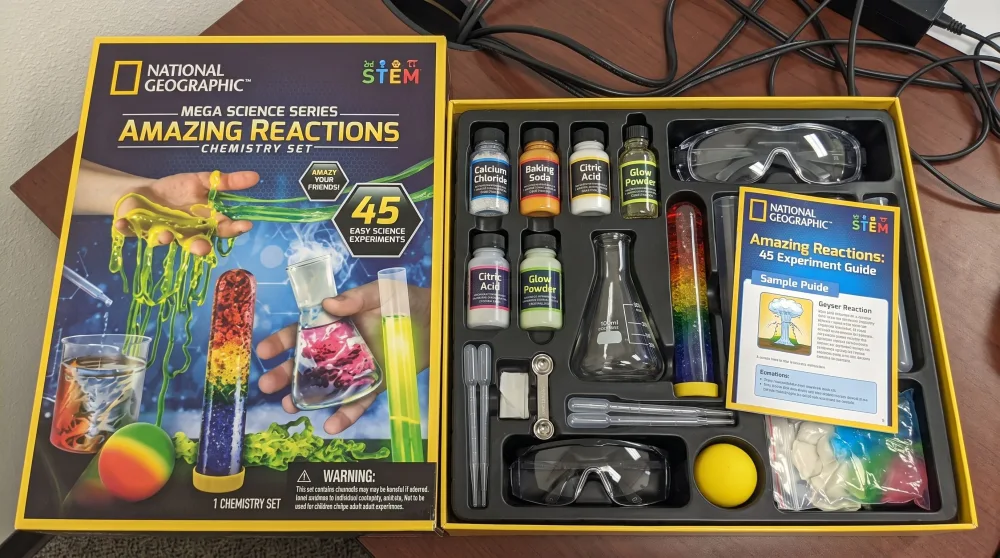
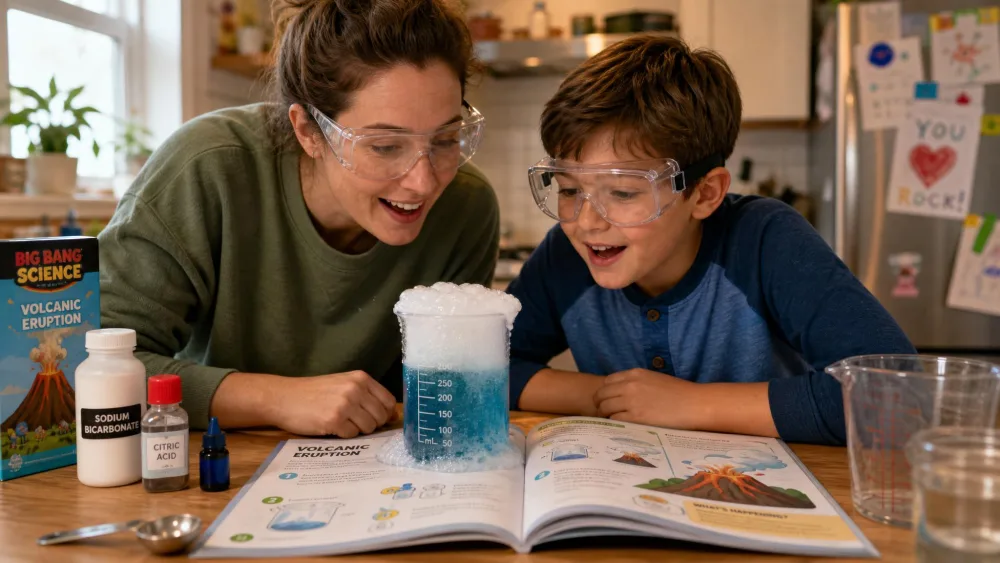
If your child wants eruptions rather than colour changes, buy the National Geographic Chemistry Set with 45 Experiments. The step-by-step instructions are illustrated and kid-friendly, and each explains the chemistry behind what just happened rather than leaving it as a trick. The volcano and the rocket are the two experiments kids ask to run a second time, while the quieter colour-change activities land flatter by comparison. A handful of experiments simply do not work as pictured, though that has never been enough to break the session.
Pros and Cons
Pros
- 45 experiments with genuinely dramatic results
- Illustrated step-by-step instructions that explain the chemistry
- Mild enough chemicals for a group session outdoors
- Every experiment ends with an explanation of the reaction
Cons
- Only one set of goggles in the box
- Several experiments do not work as pictured
- Colour-change activities underwhelm next to the eruptions
Best For (Age and Supervision)
Best for ages 8-12, and a good fit for a child who has tried a smaller kit and wants bigger results. The eruptions belong outdoors or on a wipeable surface with an adult running the pour. Buy a second pair of goggles if more than one child takes part. Skip it if you want quiet tabletop science.
3. Thames & Kosmos Ooze Labs Chemistry Station — Best Lab Setup
The Station Is the Point
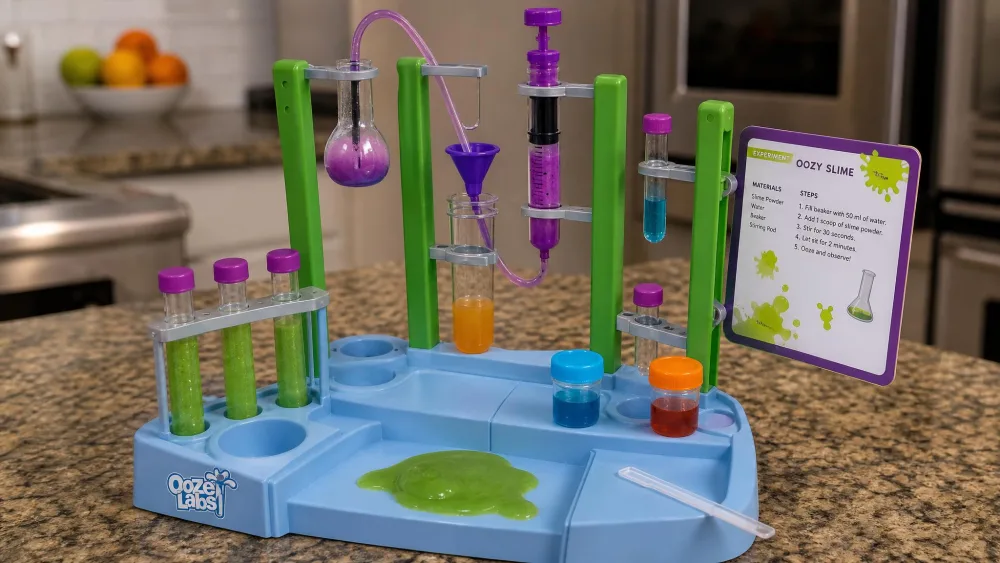
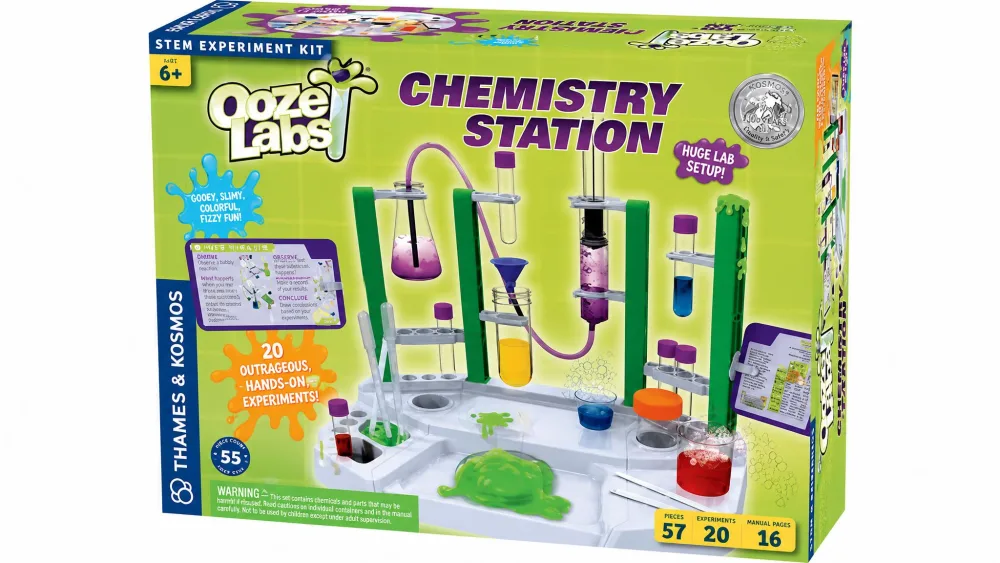
The first spill teaches you the one thing this kit gets wrong. The experiment cards clip to the back of the station, which puts them directly behind the test tube rack, which is precisely where a pipette drips and a beaker tips. They look laminated, so nobody thinks to move them. Then a card takes a splash of coloured slime, the ink softens, and the step numbers on the lower half go blurry. Slide them into a sheet protector before the first session and this never becomes a problem at all.
Most kits are a box of parts. The Thames & Kosmos Ooze Labs Chemistry Station is a moulded lab bench with clip-on experiment cards, and that difference matters more than the spec sheet suggests. It holds 57 pieces including beakers, test tubes, flasks and pipettes, and runs 20 non-hazardous experiments covering glowing slime, fizzing reactions, oozing bubbles, paper chromatography, and acids and bases. The chemicals are non-hazardous and it does not contain borax, which is the first question parents ask about slime kits. The station itself is the draw: a six-year-old wants to keep it set up on the counter because it looks like a workstation, though he needs an older sibling or an adult to run the steps. Two further warnings: a couple of the 20 experiments can fail outright, usually the thermocolour slime and the carbon-dioxide fire-extinguisher demonstration, and the kit assumes a well-stocked kitchen, since staples like cornstarch are not supplied.
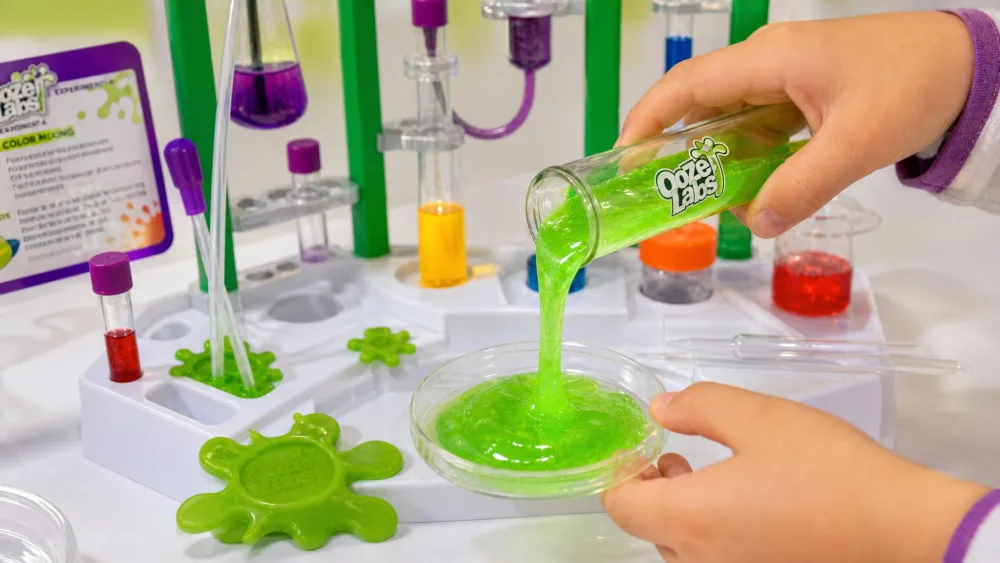
Parent tipSlip the clip-on experiment cards into a zip bag or a sheet protector before the first session. They live in the splash zone and they are not as waterproof as they look.
Pros and Cons
Pros
- Moulded lab station gives the kit a permanent home
- 57 pieces of real lab ware including flasks and pipettes
- Non-hazardous chemicals with no borax
- Clip-on cards plus a 16-page colour manual
Cons
- Experiment cards are not waterproof
- Two of the 20 experiments regularly fail
- Needs kitchen staples that are not supplied
Best For (Age and Supervision)
Rated for ages 8 and up, but the station format pulls younger kids in, and a six-year-old will work it happily with an older sibling driving the steps. Supervision is light once ingredients are measured. Prices swing widely, so watch it rather than buying at full list. Not the pick if you want a large experiment count.
4. Doctor Jupiter Ultimate Science Experiments Kit — Best for Experiment Variety
Why We Picked It
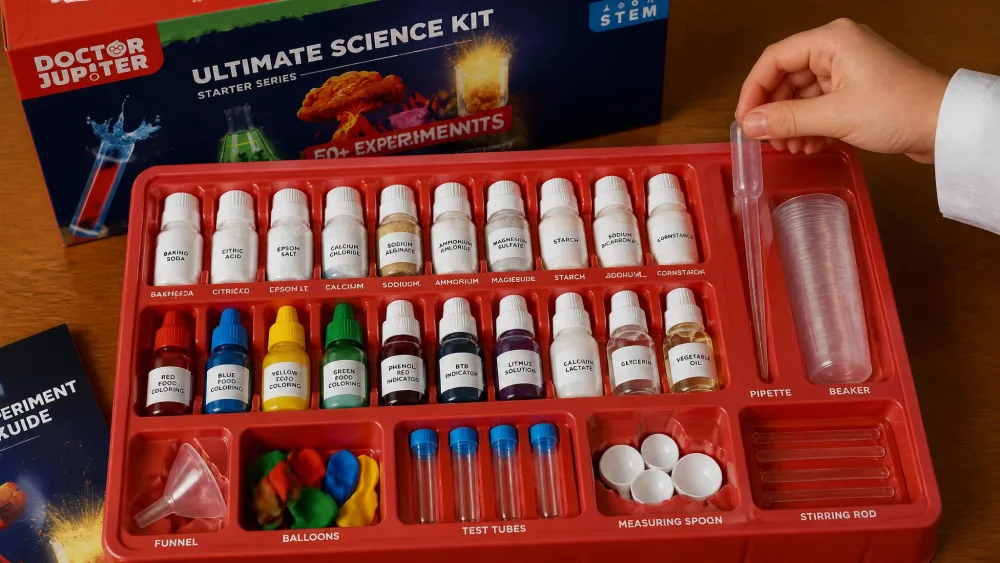
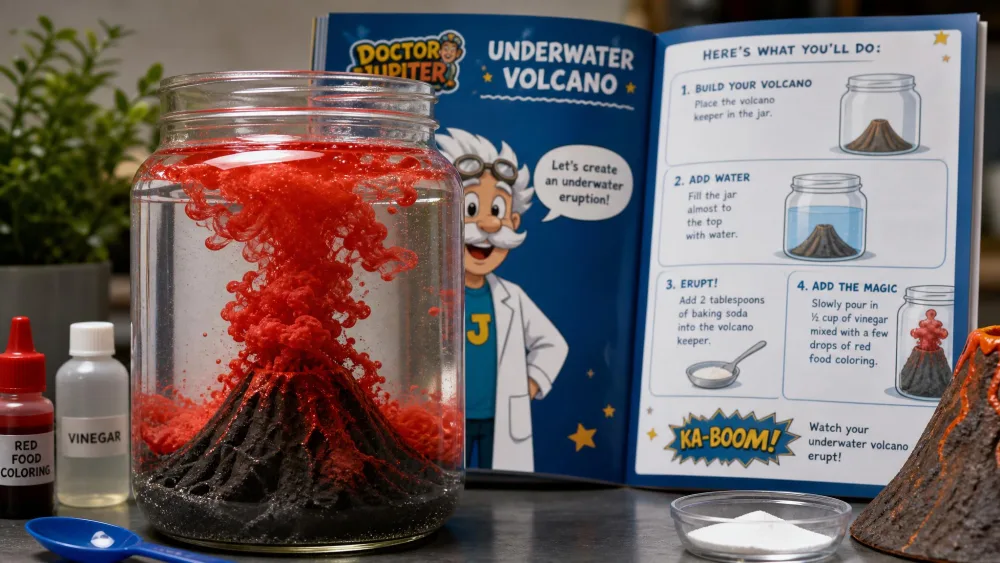
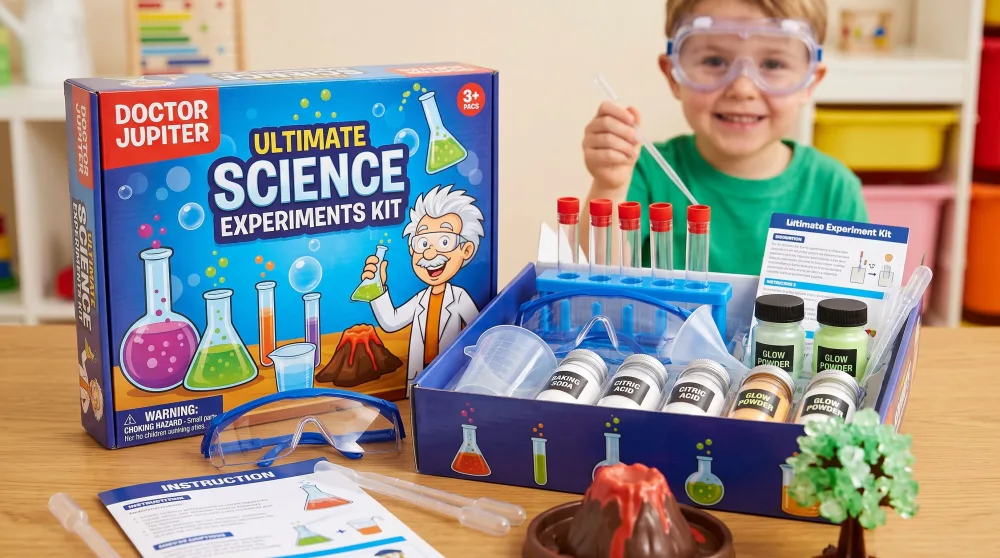
Where the National Geographic sets sell spectacle, the Doctor Jupiter Ultimate Science Experiments Kit sells volume, with 135+ experiments at a price that undercuts most big-name kits.
What sold us was setup. The kit arrives organised in labelled bottles, so there is no ten-minute sorting session before anything happens, and an eight-year-old can run several experiments in one afternoon with light supervision. The catch is quantity: the supplied amounts are small, and finishing the guide means restocking ingredients along the way. Most of what runs short is cheap to replace. Read 135+ as the number of activities described, not the number you can run twice.
Pros and Cons
Pros
- 135+ experiments for well under the price of the big-brand kits
- Arrives organised in labelled bottles, so setup is quick
- Illustrated guide built for parent and child together
- Light supervision is enough once ingredients are measured
Cons
- Supplied quantities are small and need restocking
- No stated tool or piece count on the listing
- Less established brand than National Geographic or Thames & Kosmos
Best For (Age and Supervision)
Best for ages 8-12, and a strong fit for a child who gets bored once the headline experiments are done. Supervision can be light, since the labelled bottles remove the guesswork, but stay in the room for anything involving pouring. Not the choice if you want every experiment supplied in full.
5. National Geographic Magic Chemistry Set — Best Budget Starter
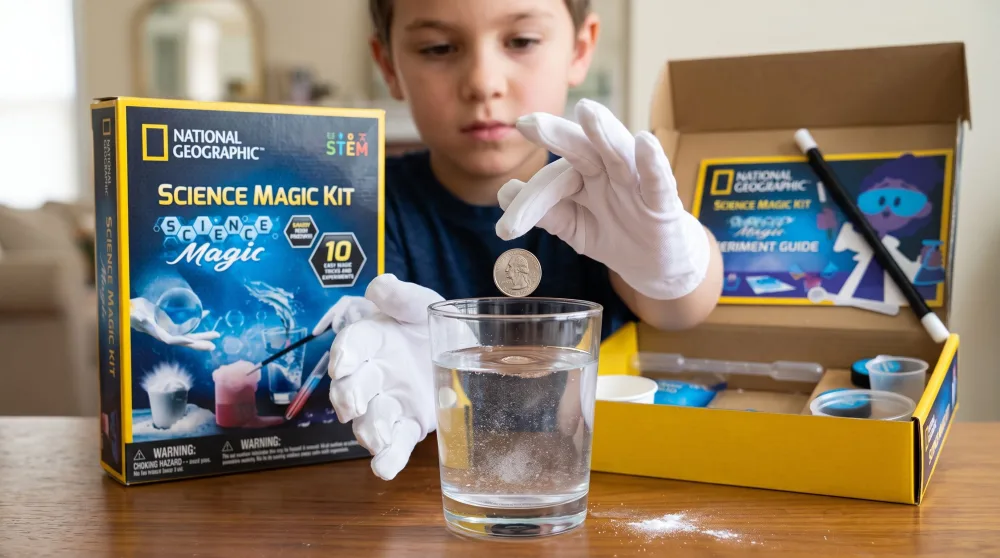
Why We Picked It
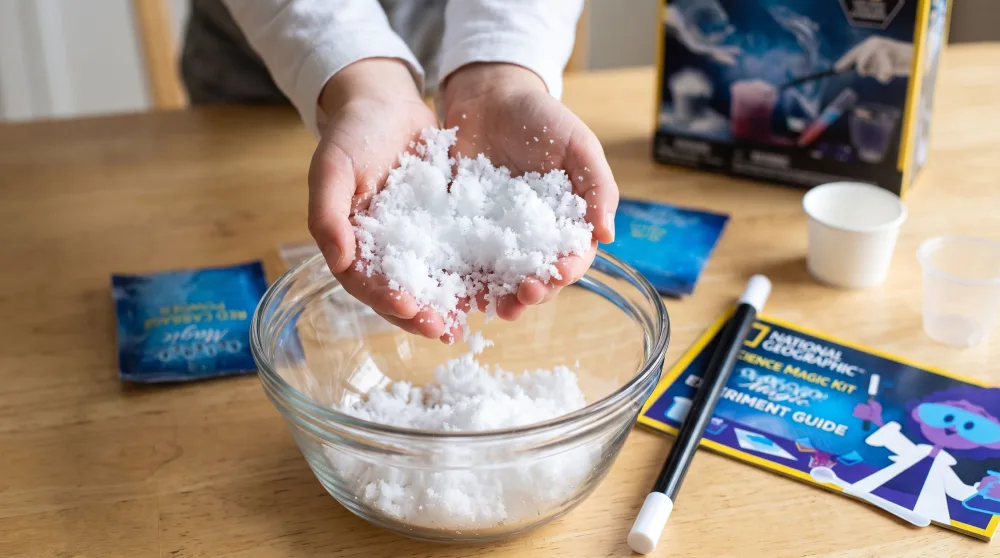
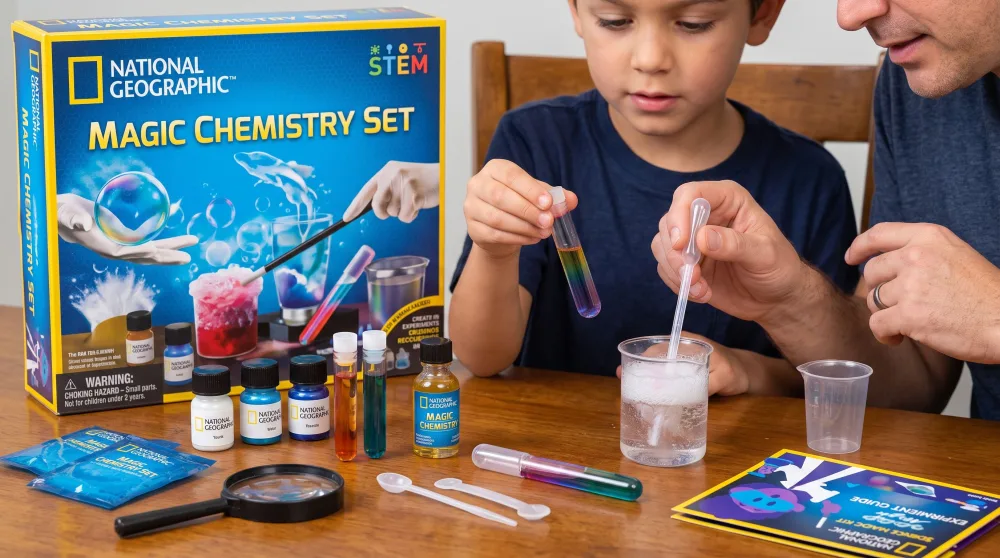
If the Doctor Jupiter kit is the way to buy the most experiments, the National Geographic Magic Chemistry Set is the way to spend the least, and it is the cheapest honest way to find out whether your child likes chemistry at all. It runs 10 magic-trick science experiments, including a floating coin, colour-changing water and instant snow, and ships with a wand and white gloves plus an illustrated guide explaining the science behind each trick.
The wand-and-gloves framing turns each experiment into a performance, and that gets kids through a full week of one-a-day sessions. Four- and six-year-olds can run the tricks with an adult beside them and then perform them for the family, and that show-it-off ending is why they come back. Plan for two gaps: there is no eye protection in the box, and some boxes arrive with items missing, which is worth checking before you wrap it as a gift.
Pros and Cons
Pros
- Lowest price on this list by a clear margin
- Performance framing keeps kids returning for a week of tricks
- Guide explains the chemistry behind each trick
- Every tool the tricks need is already in the box
Cons
- Only 10 experiments, and they overlap heavily
- No goggles or eye protection included
- Missing components turn up in some boxes
Best For (Age and Supervision)
Labelled for ages 8-12, but the tricks work down to four with an adult running setup, which makes it the most flexible gift here. Supervision is hands-on for the first run of each trick and light afterwards. Add safety goggles yourself. Not the pick for a child who has already worked through a full kit.
6. Thames & Kosmos Chem C500 — Best for Real Chemistry (Ages 10+)
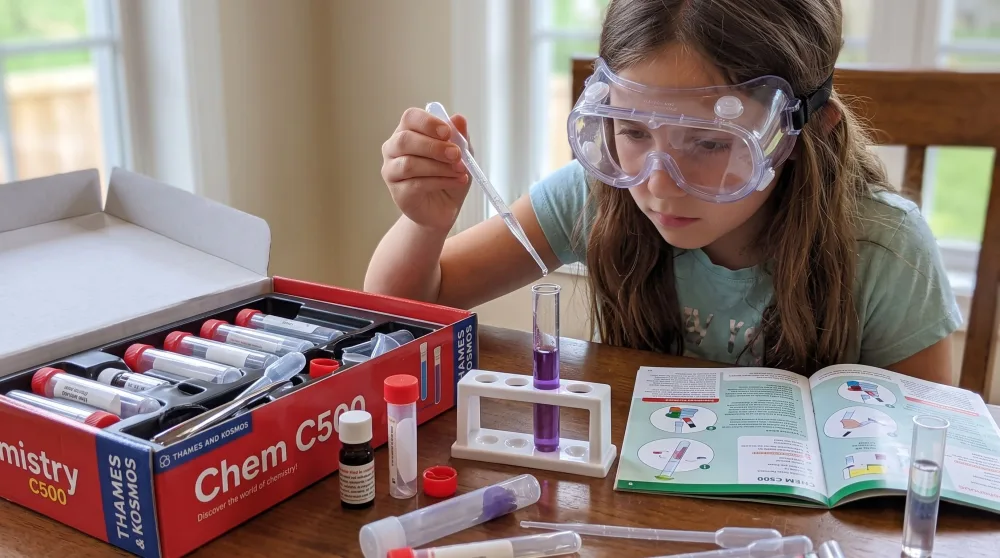
Real Chemicals, Real Rules
The acid-and-base experiments are where this kit stops being a set of instructions. A child watches the indicator solution swing from purple to pink, sits back, and asks what would happen if they put lemon juice in it instead. That question is the whole point. It means they have understood that the colour is reporting something rather than performing a trick, and once a child gets there they start proposing their own tests before finishing the numbered one in front of them. No other kit here produced that turn as reliably.
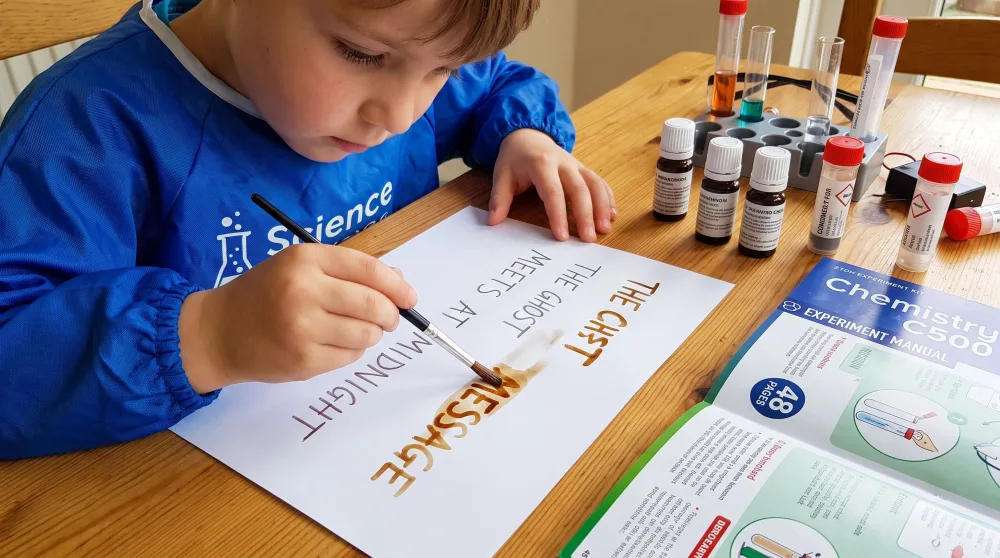
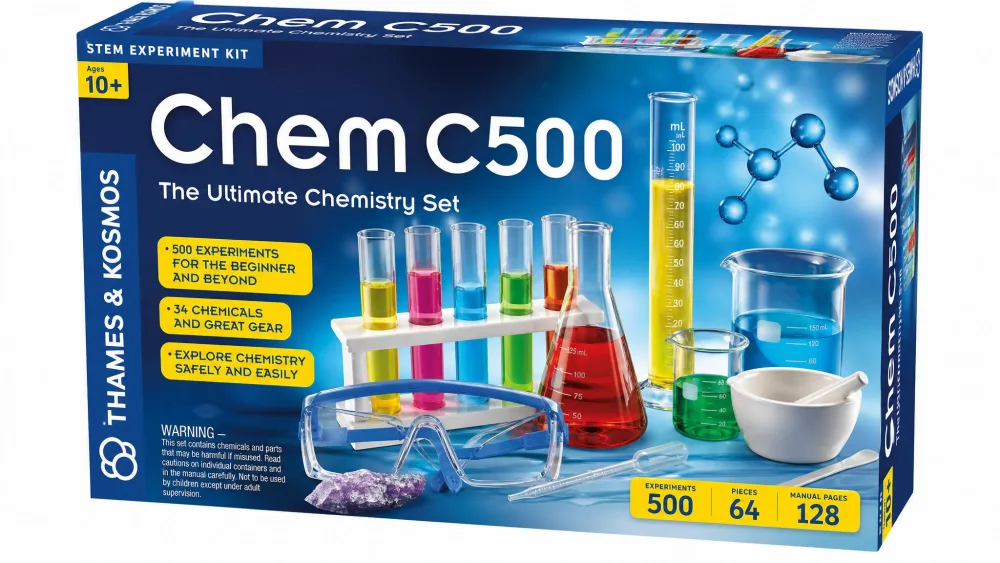
The Thames & Kosmos Chem C500 is the first kit here that behaves like actual chemistry rather than chemistry-themed activities. It runs 28 guided experiments across acids and bases, fizzy and foamy reactions, invisible ink, and solid, liquid and gas changes, and the 48-page full-colour manual explains what happened and why after each one. Be clear-eyed about two limits. It contains real chemicals and glass-style lab ware, so it is not a kit to leave in a child's room unsupervised. And it ships with about four chemicals, leaning on household supplies such as vinegar, distilled water and paper to finish the manual; the exact chemical count varies by production run and the kit depends on your kitchen either way. Quantities cover exactly one pass, so buy spare consumables at the same time. If your child clears it, the Chem C1000 steps up to 125 experiments and an 80-page lab manual for ages 10 and over.
Pros and Cons
Pros
- 48-page manual explains the chemistry after every experiment
- Real chemicals and proper lab ware
- Parents' Choice Silver Award winner
- Clear step-up path to the Chem C1000
Cons
- Ships with only about four chemicals
- Quantities cover a single pass through the manual
- Needs constant adult supervision
Best For (Age and Supervision)
Best for ages 10 and up, and right for a child who has outgrown spectacle and wants explanations. This is a supervised-only kit from start to finish, and it should be stored where younger kids cannot reach it. Not suitable as a solo gift for an eight-year-old, however capable they are with plastic-tool sets.
7. UNGLINGA 210 Experiments Science Kit — Best for Experiment Count
210 Experiments, One Weak Manual
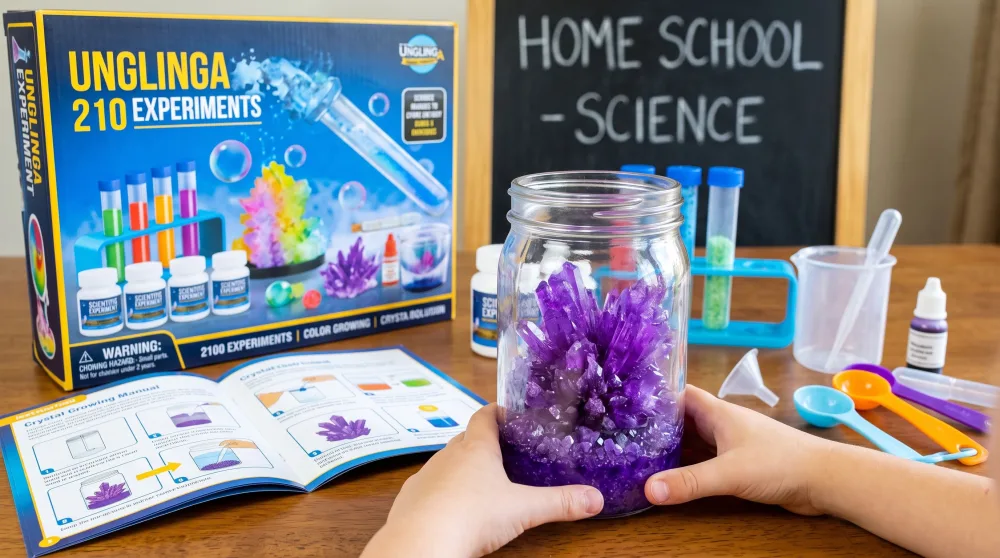
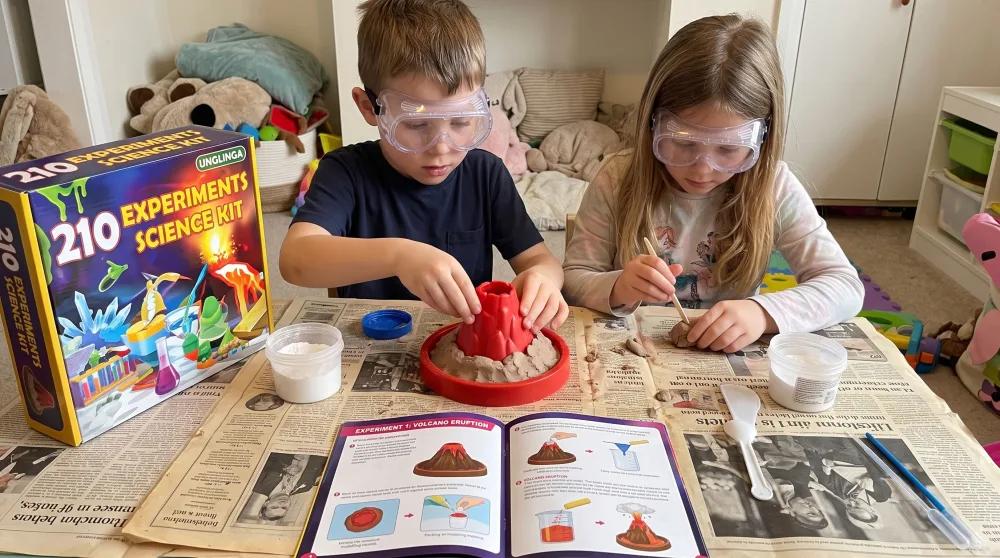
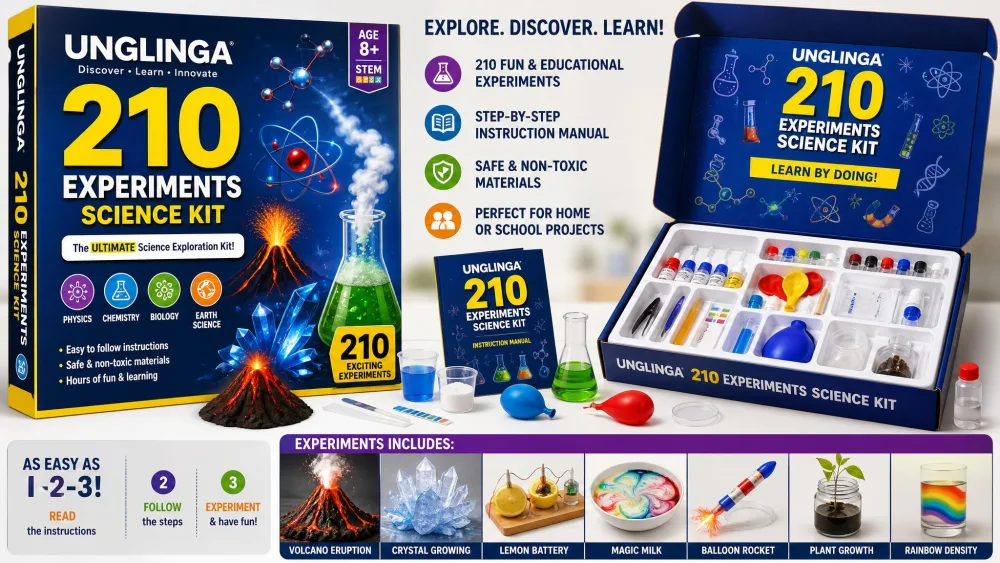
Nothing else here comes close on raw count. The UNGLINGA 210 Experiments Science Kit runs over 210 experiments spanning chemistry, physics and earth science, including a volcano build and growing crystals, with a full-colour step-by-step manual and framing built for group activities and school projects. Everything needed for the in-box experiments is supplied, and a separate booklet extends the kit with household-item activities, so one purchase covers a long stretch of science afternoons across more than one child.
The manual is the weak point, and it is worth saying plainly. Several experiments read clearly for an adult but confusingly for a child working alone, which turns the kit into a parent-led activity more often than the packaging implies. In the brand's smaller 150-experiment set, a six-year-old can run some experiments alone, which is a real confidence win, but most still need an adult for pouring and measuring. That smaller set also includes latex balloons, and contents change between production runs, so check the box if anyone in your house has a latex allergy.
Pros and Cons
Pros
- Over 210 experiments in one purchase
- Covers chemistry, physics and earth science together
- Everything for the in-box experiments is supplied
- Group and school-project framing suits multiple kids
Cons
- Manual instructions confuse kids working alone
- No stated age band on the listing
- Sibling variants include latex balloons
Best For (Age and Supervision)
The listing states no age band, so judge by the work: the measuring and pouring read as an eight-and-up job, with an adult reading the trickier instructions aloud. It suits a household with several kids of different ages better than a single child. Skip it if you want a kit your child can run without you.
8. Playz Extreme Chemistry — Best for Messy Fun
Why We Picked It
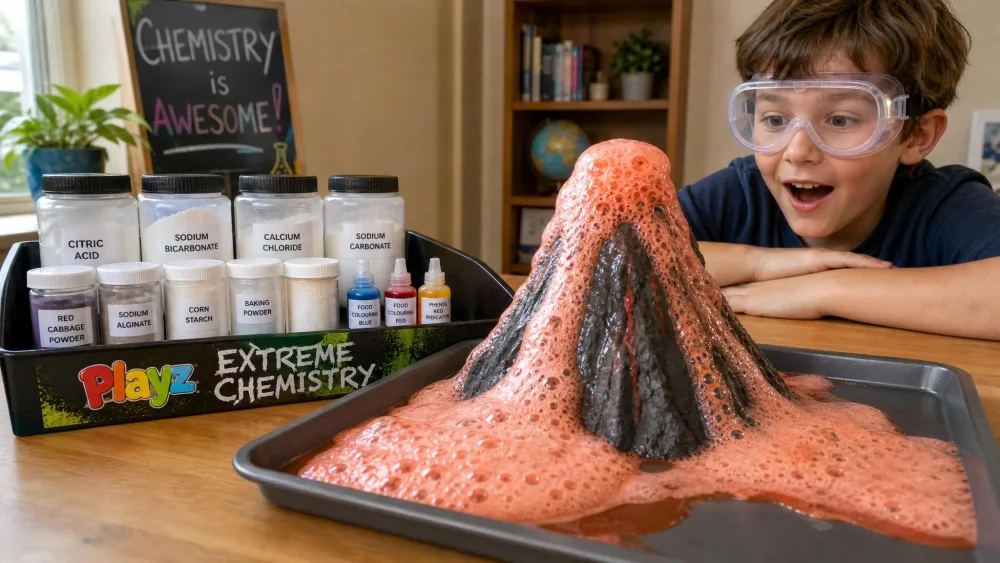
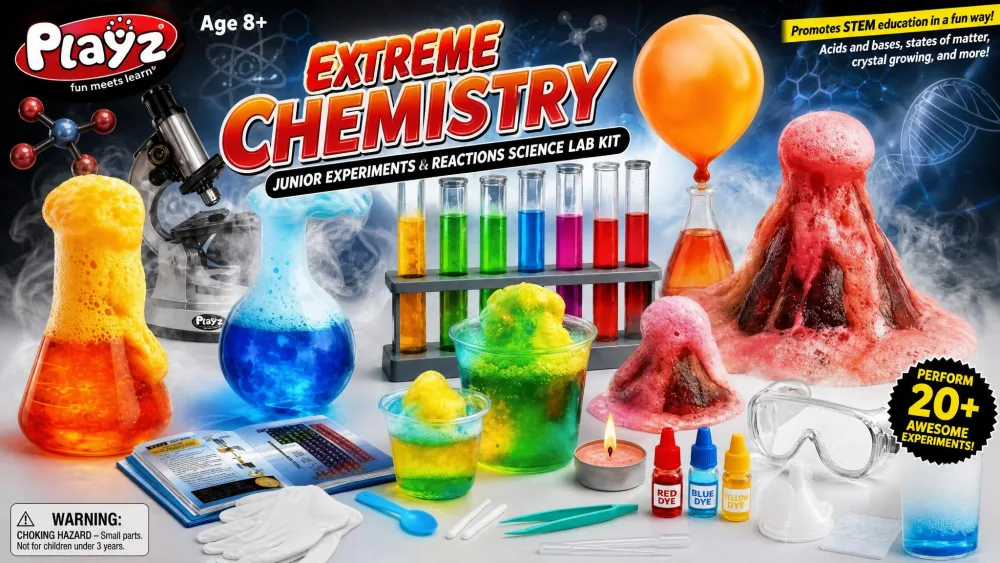
Playz Extreme Chemistry takes the big-reaction idea further than the 45-experiment set and adds somewhere to put the mess. It runs 52+ chemistry experiments with 51+ tools included, and it is built around the loud stuff: a foaming volcano, a self-inflating balloon and test-tube density stacks. The labelled containers and storage tray genuinely cut the cleanup and make it easy to put the kit away half-finished, which is why homeschool families keep coming back to it.
The chemicals are ordinary kitchen staples such as citric acid and baking soda, so there is nothing to worry about beyond spills. The full-colour booklet, though, reads like a small textbook, and for a nine-year-old it can be a first proper look at the periodic table. In practice it works as a spectator kit: an eight-year-old runs the experiment alongside a parent while a younger sibling watches from across the table. If you were hoping for a solo activity, look at the picture-led sets instead.
Pros and Cons
Pros
- 52+ experiments and 51+ reusable lab tools
- Labelled containers and a storage tray cut the mess
- Ingredients are safe kitchen staples
- Booklet goes deep enough to introduce the periodic table
Cons
- Text-heavy booklet makes it a parent-led kit
- Not a solo activity for younger kids
- The showiest experiments need a wipeable surface
Best For (Age and Supervision)
Best for ages 8-12, with a parent working alongside rather than supervising from the kitchen. Not the pick if your priority is a child working independently.
9. Yellow Scope Foundation Chemistry Kit — Best Real-Lab Skills Kit
The Lab Notebook
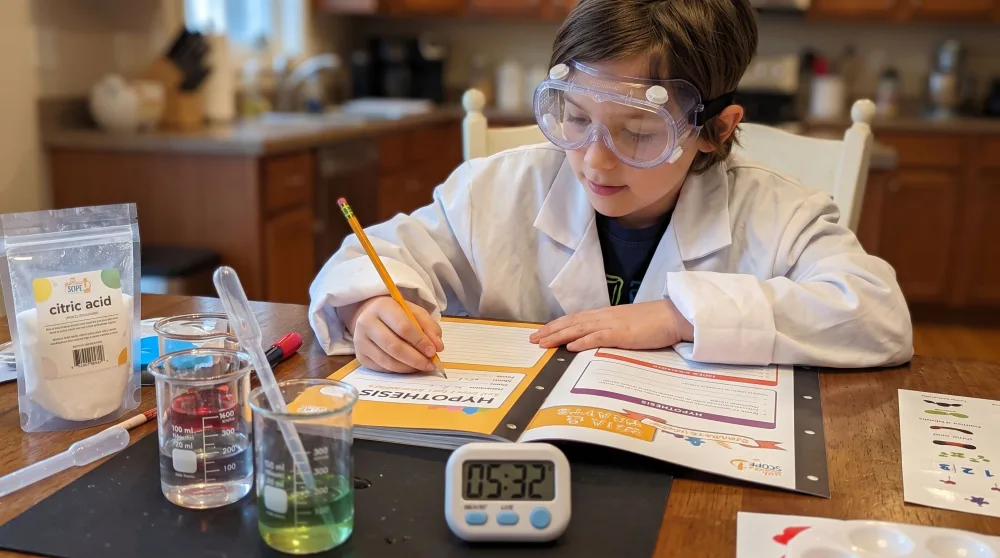
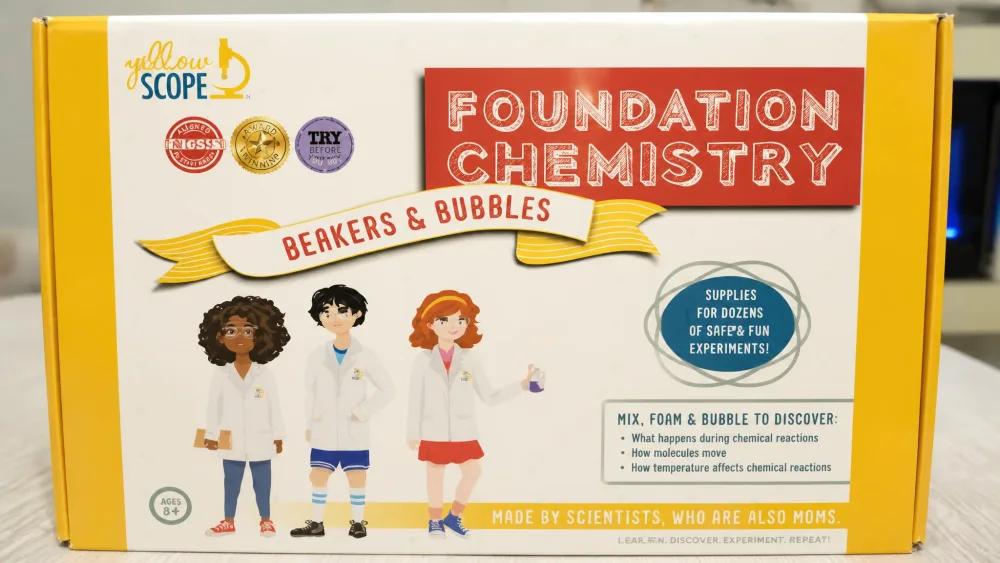
The Yellow Scope Foundation Chemistry Kit, sold as Beakers & Bubbles, teaches the habit rather than the trick. It runs 19+ experiments on chemical reactions, molecular motion and temperature, with real lab equipment including beakers, a thermometer and a digital timer.
The 28-page lab notebook is why it is on this list. Kids write a hypothesis, record what they observe and draw the result, and the included coloured pencils, sharpener and chalk mean nothing has to be fetched mid-experiment. The kit leans on common household products alongside quality tools, and nine-year-olds treat the goggles-and-labelling ritual as half the fun. Price is the sticking point, and it is a fair one — this is the most expensive kit here per experiment, and whether the lab notebook justifies that depends on how much your child likes writing things down. When the Foundation kit is finished, the Acid, Base & pH kit is the natural next step, and families buy them in sequence.
Pros and Cons
Pros
- 28-page lab notebook builds a real scientific workflow
- Genuine lab equipment including a thermometer and digital timer
- Pencils, sharpener and chalk supplied so sessions never stall
- Parents' Choice Gold Award and Toy of the Year finalist
Cons
- Lowest experiment count on this list
- Most expensive kit here per experiment
- Relies on household products you supply
Best For (Age and Supervision)
Best for ages 8-12, and the strongest fit for a child who likes writing things down as much as mixing them. Not the buy if your child measures a kit by the number on the box.
10. National Geographic Junior Chemistry Set — Best for Ages 4-6
What a Four-Year-Old Can Actually Do
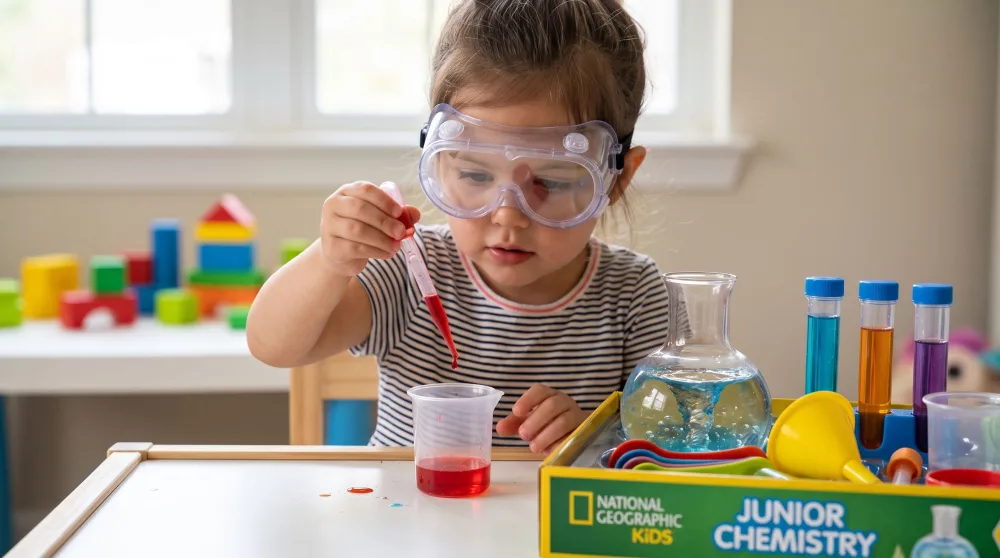
You can tell how well a preschool kit is built by where the pieces end up afterwards. The droppers from this set never went back in the tray. They migrated to the bath, where a four-year-old spent weeks filling and squirting them long after the last experiment was finished, and they came through it fine — no cracked barrels, no cloudy plastic, and they still wash clean. That is the honest durability test for this age group, because the tools get treated as toys whether or not you intend them to be.
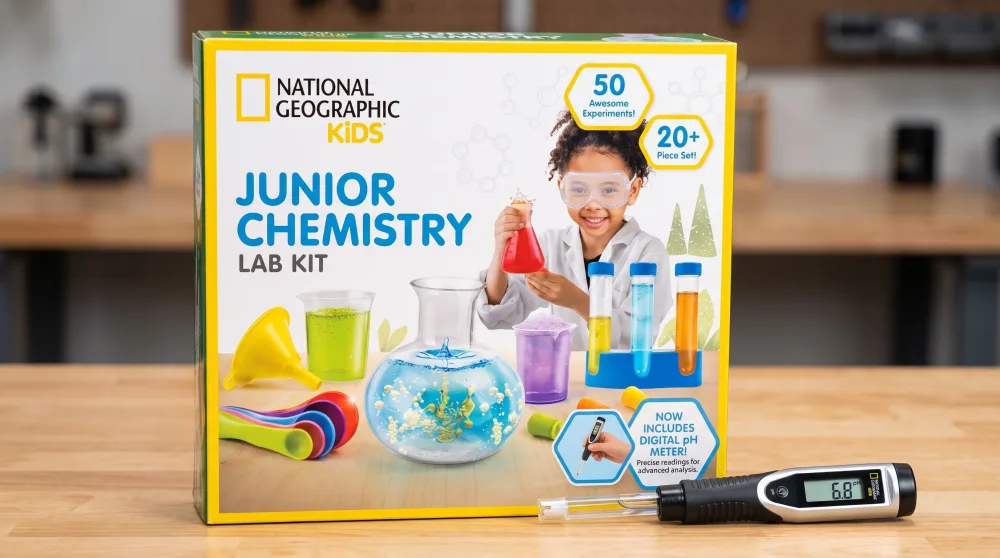
Most kits labelled for preschoolers are colour-mixing in a nicer box. The National Geographic Junior Chemistry Set is the rare exception, with 50 experiments and 20+ kid-friendly lab tools built for ages 4-6, and picture-led instructions so a child who cannot read yet can still follow along. Goggles are included, along with plastic droppers, flasks, beakers and funnels. The set also stretches, with families still finding experiments left four months after Christmas, which is unusual at this age. You do buy the consumable ingredients yourself, since most activities run on household items. Weigh two flaws: some instructions are off enough that an ingredient goes missing or an experiment misbehaves, which is the main complaint on a kit people otherwise like a lot, and it includes goggles but no gloves, so add extra-small nitrile gloves if your preschooler minds sticky hands.
Pros and Cons
Pros
- 50 experiments designed for ages 4-6
- Picture-led instructions work for pre-readers
- 20+ durable, washable kid-sized lab tools
- Goggles included in the box
Cons
- Some instructions are inaccurate
- No gloves supplied
- You buy the consumable ingredients yourself
Best For (Age and Supervision)
Best for ages 4-6, and the right first kit for a child who wants to do what an older sibling is doing. Supervision is hands-on throughout, because the appeal at this age is doing it together. Not worth buying for a seven-year-old, who will find the activities thin within a fortnight.
How to Choose a Chemistry Set for Your Child
Match the Kit to Your Child's Age
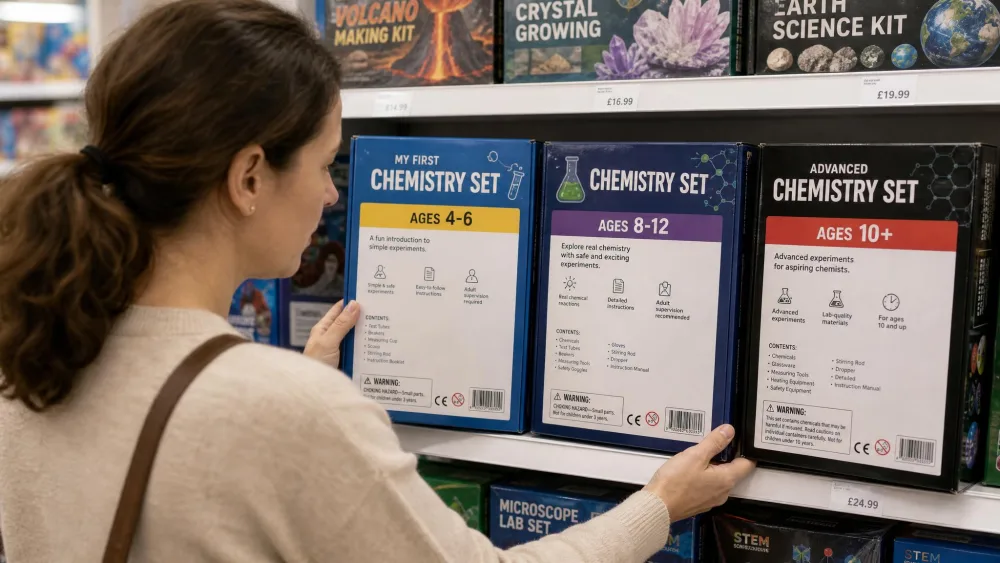
Age labels on chemistry sets are wider than they look. Almost everything here says 8-12, but a kit that suits an eight-year-old rarely satisfies a twelve-year-old. Use the instructions as your guide instead of the number on the box: picture-led sets like the Junior Chemistry Set work from four, illustrated step-by-step sets work from eight, and manual-driven kits like the Chem C500 belong with a ten-year-old and up.
Safety Features and Adult Supervision
Check what safety gear is in the box before you buy, because it varies more than you would expect. Several popular kits ship one pair of goggles or none, so a second child needs their own pair. The Junior Chemistry Set includes goggles but no gloves, and the Magic Chemistry Set includes no eye protection at all.
Experiment Count vs. Experiment Quality
A big number on the box tells you how many activities are described, not how many your child will finish. The Magic Chemistry Set has 10 experiments that build on each other, and kids run it for a solid week. The UNGLINGA kit has over 210, and its manual is the reason some never get attempted.
Look at what is supplied in full versus what leans on your kitchen. A kit with 45 fully supplied experiments beats a kit with 200 that needs a shopping list.
Instruction Quality and Refill Availability
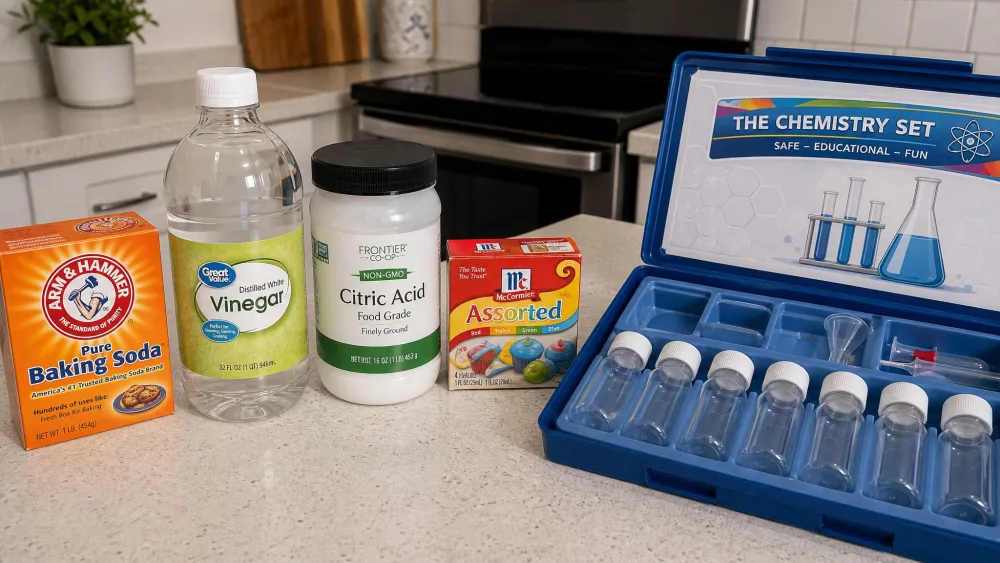
The instruction manual decides who runs the kit, which is the picture-led versus text-heavy split described above. Read a few pages of the manual before you decide who this kit is really for.
Refills matter as much. Most kits are sized for exactly one pass, so the Chem C500 and the Doctor Jupiter kit both run short when a child repeats a favourite reaction.
Replay Value and Storage
Bonus guides extend a kit cheaply: the Amazing Chemistry Set's household-material guide and UNGLINGA's separate booklet both keep going long after the supplied chemicals are gone. The kits that last are the ones that are easy to put away half-finished. Playz Extreme's labelled containers and tray are the best example, and the Ooze Labs station works the same way by keeping everything in one moulded home.
Chemistry Set Safety: What Parents Should Know
Chemistry sets sold in the US for children are regulated, and it helps to know what that means at the shelf. ASTM F963-23 is the mandatory toy safety standard, incorporated into federal regulation and effective from 20 April 2024. It became mandatory through Section 106 of the Consumer Product Safety Improvement Act of 2008, and toys made for children 12 and under have to be third-party tested against it and covered by a Children's Product Certificate.
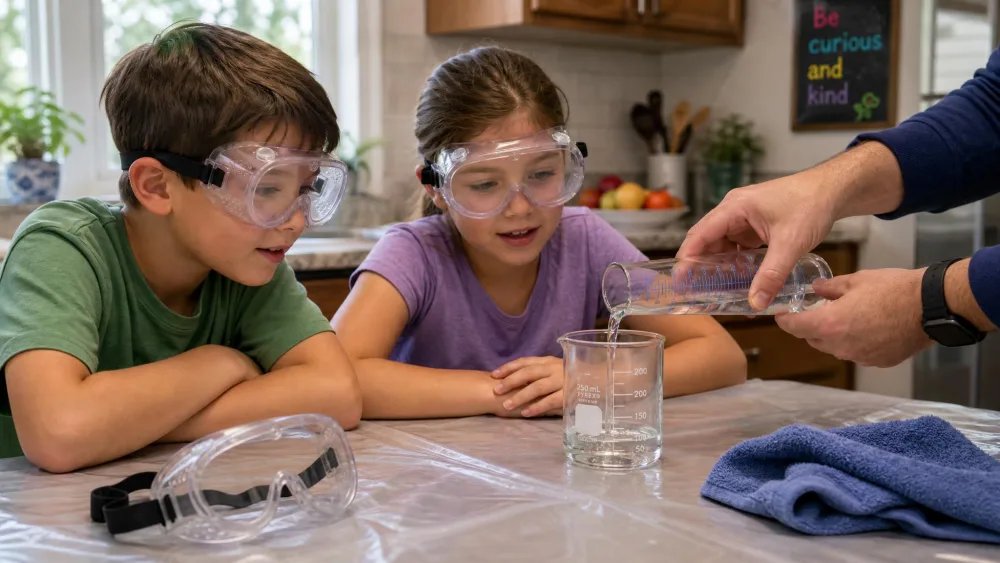
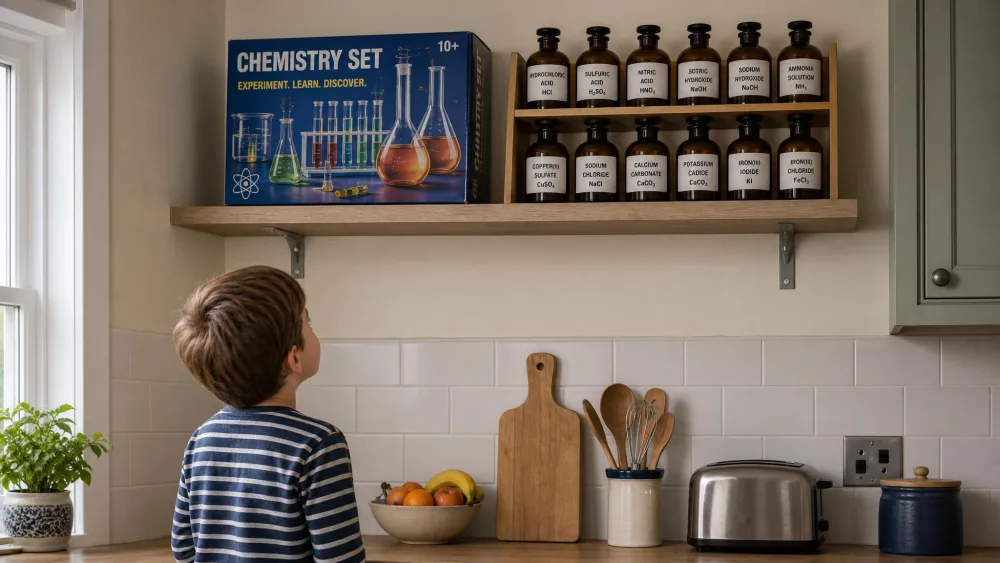
Watch outStay in the room. Put goggles on every child at the table, not only the one running the experiment, and count the pairs before you open the box. Keep chemicals in their labelled containers, work on a wipeable surface, and wash hands at the end of every session even with non-toxic ingredients. Store kits with real chemicals and glass-style lab ware out of reach between sessions. For the wider picture, the ASTM F963 toy safety standard is what manufacturers test against, and CPSC toy safety guidance covers age labelling and general toy safety for parents.
One more thing worth checking: allergies. Kit contents change between production runs, and latex balloons turn up in some science kits without being called out on the listing. If anyone in your house has a latex allergy, open the box and check before your child does.
Frequently Asked Questions
Which chemistry set is best for a beginner?
For a first kit at a low price, the National Geographic Magic Chemistry Set gets a child through a week of tricks for under twenty dollars. If you already know chemistry will stick, start with the National Geographic Amazing Chemistry Set instead, because the bonus guide keeps it useful long after a starter kit would be finished.
What should I keep in the cupboard so we never have to stop mid-experiment?
Baking soda, white vinegar, citric acid, cornstarch, food colouring and a jug of distilled water will cover the great majority of repeats and household-material activities across every kit here. Buy them in supermarket quantities rather than as branded refills, since the amounts a kit supplies are tiny by comparison. Keeping them in the same cupboard as the kit is what turns a repeat request into a yes instead of a shopping trip.
Is a chemistry set worth buying if my child already has a general science kit?
Usually yes, because the two do different jobs. A general science kit samples physics, earth science and biology alongside a few reactions, which is broad but shallow. A dedicated chemistry set stays with one subject long enough for a child to notice patterns between experiments, and that is where the questions start coming from them rather than from the manual.
What do I do when an experiment fails?
Run it again before you say anything, because the usual causes are a mismeasured quantity, a substitution, or a step done out of order, and all three are fixable in two minutes. If it fails twice, say out loud that this is a result too and ask what might have gone differently. The risk is a child concluding the science is broken rather than the procedure, and the fix is treating the failure as information instead of quietly moving on to the next page.
What does "non-toxic" on the box actually mean?
It means the contents are not expected to cause harm in the quantities supplied and when used as directed. It does not mean edible, it does not cover a child rubbing an eye with a wet hand, and it says nothing about allergies to things like latex components. Goggles, hand washing and keeping food off the table still apply to a kit marked non-toxic.
Can siblings of different ages share one kit?
They can share the session more easily than the kit. A younger child can measure, pour under supervision and call out steps from the manual while an older one runs the reaction, and that works well. What does not work is expecting one kit to satisfy both, so buy for the older child's ability and give the younger one a real job, or pick a picture-led set the younger one can own outright.
Final Thoughts: The Best Chemistry Set for Your Child
If you want one answer, buy the National Geographic Amazing Chemistry Set. The bonus guide is what keeps it earning shelf space, and the balance of spectacle and staying power fits the 8-12 band most families are shopping for.
For a child who wants the loudest possible results, the 45-experiment National Geographic set delivers the volcano and rocket they are picturing. For the widest coverage in one purchase, the UNGLINGA 210-experiment kit is unmatched on count, and the Ooze Labs Chemistry Station is the one that stays set up on the counter.
At the two ends of the age range, the Junior Chemistry Set is the only real chemistry kit here for a four-year-old, and the Chem C500 is where a ten-year-old starts doing chemistry rather than watching it. Whichever you choose, buy a spare pair of goggles and keep the kitchen staples stocked, and the kit will outlast its first weekend.