10 Best Microscopes for Kids in 2026 (Tested by Age)

A kids' microscope is a lens-and-light instrument that takes something too small for the naked eye and makes it big enough to argue about: a hair, a grain of salt, the leg of an ant. What separates a good one from a frustrating one isn't the brand on the box. It's whether the magnification, the focusing and the lighting suit the age of the child at the eyepiece.
That's why the 2000x printed on so many boxes is the least reliable number in the category, and why a 20X stereo scope can be the better buy for a five-year-old. We picked these ten by asking one thing of each: can a child get a clear image without an adult taking over the knobs?
Our Top 10 Picks at a Glance
| Product | Type | Magnification | Best for (age) | Our rating |
|---|---|---|---|---|
| AmScope 52-Piece STEM Kit | Compound | 120X to 1200X | 8 to 14 | 4 of 5 |
| GeoSafari Talking Microscope | Talking viewer | Fixed images | 3 to 5 | 4 of 5 |
| National Geographic Microscope | Compound, dual lights | Up to 400x | 6 to 10 | 4 of 5 |
| 1000X Handheld Digital | Digital, screen | 1000X claimed | 3 to 13 | 4 of 5 |
| PalliPartners Compound | Compound, dual LED | 100X to 2000X | 11 and up | 4 of 5 |
| Carson MicroBrite Plus | Pocket handheld | 60x to 120x | 7 and up | 4 of 5 |
| My First Lab Duo-Scope | Compound and stereo | 40X to 400X | 8 to 14 | 3 of 5 |
| Nancy B's Science Club | Light and dissecting | 30x to 400x | 8 and up | 3 of 5 |
| 58-Piece Microscope Kit | Compound | 100X to 1200X | 7 to 12 | 3 of 5 |
| Aomekie Stereo Microscope | Binocular stereo | 20X and 50X | 5 to 9 | 3 of 5 |
NoteThe number on the box is the least useful thing about a kids' microscope. What we looked at first was whether a child could get a clear image at all.
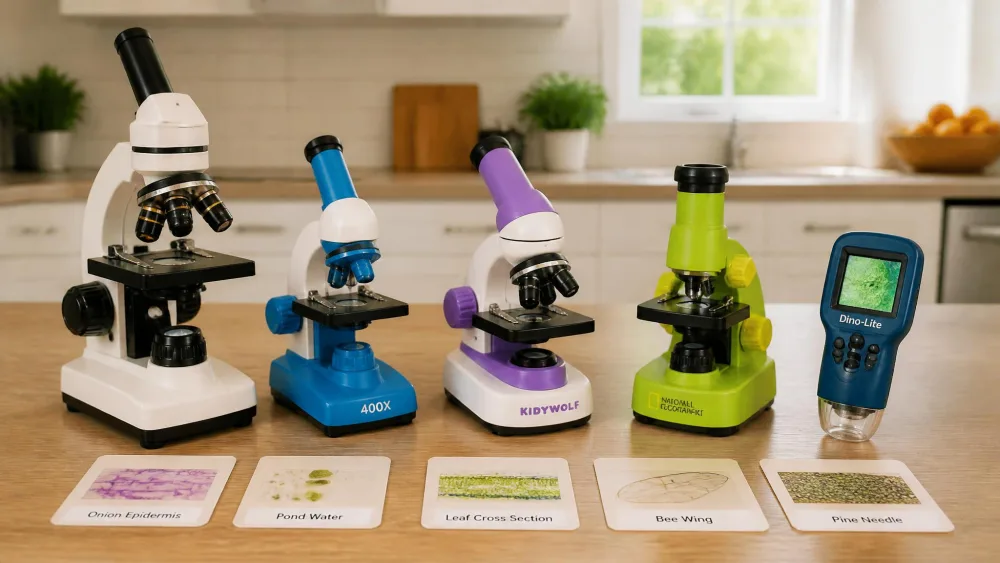
The 10 Best Microscopes for Kids, Reviewed
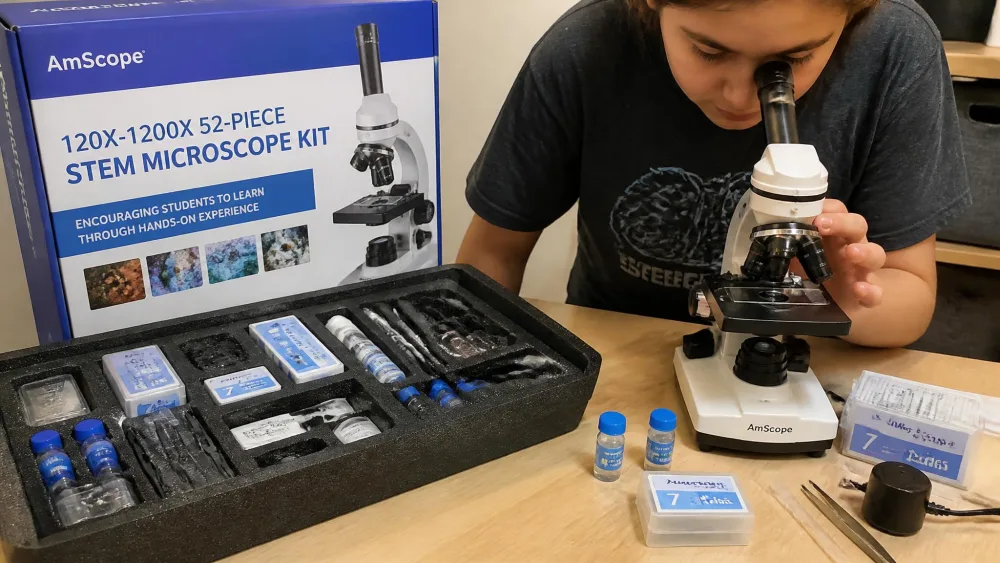
AmScope 120X-1200X 52-Piece STEM Kit — Best Overall
Six magnification settings from 120X to 1200X, a monocular head, an LED ring light and a colour filter wheel pack into a hard case with the rest of the 52-piece kit.
Ours arrived with dust on the eyepiece and on the prepared slides, and that dust reads through the glass as smears until both are wiped. After that it came down to the sequence: lowest power first, specimen centred over the aperture, light adjusted, then up a stop at a time. Going straight to 1200X gave us a blur and nothing else. Focus is coarse-only, so the field drifts while you're focusing.
Do that check the day it arrives, though, not the day you hand it over. A real share of these arrive not working at all: nothing in the eyepiece, or a lens fogged on the inside where no cloth reaches. The light-and-mirror assembly is what gives out first, and it can go inside the first couple of uses.
Pros
- Six steps from 120X to 1200X
- Hard case, ring light and filter wheel included
- Around $45 at the time of writing
Cons
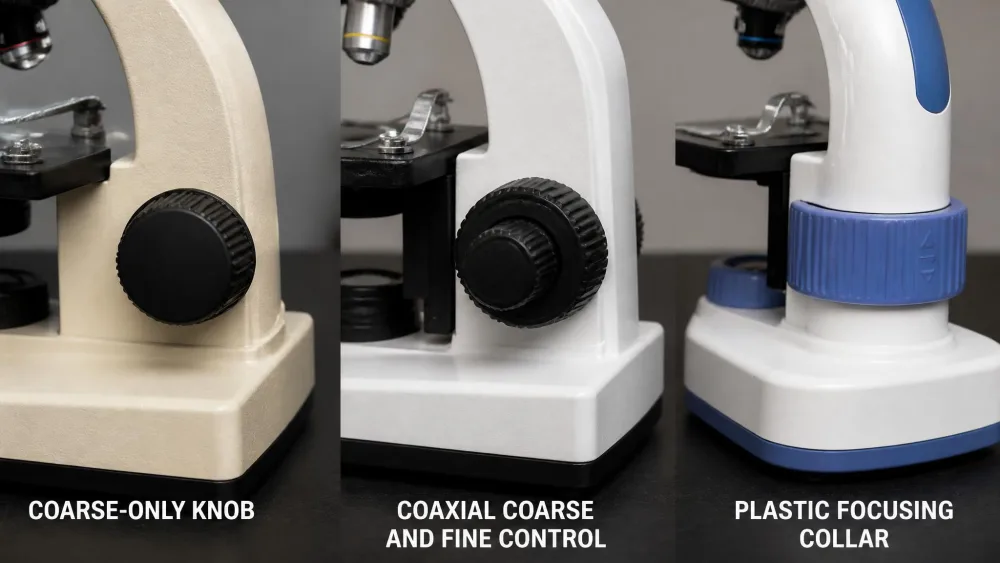
- Coarse focus only, no fine adjustment
- Plastic knobs behind a metal-body claim
- Some units arrive fogged or dead
Best for: Kids who'll work up through the magnifications. Not for: A five-year-old who wants a picture in ten seconds. Age tested: No age on the listing; the start-low routine suits about 8 and up.
Check price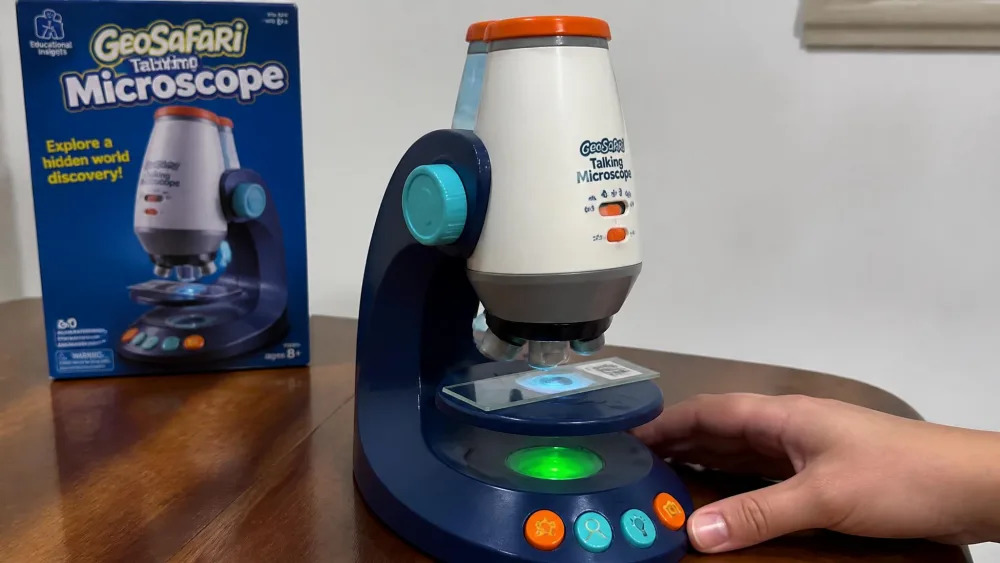
Educational Insights GeoSafari Talking Microscope — Best for Preschoolers
This one isn't an optical microscope, and treating it as one sets a preschooler up for disappointment. It shows fixed photographs: 20 pre-prepared slides, 60 full-colour images and over 100 narrated facts and quiz questions.
It holds a rambunctious four-year-old on its own, which almost no talking toy manages. The slides only trigger the audio grooved-side down, and that groove can be felt but not seen. The drawer stops latching, and then the slides spill.
Pros
- Holds a preschooler's attention with no adult alongside
- 20 slides, 60 images, over 100 narrated facts
- Two eyepieces, so nobody squints
Cons
- Not optical; the images are fixed photographs
- Slides only work grooved-side down
- No add-on packs, so 20 slides is the library
Best for: Ages 3 to 5, and young explorers not ready to focus anything. Not for: A six-year-old who wants to look at pond water. Age tested: 4 years old.
Check price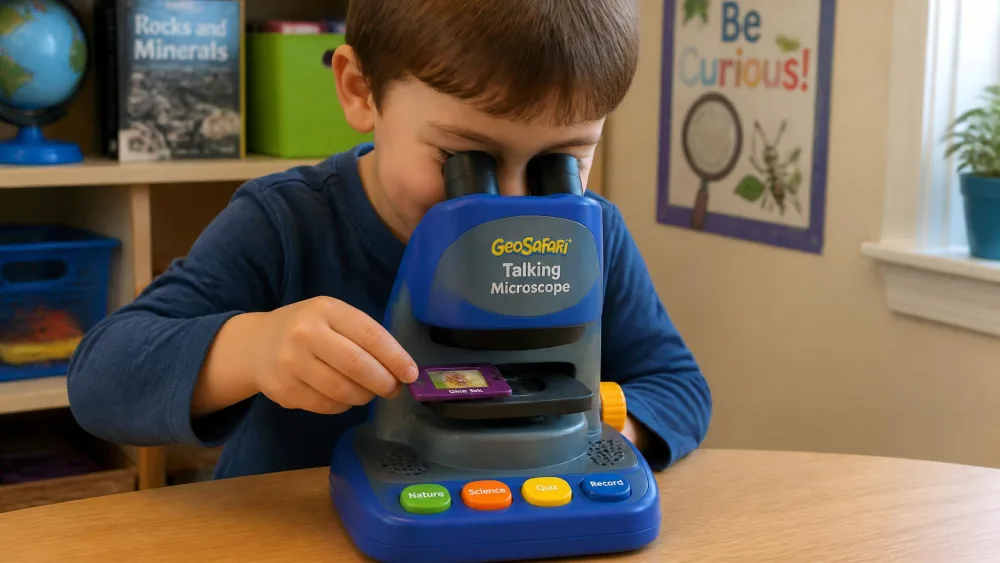
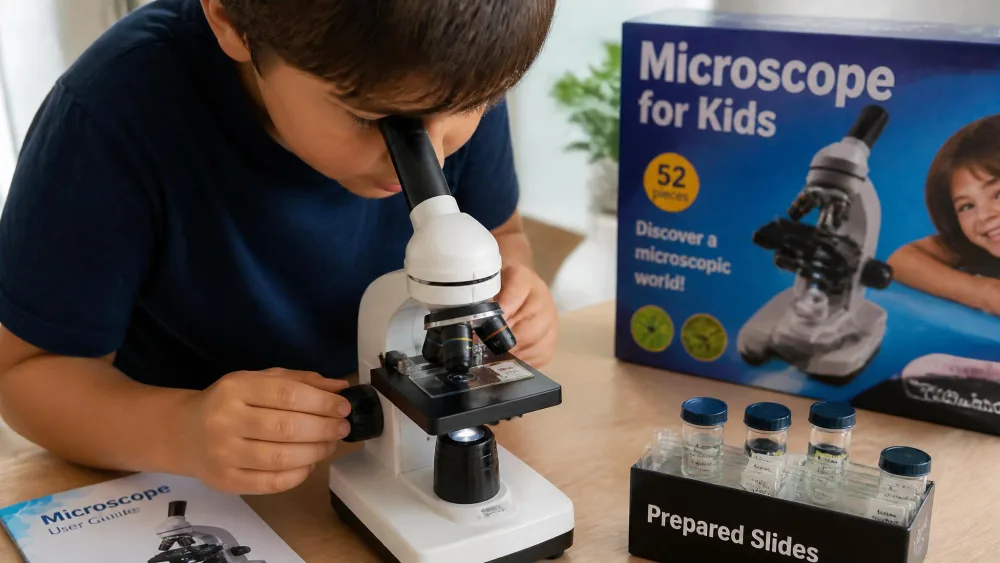
National Geographic Microscope for Kids — Best Science Kit
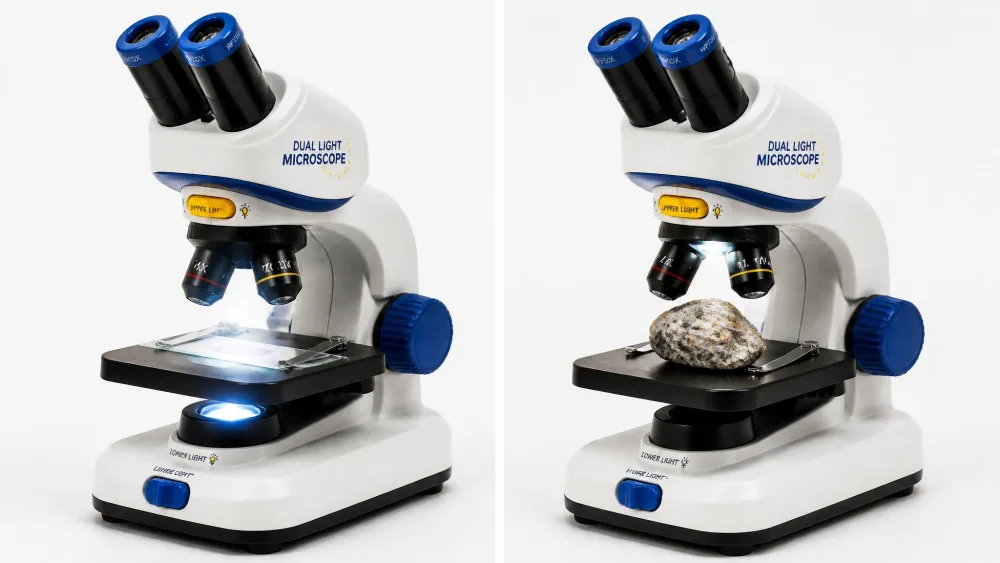
Lights above and below the stage are what make this a science kit rather than a slide viewer. The under-stage light handles the six prepared plant slides; the top light takes a rock or a beetle wing unsliced.
The stage is what gives out. Raise it too far and the mechanism cracks, which is how ours ended after ten months of daily use by a six-year-old. Under about seven, the included specimens run out inside ten minutes.
Pros
- Lights above and below the stage
- Six prepared slides, six blanks, six minerals
- Batteries last months, even with the light on
Cons
- The stage mechanism cracks if raised too far
- Focus sticks and then jumps instead of gliding
- Starter specimens run out fast under seven
Best for: Ages 6 to 10, especially kids who like a lab guide. Not for: Anyone expecting that stage to survive daily cranking. Age tested: 6 years old.
Check price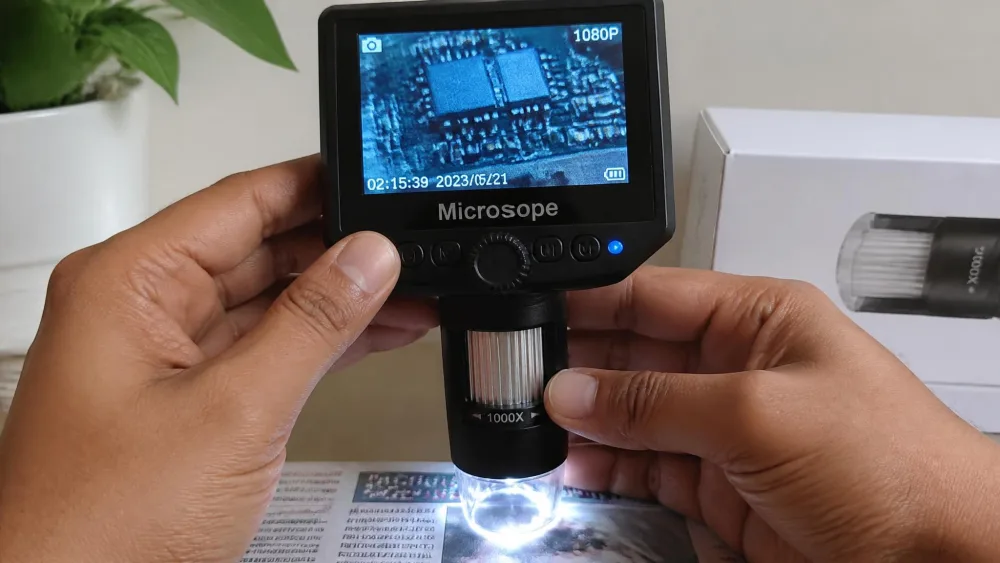
1000X Handheld Digital Microscope with 2.0-Inch IPS Screen — Best Digital Screen Model
The screen changes who gets to look. Two or three heads crowd the same 2.0-inch display instead of one child hogging a tube, and a three-year-old works it unprompted.
What it shows is worth being precise about. Threads inside a single grey yarn, the ridges on a fingertip, the texture of skin: all of that comes through. Cells and bacteria don't. Peel the film off the lens before the first look, and don't scrub at any adhesive it leaves, because that scratches the plastic for good.
Pros
- Several kids watch the same image at once
- A three-year-old works it unaided
- Rechargeable, 200g, 12-month warranty
Cons
- 1000X is optical plus digital, not resolving power
- No cells and no bacteria
- Lens film leaves adhesive that scratches
Best for: Families sharing one scope across a wide age spread. Not for: A biology student who needs to resolve a cell wall. Age tested: 3 years old, and again with a teenager.
Check price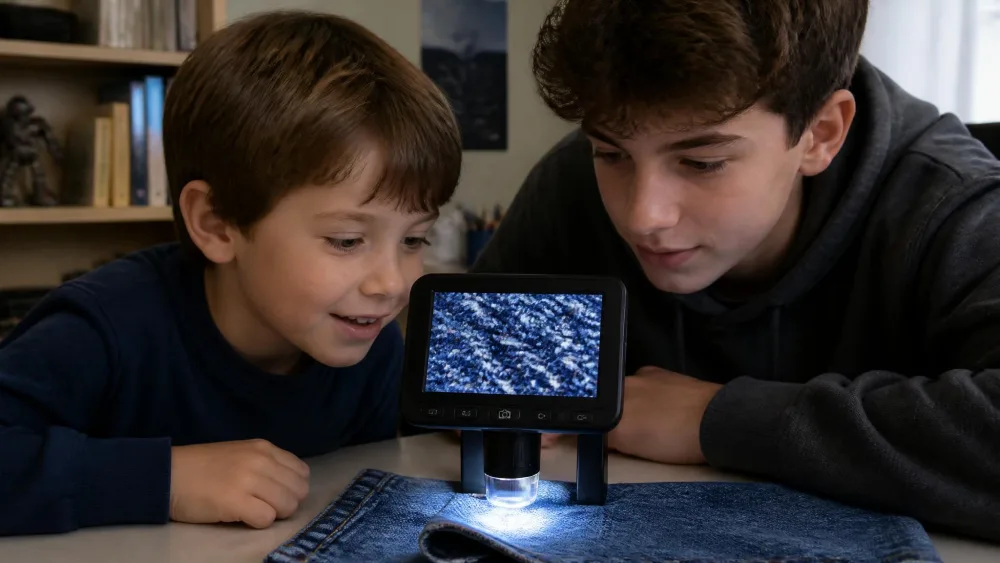
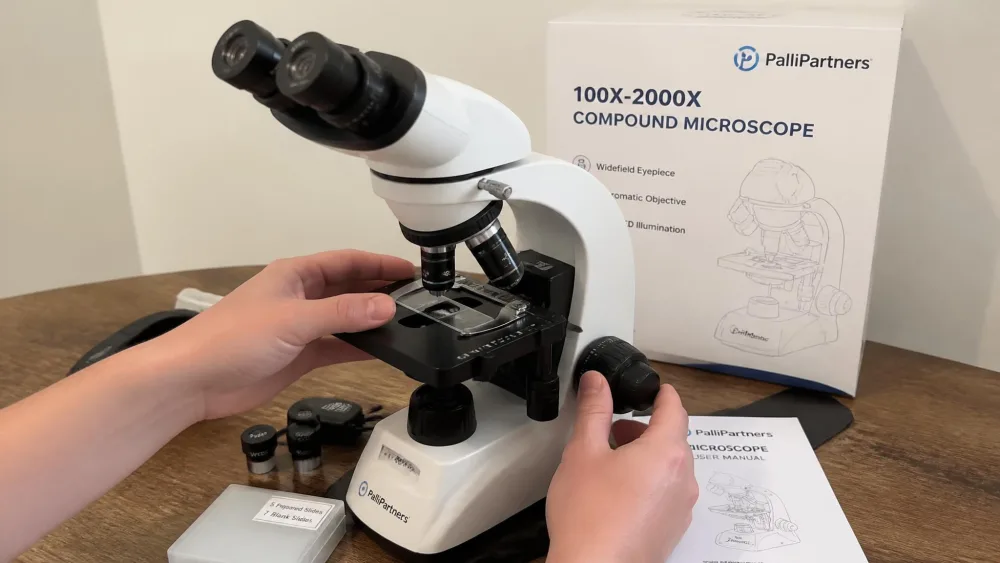
PalliPartners 100X-2000X Compound Microscope — Best for Teens and Biology Class
Teenagers get something different here. A 45-degree inclined head keeps a long sitting comfortable, and dual LEDs, coated lenses, a prepared slide set, a smartphone adapter and a UL-listed power adapter come with it.
An eleven-year-old in our house runs every feature without an adult in the room. There's no separate fine-focus knob, though, so the last increment of sharpness is the hard one. Blank slides are in the box; cover slips aren't.
Pros
- A 45-degree head that stays comfortable
- An eleven-year-old runs every feature alone
- Dual LEDs, coated lenses, smartphone adapter
Cons
- No separate fine-focus knob
- No cover slips, so a slide-prep kit is extra
- 2000X is the listed ceiling, not a working figure
Best for: Ages 11 and up, and anyone taking biology this year. Not for: A younger child who wants to carry a scope around. Age tested: 11 years old.
Check price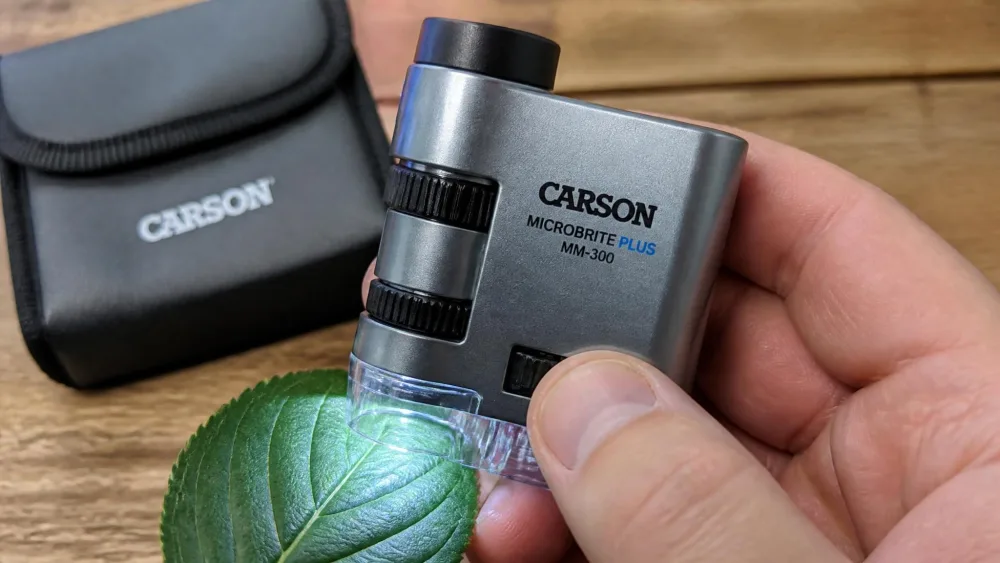
Carson MicroBrite Plus MM-300 Pocket Microscope — Best Budget Pick
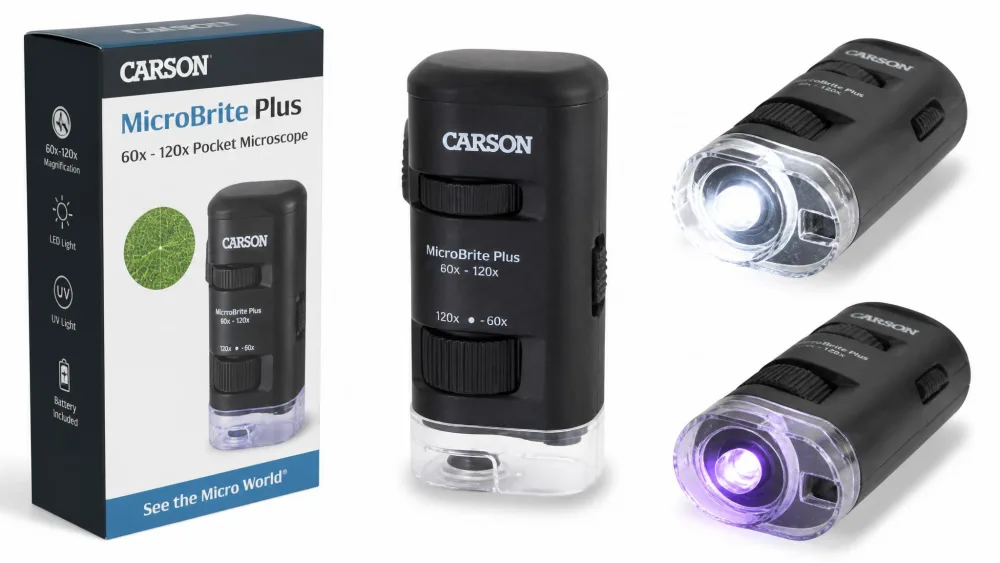
We keep this one in a coat pocket, and that's the whole argument for it. No stage, no slide holder, just a focusing ring, a zoom dial and an LED, at around $15.
Push toward 120x and the rules tighten. It focuses reliably only on a flat, still subject, so a leaf on a living plant just shakes. Glasses have to come off, the view is inverted, and the collars slip with use.
Pros
- Pocket-sized and steady at low power
- 60x to 120x optical zoom with the LED built in
- The cheapest real magnification here
Cons
- Needs a flat, still subject under the lens
- Glasses off, and the viewfinder is tiny
- Focus and zoom collars loosen with use
Best for: Field trips, coat pockets and kids who bring things home. Not for: Slide work at a desk. Age tested: No age on the listing; the inverted view puts it at about 7 and up.
Check price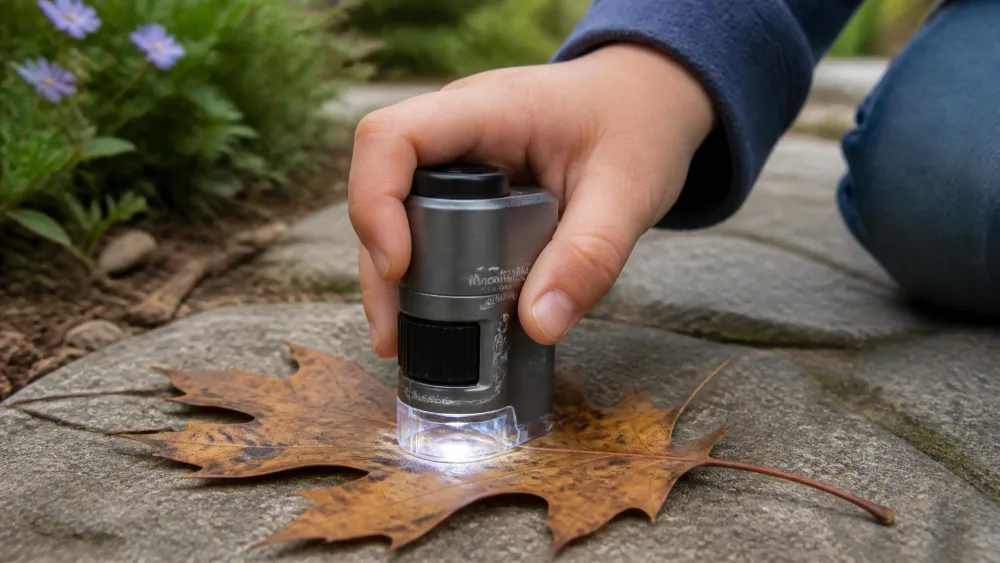
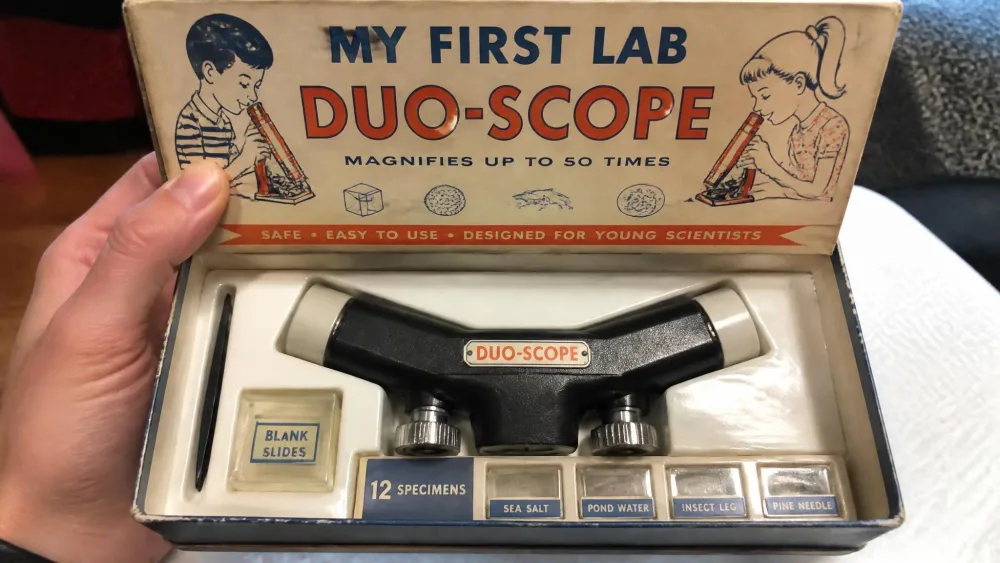
My First Lab Duo-Scope — Best Compound-and-Stereo Combo
Two microscopes share one body here, and that's the reason to look. Glass objectives handle slides at 40X, 100X and 400X; switch to the overhead light and rocks, coins and whole insects work unsliced, though only one light runs at a time. The catch is the price: around $184 at the time of writing, well above its own historical band.
What you're paying for is the glass. A plastic-lensed scope goes dirty and cloudy inside a year and quietly stops getting used, and this one doesn't. What it does instead is punish a heavy hand. Wind the stage up that last turn under the 40X objective and the lens touches the slide and cracks it, because nothing else in the kit sits so close to the glass. Force the focus knob past its stop and the rack strips, which is the single most common way this scope gets broken. And the base is light under a top-heavy body, so a knocked table puts the whole thing on the floor.
Pros
- Compound and stereo in one, a light for each
- Real glass objectives and a metal eyepiece tube
- A 50-piece kit and a 1-year warranty
Cons
- Around $184, far above the rest of this list
- The focus rack strips if the knob is forced
- Top-heavy on a light base, so it tips
Best for: Grades K-12 households wanting one scope for everything. Not for: Anyone shopping the sub-$60 shelf. Age tested: Listed for grades K-12; the focus rack needs a child old enough to stop at the knob's limit.
Check price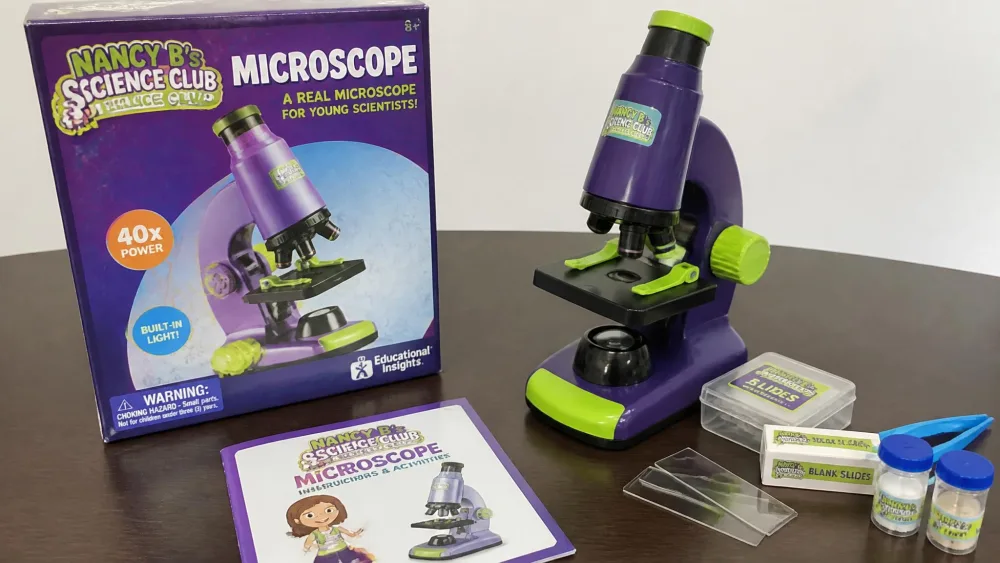
Educational Insights Nancy B's Science Club Microscope — Best for Journaling Scientists
The journal is the reason to buy this set. Twenty-two pages of guided write-and-draw experiments keep an eight-year-old coming back more than the scope itself does.
The optics are plastic, and it shows. Low power works; at the top of the 30x to 400x range the image is a blur nothing will resolve. Turning the focus shifts the slide on three axes at once, which is why six is too young for it and eight isn't.
Pros
- A 22-page journal used more than the scope
- Two LEDs for slide work and dissecting
- Cover slips, tweezers and a full prep tool set
Cons
- Plastic optics blur at the top of the range
- Focusing moves the slide on three axes
- The listing states two age ranges and two piece counts
Best for: Kids around 8 and up who like writing down what they see. Not for: A child who wants sharp images at 400x. Age tested: 6 and 8 years old.
Check price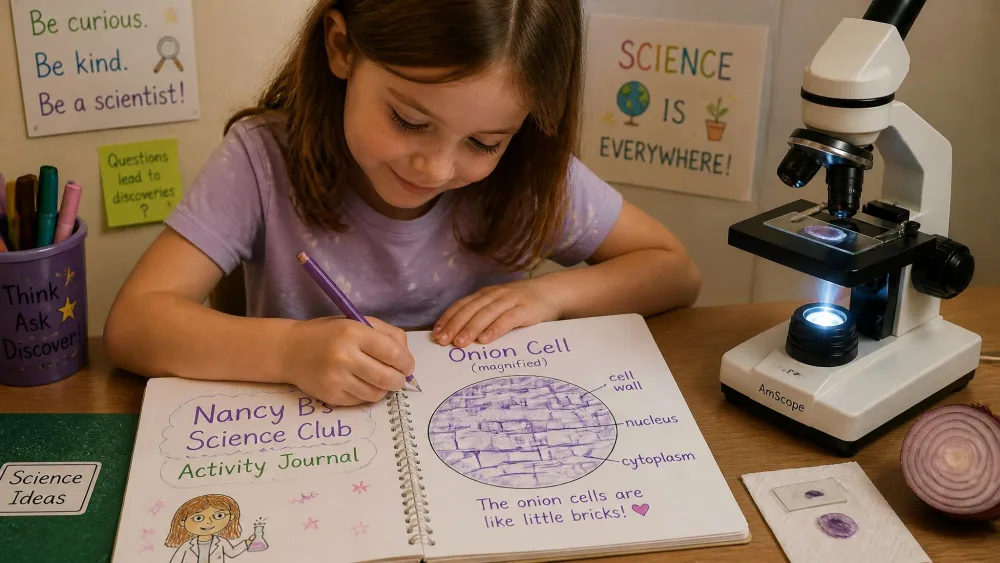
58-Piece Kids Microscope Kit — Best Accessory Kit
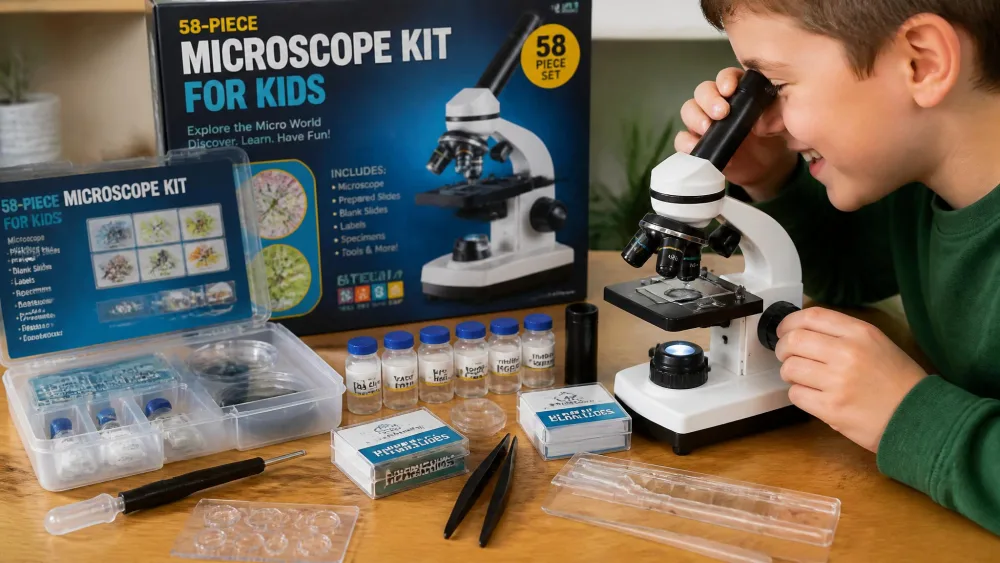
Fifty-eight pieces sounds like marketing until the box opens: 13 prepared specimens, 31 blank slides, tweezers, a dropper and an illustrated colour guide. Those blanks are where the value is, because they're what keeps a scope going past the first evening.
Focus is the weak spot. A leaf resolves into stripes rather than cells, and getting that far takes more turning than most children will give it, so a five-year-old needs an adult hand on the knob.
Pros
- 31 blank slides and 13 prepared specimens
- Metal body, LED light, carrying case
- An illustrated guide to the parts of a microscope
Cons
- Focus is coarse; a leaf reads as stripes
- A genuinely sharp scalpel in a kit labelled from five
- Some units ship with a flickering LED
Best for: Ages 7 to 12, and anyone who wants to make their own slides. Not for: Unsupervised younger children, because of that scalpel. Age tested: 5 and 7 years old.
Check price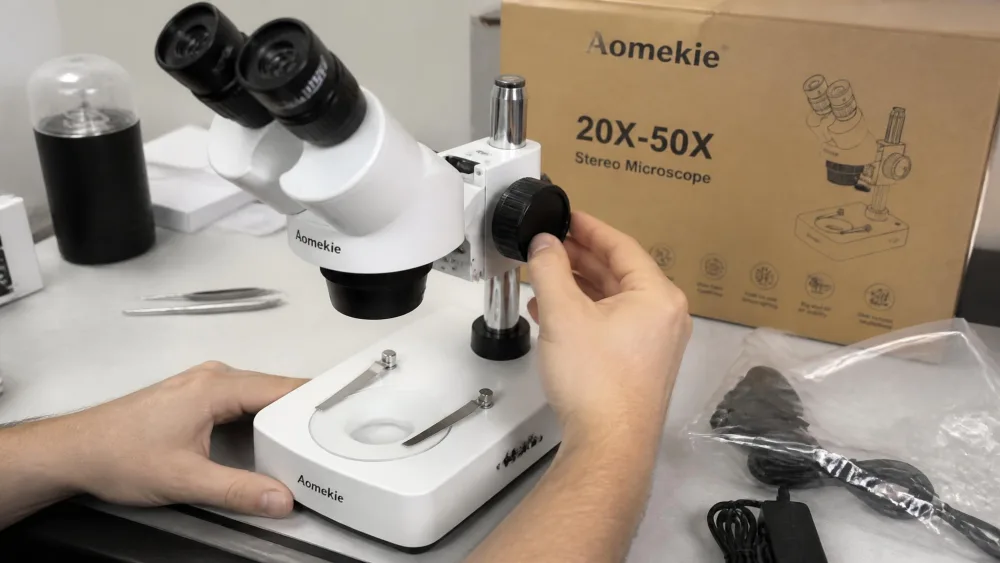
Aomekie 20X-50X Stereo Microscope — Best for Bugs, Rocks and Outdoor Finds
Two eyepieces instead of one remove the hardest part of a first microscope, which is holding one eye shut while keeping the other at a fixed distance from a tube.
Twenty and fifty times is the range where a five-year-old still recognises what's on the stage. The body is very light plastic and reads as a toy, though the optics are clean. There's no under-stage light, so slide work is off the table.
Pros
- Two eyepieces, so no squinting and no eye strain
- A range a five-year-old can interpret
- Clean optics, 12 minerals, cordless use
Cons
- Very light plastic body that feels like a toy
- No under-stage light, so slides are out
- The shipped accessory count varies
Best for: Ages 5 to 9, and whatever comes in from the garden in a jar. Not for: Slide work, or anything needing light from below. Age tested: 5 years old.
Check price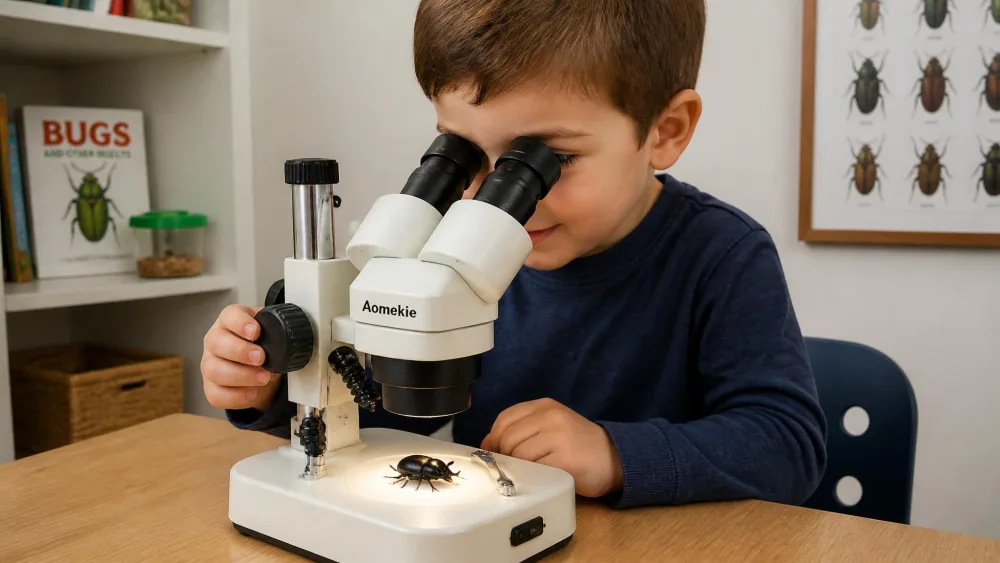
How We Chose These Microscopes
Every scope here earned its slot the same way: on what a child gets out of it, not on the top number printed on the box. Specs came first, because a listing tells you what glass sits in the tube. Then came the harder questions.
Does the focus land where a child puts it, or stick and then jump? What breaks first, and how soon? Does the image hold together at the top of the stated range? And what is there left to do on the second evening, once the prepared slides have all been through once?
Price mattered, but only measured against what's in the box. Every failure pattern we found stayed in the Cons lists, because the honest half of a hands-on write-up is the half that saves you money.
Best Microscope for Kids by Age
| Age band | Magnification that helps | Scope type | What they can see at it |
|---|---|---|---|
| 3 to 5 | None, or 20X to 50X | Talking viewer or stereo | Whole bugs, feathers, sand grains, in 3D |
| 6 to 9 | 40x to 100x, 400x in reserve | Compound with dual lights | Onion skin, leaf veins, salt, printed dots |
| 10 to 13 | 100x to 400x | Compound with a proper stage | Plant cells, cheek cells, pond life |
| 14 and up | 400x through good glass | Compound, inclined head, steady stage | Cell walls, protozoa, their own smears |
Ages 3-5: Talking and Look-and-See Scopes
At three and four, focusing is the barrier, not curiosity. A child this age can't hold one eye shut, keep the other steady and turn a knob all at once, so what works here takes the focusing away. The GeoSafari Talking Microscope narrates fixed photographs; a stereo scope uses two eyepieces and a range where a bug still looks like a bug.
Ages 6-9: First Real Optics
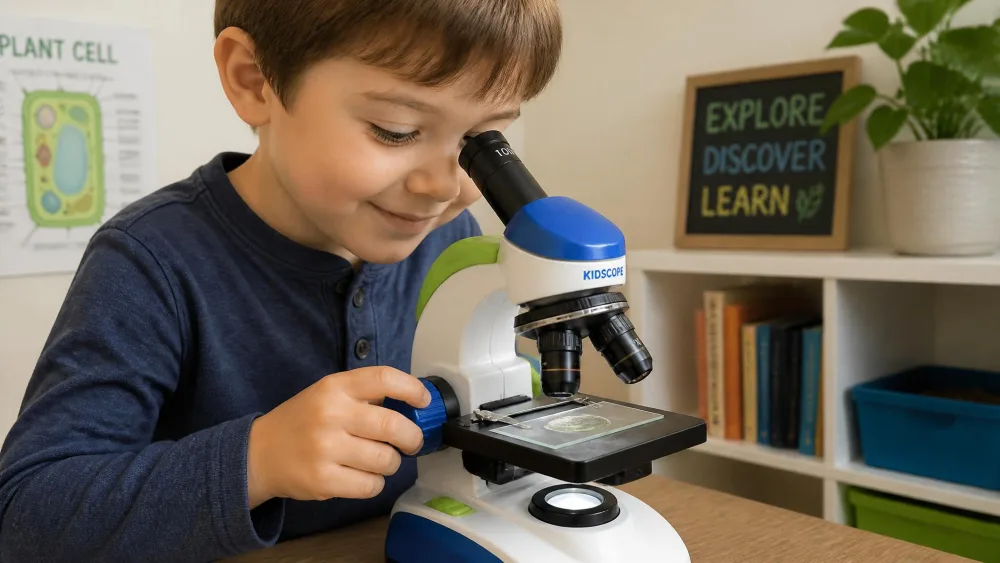
Six is roughly when a real microscope starts to pay off, and the National Geographic kit is built for that window: three magnifications up to 400x, lights above and below, knobs sized for small hands. Expect to sit alongside at first, and expect that the six prepared slides won't last past ten minutes.
Ages 10-13: Compound Scopes and Real Slide Work
By ten, the ceiling stops being the child and starts being the glass. This is the age for a compound scope with a proper stage and enough reach for plant and animal cells, and the age when a child starts making their own slides instead of working through the prepared ones. Our top pick covers it.
Ages 14+: Lab-Grade and Biology-Class Scopes
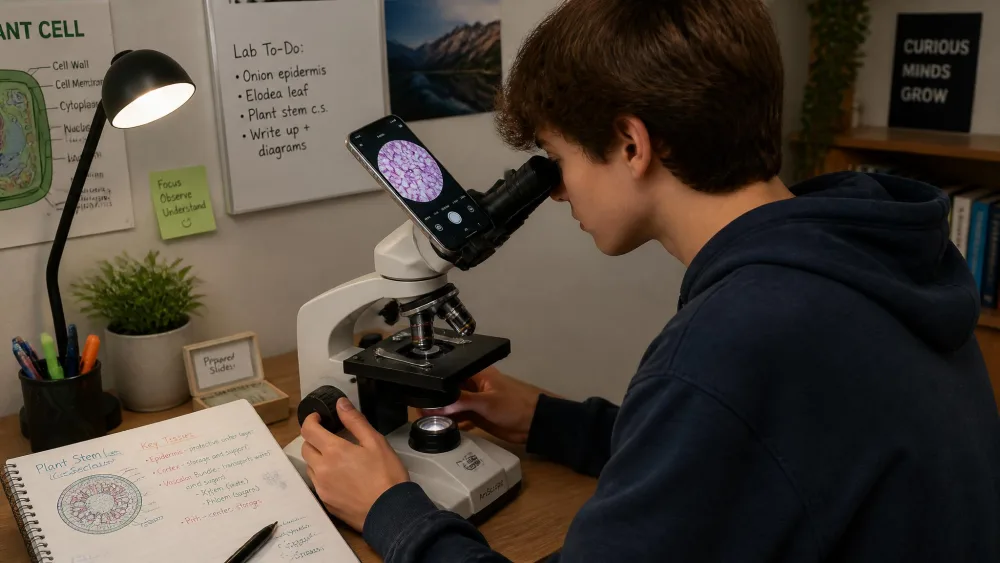
Teenagers need a stage steady enough to hold a target still while they draw it, and a head they can sit at for an hour. What this price class mostly does without is a separate fine-focus knob, and the PalliPartners compound scope is no exception, so the last increment of sharpness takes a patient hand on the one knob it has. It's still the closest thing here to a biology-class instrument: a 45-degree inclined head for long sittings, coated lenses, dual LEDs and a smartphone adapter. An eleven-year-old can already run every feature alone, so there are school years of use in it.
How to Choose a Microscope for Kids
Match Magnification to Age (and Ignore the 2000x Hype)
Magnification on a microscope is a multiplication, not a rating. A 10X eyepiece over a 40X objective is where My First Lab's 400X comes from, and a stronger objective raises that figure without improving anything the lens gathers. What decides whether a child sees something is the glass, the light and the steadiness of the stage, which is the ground Nikon's MicroscopyU guide to microscopy basics covers at length.
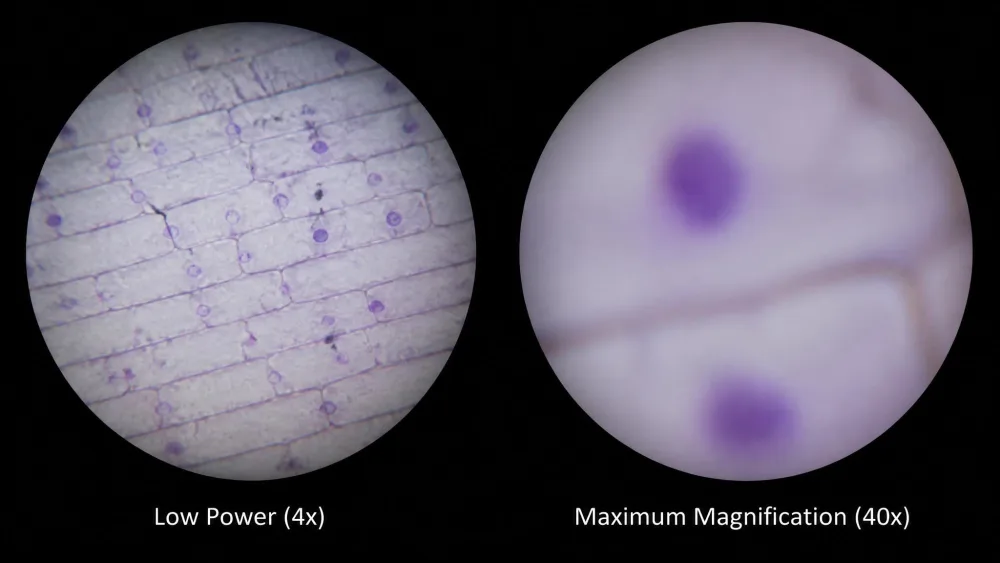
That multiplication is why the age matters more than the figure. A five-year-old needs a picture they can name, so a small number through clean glass beats a large one through plastic. A twelve-year-old chasing cells needs a real 400x.
Watch outTreat 1000x and 2000x on a kids' microscope box as a marketing figure rather than a capability. Past roughly 400x a cheap scope gives a dim, blurry image however carefully you focus, and the extra reach is usually digital zoom enlarging the blur along with the specimen.
Optics and Build: Glass vs. Plastic, Metal Body vs. ABS
Glass and plastic optics behave differently after a year, though you won't see it on day one.
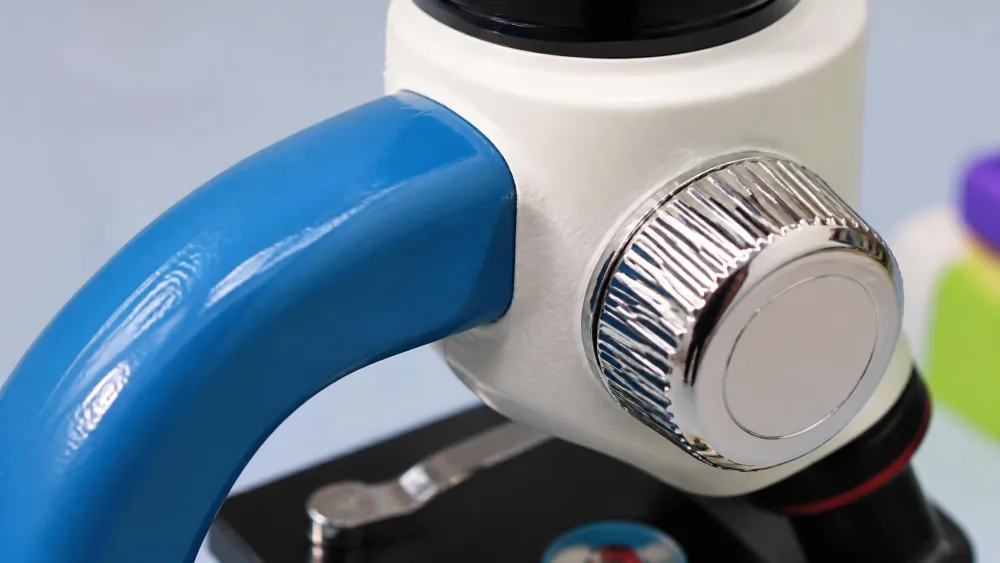
Most listings won't say which they've used, and a title that says metal body can still mean plastic knobs and a plastic light housing, so read the claims carefully. Where a listing does state real glass objectives, as My First Lab's does, that's the line worth paying for.
Lighting: Top, Bottom and Dual LED
A light under the stage shines up through thin, translucent things: prepared slides, onion skin, an insect wing. A light above the stage bounces off solid ones: rocks, coins, whole beetles.
Under about ten, it's the top light that gets used more, because it asks for no slide preparation.
Focus Knobs and Whether Your Child Can Use It Alone
Coarse focus moves the stage quickly; fine focus is what lands the image. Plenty of scopes in this price range only have the first, our top pick included, so the field drifts while you're focusing.
A focus that drags the slide sideways while it sharpens turns every session into a chase, which is what separates a set an eight-year-old manages from one a six-year-old gives up on. Ask one question before you buy: will your child still be turning that knob after two minutes of nothing happening?
Included Slides, Specimens and Accessories
Prepared slides are what a scope does on the first evening. Blank slides are what it does for the rest of the year.
Count the blanks before you count anything else, and check for cover slips by name, because they're the piece most often left out of an otherwise generous kit.
Educational Value: Toy, or Something They'll Actually Learn From
The difference between a toy and something a child learns from usually isn't the optics. It's whether the box gives them something to do next.
A modest set with a journal of write-and-draw experiments gets pulled out week after week; a sharper scope with nothing to follow often doesn't. A scope with no guide still works, but then somebody has to supply the next question, and that's usually you at nine in the evening.
Safety Features for Younger Children
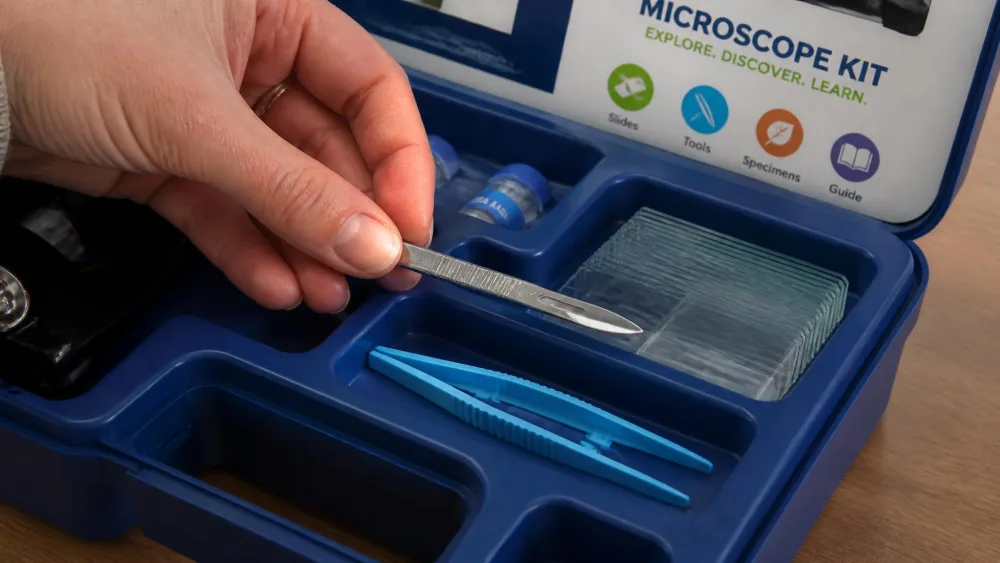
Two things in these boxes deserve a look before a young child opens one. The first is glass: cover slips and prepared slides are thin, and thin glass chips. The second is the tool tray, because several of these kits ship a scalpel and they don't flag it on the front.
Watch outOpen a science kit yourself before your child does, and lift out anything sharp until you're ready to supervise it. Age grading reflects the skills a kit needs, not the hazards packed inside it, and the U.S. Consumer Product Safety Commission publishes recalls and safety guidance worth searching on any brand you don't recognise.
What to Expect at Each Price Point
Under $20 you're buying a pocket scope with no stage, and the Carson MicroBrite Plus is the one worth owning there because it does one job well instead of four badly.
Between $30 and $50 sits the sweet spot for a first real microscope: the National Geographic kit near $40, our top pick near $45, the 58-piece kit and Nancy B's around $39. Past $150 you're paying for a combination scope. All these prices move with promotions and sellers.
Microscope Types Explained
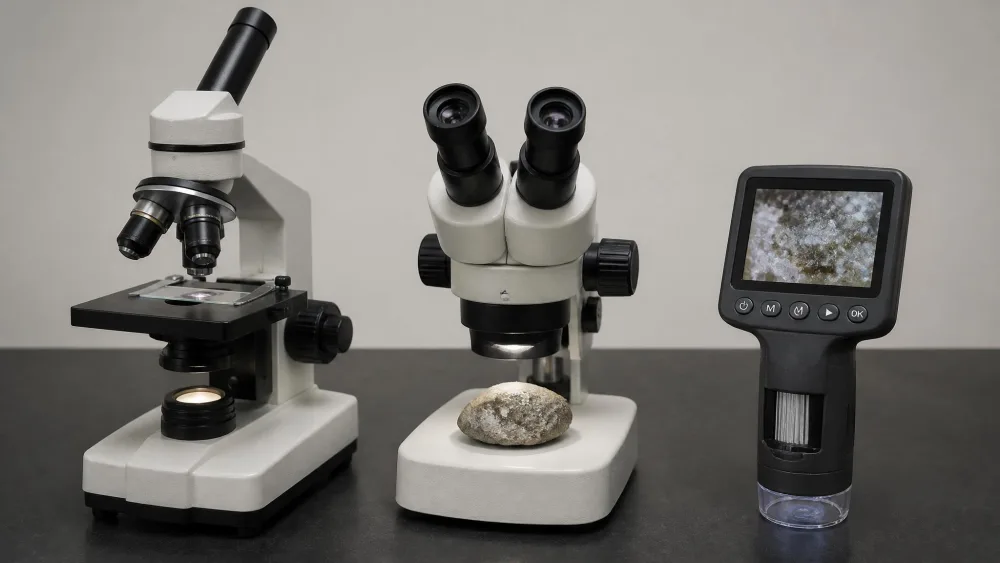
Compound Microscopes
A compound microscope stacks two lenses, an eyepiece and an objective, and shines light up through a thin specimen from below. It's the type most people picture, and the only one here that reaches cells.
The trade is that everything has to be thin, flat and mounted on a slide, so a rock or a whole beetle is out. If you're weighing compound versus stereo microscopes, that restriction decides it for most families.
Stereo (Dissecting) Microscopes
A stereo scope lights the specimen from above and gives each eye a slightly different view, so what a child sees has real depth. Magnification is low by design, usually 20X to 50X, and that's the point rather than a shortcoming.
It's the easier instrument for a young child, because nothing has to be mounted and two eyepieces remove the squinting. My First Lab folds both types into one body.
Digital and Handheld Microscopes with Screens
A digital microscope puts a small camera where the eyepiece would be and shows the picture on a screen, so everyone sees at once and nobody waits a turn. For the mechanics, what a digital microscope is makes a good primer.
The trade-offs are a camera's rather than an eyepiece's. Detail comes from the sensor, 2MP on our screen pick, and no setting improves on what that chip records. Battery and screen are what you notice daily: about two hours per charge and a 2.0-inch display. What you gain is that a picture can be kept, and 32M of onboard storage holds a couple of hundred of them for a school project.
What Kids Can Actually Look At: 10 First Slides to Try
Start with things that look dramatic at low power, not things that are scientifically interesting at high power. If your child asks why the picture flips upside down, how an optical microscope actually works is worth ten minutes together.
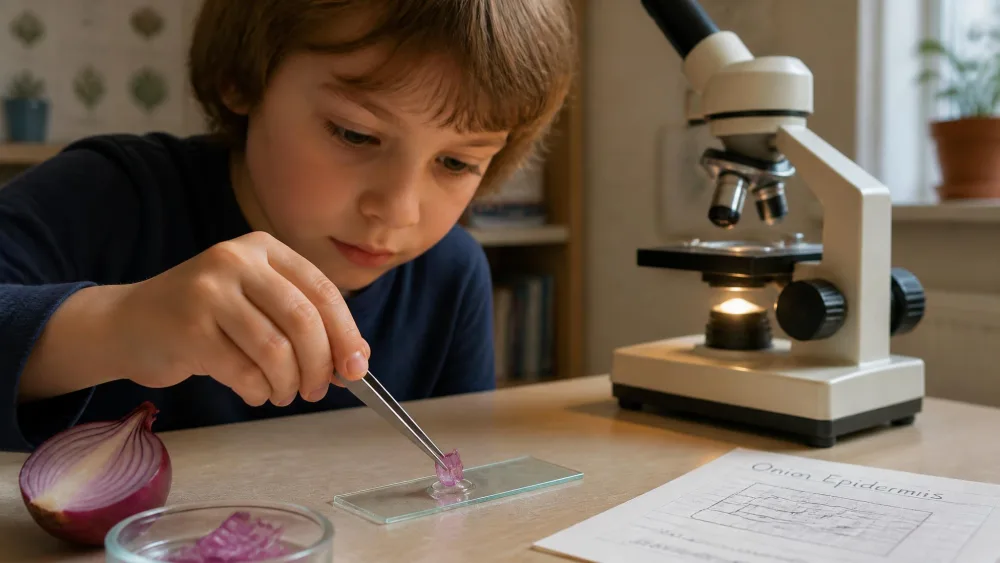
- Onion skin. Peel the film from between two layers, lay it in water, and cells appear as a brick wall.
- Salt and sugar side by side. Cubes against rounded lumps, at the lowest power.
- A human hair, then a pet's. The difference is obvious, and it usually starts an argument about whose is thicker.
- Pond or puddle water. One drop under a cover slip, and something will be moving.
- The underside of a leaf. Veins first, then the breathing pores if the glass is good enough.
- Newspaper or a colour photograph. The dots that build a printed picture surprise every child.
- Fabric threads. Cotton, wool and polyester look nothing like one another.
- A feather. Barbs and hooks, best under the top light of a stereo scope.
- Sand, or a chip off a rock. Colour and crystal shape, far better in three dimensions.
- A cheek swab in water. Seeing their own cells is the moment that sells the microscopic world.
Frequently Asked Questions
How long does a first microscope last before a child outgrows it?
Outgrowing one looks like a specific thing: the child wants a sharper picture at the top of the range and can't get it. Plastic optics hit that wall first, which is why Nancy B's is honest at 30x and a blur at 400x. Glass objectives push the limit off the instrument and onto how well the slide was made, and that's a limit a child can keep working at for years. Preschool viewers are the exception, since the GeoSafari's 20 slides are the whole library, so they age out on a schedule and hand down well.
How much magnification does a kid actually need — and is 1000x or 2000x real?
Forty to 400x covers everything a child under fourteen will realistically want to see, and it's the band most of this list works in. Above it, one word is doing two jobs. Optical magnification is what the lenses gather; digital zoom is a crop of pixels the sensor already recorded, so it makes the picture bigger without putting anything new in it. Our screen pick's own listing states its 1000X as optical plus digital combined, and that's the phrasing to look for on any model with a display.
Compound, stereo or digital handheld — which type suits which child?
For one child, buy for the age they are now. For a houseful, buy the one that gets shared: a compound scope with a light above the stage as well as below it does much of what a stereo scope does, and a screen model lets three kids look at once instead of queueing at an eyepiece. What doesn't work is buying up to the oldest, because a scope an eleven-year-old runs alone is one a five-year-old can't land on a specimen at all.
Do kids' microscopes come with prepared slides, or do you buy those separately?
Most arrive with a handful, so the more useful question is what to buy next. A starter prep pack wants three things together: blank slides, cover slips and a small bottle of stain, because a home-made specimen needs all three. Replacements sell as school science supplies rather than as toys, so search there rather than the toy aisle. Two picks change the maths: the 58-piece kit ships 31 blanks, and the GeoSafari has no add-on packs at all.
Can a child use one on their own, or does an adult need to set it up?
It depends on the focusing far more than on the child. The adult job at setup is short and specific: batteries in, protective film peeled off the lens, eyepiece and prepared slides wiped, the scope set somewhere flat and near an outlet if it's corded, and anything sharp lifted out of the tray first. After that, sitting alongside is a first-week thing rather than a permanent one, and from about seven a child runs the whole kit alone.
My child's microscope image looks blurry — what should I check first?
Go back to the lowest magnification and only step up once the specimen is sharp and centred there. Then check the ordinary culprits: dust on the eyepiece and the slide, a protective film still stuck over a digital lens, and which side of the stage the light is on. If it's blurry only at the top setting, that's the optics showing you their limit.
How do I clean and store a kids' microscope?
Lens paper and a breath of moisture, never a shirt sleeve and never a household cleaner. Don't scrub at adhesive residue on a plastic lens, because that scratches it permanently. Store the scope in its case with the lowest objective in place, and keep glass slides and any scalpel in a separate drawer.
Final Verdict: The Microscope We'd Buy for Most Kids
Ten scopes, four age bands and one number worth ignoring is a lot to carry at once, so here's where we land.
For most families with a child between eight and fourteen, the AmScope 52-piece kit gives the most usable range for the money, provided everyone treats the top magnification as a place to visit rather than to live. Under six, buy the GeoSafari and let the focusing wait a couple of years.
Between five and nine with a garden nearby, the Aomekie opens a whole new world of things a child already recognises. And if fifteen dollars is the budget, a Carson in a coat pocket beats a bigger scope that never leaves its case.