The 10 Best STEAM Kits for Kids in 2026

A STEAM kit is a hands-on project box that blends science, technology, engineering, art and math. In one sitting, a child might wire a circuit, grow a crystal or design a tower.
In our home, the "A" mattered most. The kits our kids pulled out again ended with something to show off, like a magic show or a shelf of crystals.
The age labels range from 3-7 for the youngest builders to 10+ for the crystal combo. Most kits start at 8+. Below, we note what held attention, what needed a grown-up and what wore out first.
Our Top STEAM Kit Picks at a Glance
| Kit | Best For | STEAM Focus | Ages | Kit Type |
|---|---|---|---|---|
| Snap Circuits Jr. SC-100 | Best overall | T, E: circuits | 8+ | Electronics |
| National Geographic Science Magic Kit | Chemistry | S, A: chemistry + performance | 8-12 | Experiment kit |
| 4M Deluxe Crystal Growing Combo | Science meets art | S, A: crystals + display art | 10+ | Grow-and-display |
| Klutz LEGO Gadgets | LEGO engineering | E, T: mechanisms | 8+ | Brick build + book |
| ThinkFun Gravity Maze | Logic and math | M, E: spatial logic | 8+ | Logic puzzle |
| 4M Doodling Robot | Art meets engineering | E, A: robot-drawn art | 8+ | Build-a-robot |
| Makeblock mBot Robot Kit | Beginner coding | T, E, M: block coding | 8-12 (box) | Programmable robot |
| National Geographic Break Open Geodes Kit | Earth science | S: geology | 8+ | Crack-open kit |
| Thames & Kosmos Architectural Engineering | Design | E, A, M: architecture | 8+ (varies) | Model set |
| Thames & Kosmos Kids First Robot Engineer | Preschoolers | E: gears | 3-7 | Storybook build |
1. Snap Circuits Jr. SC-100: Best Overall STEAM Kit
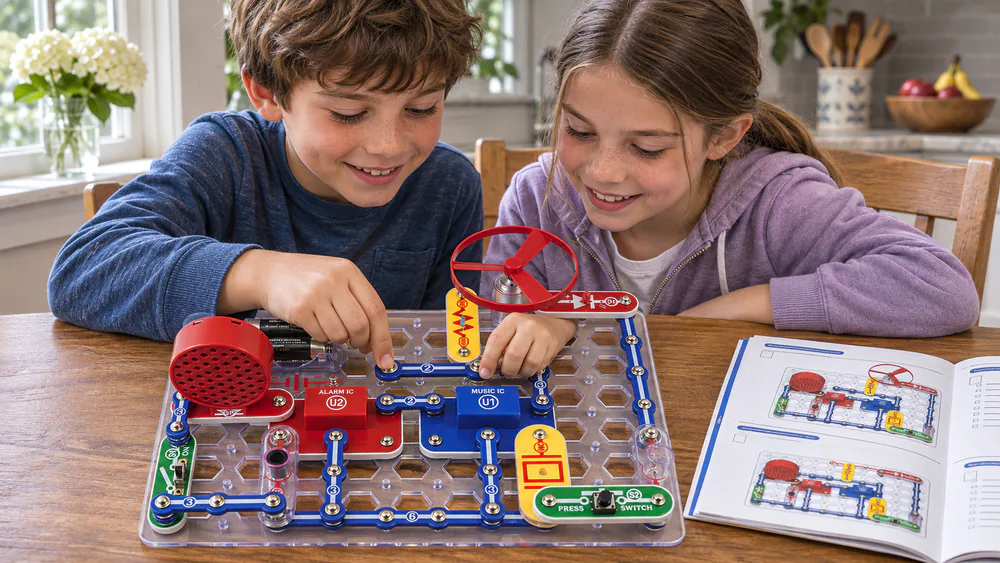
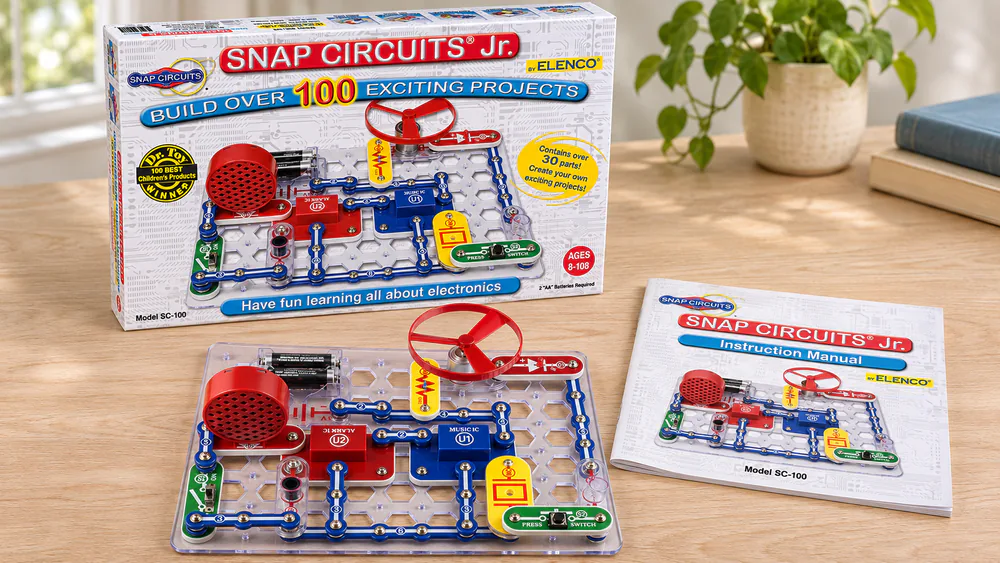
Snap Circuits Jr. SC-100 builds a doorbell, an AM/FM radio and a voice-controlled lamp with no tools or soldering. In the first session, a grown-up sat beside the builder, matching each numbered, color-coded piece to the diagram. After that, the kids needed very little help. It became a shared project, with siblings and a parent building together and asking about add-on sets with motion parts.
- Ages: 8+
- Projects: over 100 (1 to 71 in print, 72 onward online)
- Parts: about 30, depending on whether the base grid counts
- Power: two AA, sold separately
- Mess: none
- Value: Mid-priced
Best For
Kids 8 to 12. First graders can follow along too, after a short demo and with a grown-up beside them.
Skip It If
You want a solo kit for a child under 7, since younger kids tend to drift back to other toys after a handful of projects. Snaps can loosen with heavy use, and motor projects drain AA batteries, so we use rechargeables.
2. National Geographic Science Magic Kit: Best Chemistry Kit
National Geographic Science Magic Kit stages chemistry as magic: a floating coin, a vanishing test tube, snow in your hand. A grown-up measured each powder while the younger kids helped, because small hands pour in too much. Once a trick worked, it went straight into a family magic show, gloves and wand included, and even our reluctant scientist asked for another. We ran several tricks per sitting, since opened powder packets do not keep.
- Ages: 8-12
- Experiments: 20 tricks in the box, 100+ with the household-items guide
- Power: none
- Mess: moderate; some spills and temporary stains
- Value: Mid-priced
Best For
Kids who love an audience. A 6-year-old can help when an adult measures.
Skip It If
You want a solo kit. Some of the included chemicals call for a parent in the room.
3. 4M Deluxe Crystal Growing Combo: Best Science-Meets-Art Kit
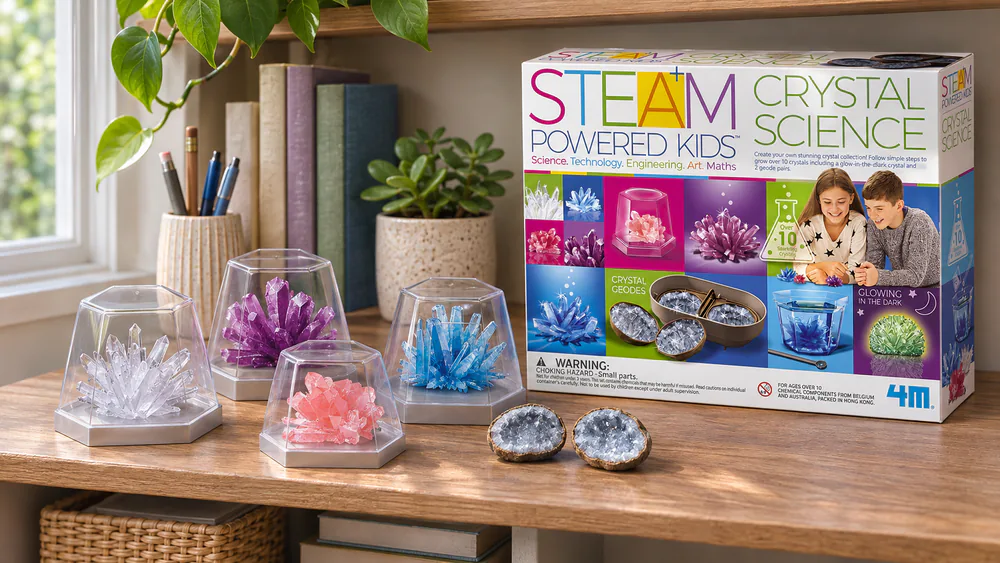
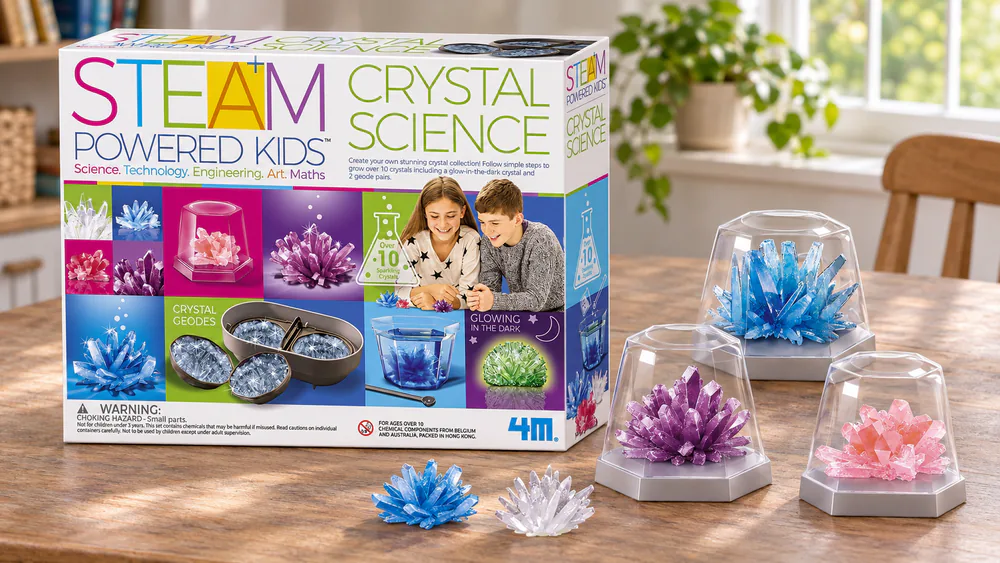
4M Deluxe Crystal Growing Combo is where science and art meet most clearly. Kids grow the crystals, choose colors and arrange them under clear display domes. We set the cups on a tray, since the solution stains porous surfaces. One batch grew odd, pretty shapes in about a week, while another sat 12 days as powdery crust. The winners went under the domes on a shelf, and the kids were excited about the collection.
- Ages: 10+
- Crystals: more than 10, including 2 geodes; most reach 1-2 inches
- Growth time: about 7 to 10 days, varying with room temperature and mixing
- Mess: medium; use a tray or thick newspaper
- Value: Budget
Best For
Patient kids who like collecting and arranging.
Skip It If
Your child wants a result the same afternoon. The waiting is the hard part.
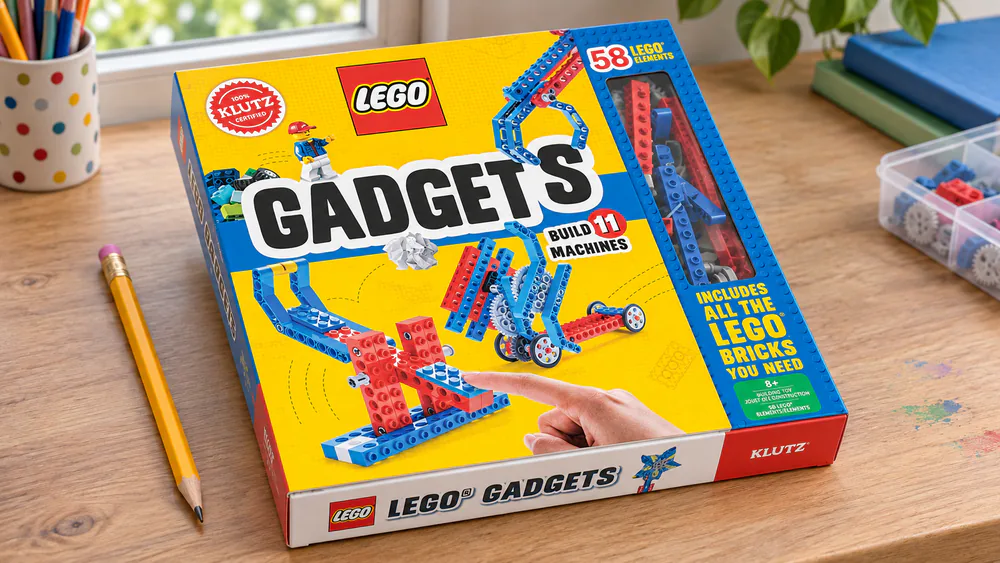
4. Klutz LEGO Gadgets: Best LEGO Engineering Kit
Klutz LEGO Gadgets pairs 58 LEGO elements with photo steps and a page on where each mechanism shows up in real life. At our table, an early reader read the steps aloud while a preschooler followed the photos, with help on small pieces and cardboard. The catapult went up first, launching paper balls and spare bricks. Afterward, the mechanisms moved into our LEGO bin as new inventions. Our Klutz LEGO Gadgets review goes deeper.
- Ages: 8+
- Builds: 11 machines, plus 6 sheets of papercraft
- Power: none
- Mess: none, but small parts
- Value: Budget
Best For
Kids who already have a LEGO bin to build into.
Skip It If
You need durable storage. The paper parts and box tear easily, and boxes sometimes arrive short a few bricks, so count first.
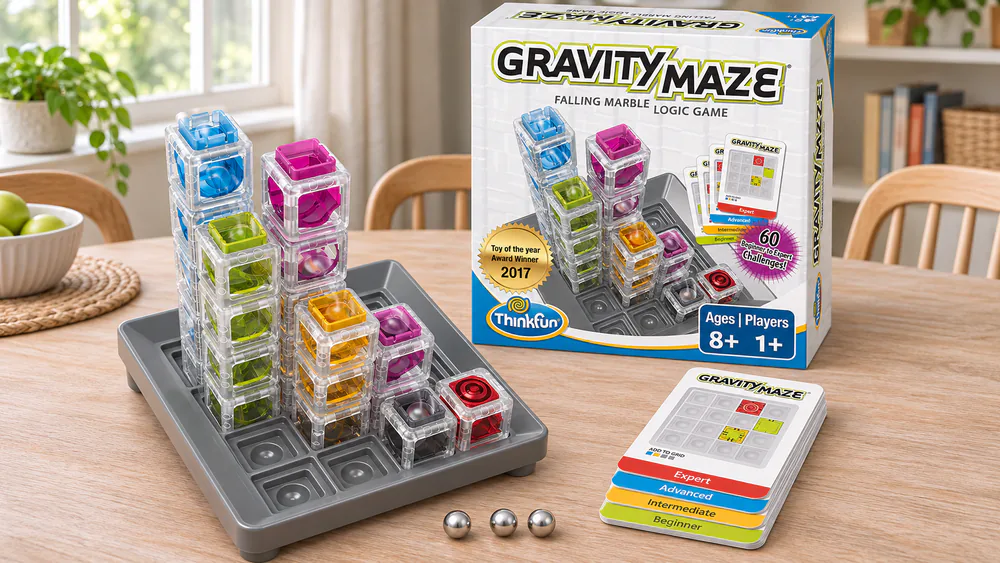
5. ThinkFun Gravity Maze: Best Logic and Math Kit
ThinkFun Gravity Maze is a marble-run logic puzzle and a Toy of the Year winner. Players place towers so a marble reaches the target. The beginner cards built confidence fast, the expert cards stumped the grown-ups, and the answers on the backs kept frustration down. It became our quiet-time pick between lessons, with younger siblings dropping marbles while an older child planned the route.
- Ages: 8+
- Challenges: 60 cards, beginner to expert
- Contents: 9 towers, 3 marbles, grid and target
- Mess: none
- Value: Budget
Best For
Puzzle-minded kids around 9.
Skip It If
A 7-year-old will play alone; it can confuse at that age. Towers also lift off the grid when bumped.
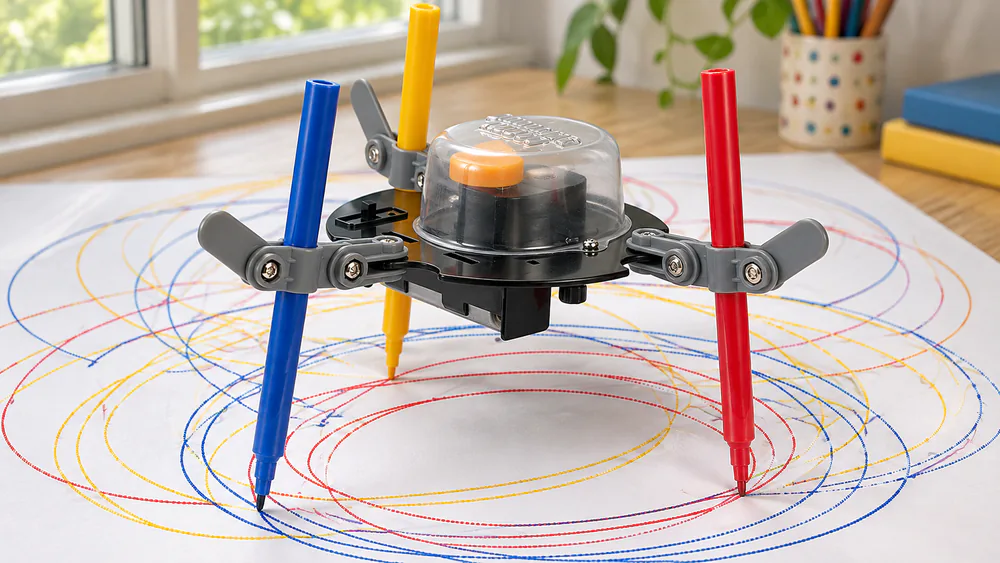
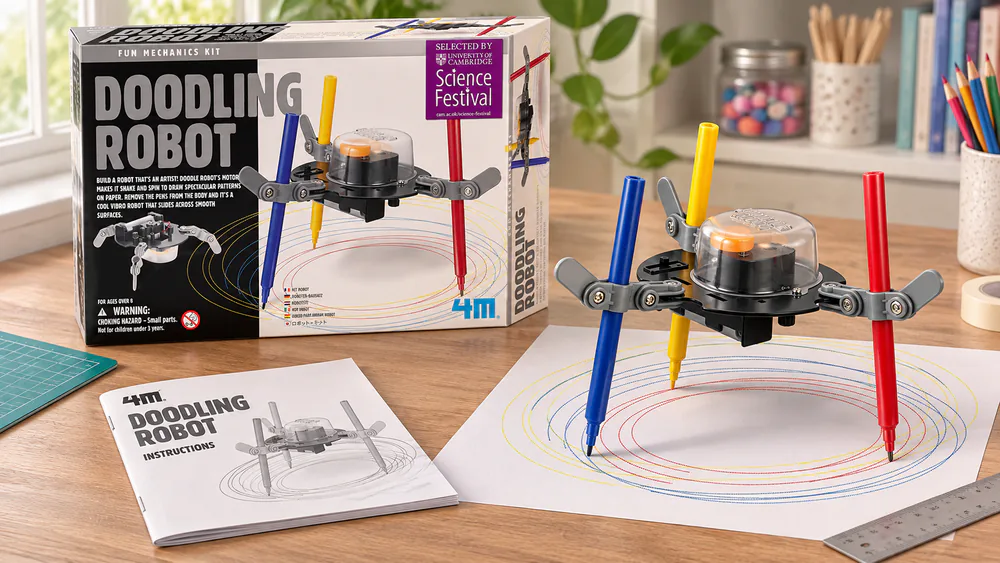
6. 4M Doodling Robot: Best Art-Meets-Engineering Kit
4M Doodling Robot is a robot kids build that then makes art. An off-balance motor makes it wobble, and attached pens draw on their own. Assembly went quickly, and then we moved the motor mount and pen angle to change the drawing. It wandered across the paper, drawing mostly circles with some loops and spirals that were fascinating to watch. Test it right after building, since some motors quit after a few minutes.
- Ages: 8+
- Builds: one drawing robot
- Power: one AA, not included
- Mess: low
- Value: Budget
Best For
Artsy kids curious about motors.
Skip It If
You want it to last. The body is flimsy, marker tips wear down to the plastic, and the tiny screws vanish.
7. Makeblock mBot Robot Kit: Best Coding Kit for Beginners
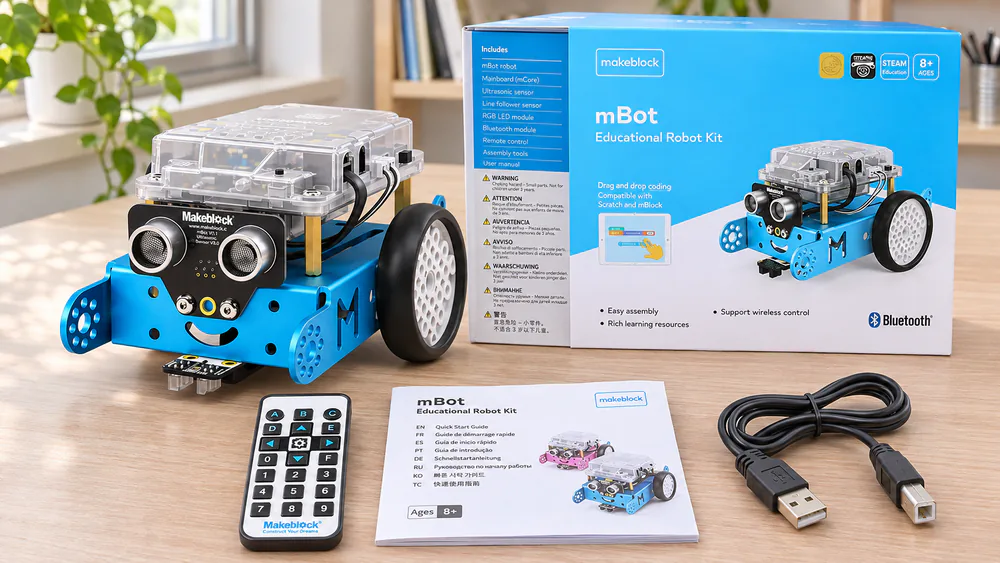
Makeblock mBot Robot Kit is a metal-chassis robot that follows lines and dodges obstacles. Kids code it with Scratch-style blocks in mBlock, then step up to Arduino text code. Assembly is listed at about 15 minutes, but a 7-year-old with a parent takes about an hour while doing most of the work. Once it ran, Bluetooth did not always reconnect, so our younger coders needed help re-pairing. The included projects went quickly, and we ended up inventing new challenges.
- Ages: 8-12 on the box; the maker lists it younger, so it depends on parent help with the app
- Power: 4 AA plus a CR2025 coin cell for the remote, not included
- App: yes
- Mess: none; one small screwdriver
- Value: Splurge
Best For
Kids ready to move from building to coding. It also accepts LEGO parts.
Skip It If
You have no coding background. The app and documentation are not foolproof, so expect some debugging.
8. National Geographic Break Open Geodes Kit: Best Earth Science Kit
National Geographic Break Open Geodes Kit comes with goggles and a guide to how geodes form. We cracked them outside on a hard surface, each wrapped in an old rag. Some split with one tap, others needed a chisel and an adult's swing, and a few crumbled. Many were white or clear quartz inside, but every reveal made our kids light up, and each child kept a piece.
- Ages: 8+
- Includes: 10 geodes and display stands; bring your own hammer
- Power: none
- Mess: high; crack them outside
- Value: Mid-priced
Best For
Families with several kids or budding geologists.
Skip It If
You are counting on purple amethyst.
9. Thames & Kosmos Architectural Engineering: Best Design and Architecture Kit
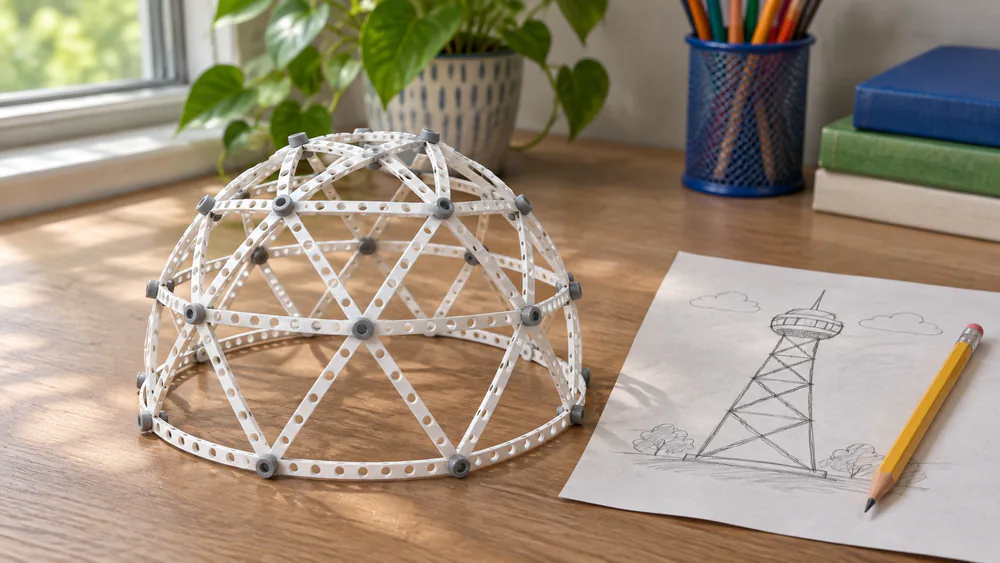
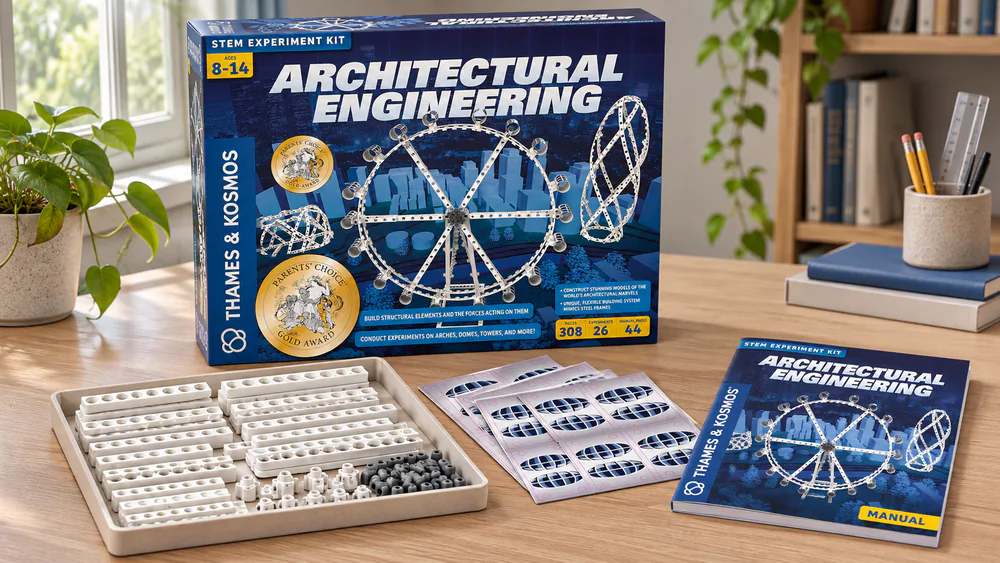
Thames & Kosmos Architectural Engineering moves from trusses and domes to models of the Eiffel Tower and Sydney Opera House. The art is architectural form, and the 44-page manual prompts kids to design their own tallest tower. An 11-year-old can build a truss bridge, an arch and a geodesic dome in a weekend. In our home, we took each model apart before building the next because the kit has enough parts for one structure at a time. The pieces stayed sturdy through repeated builds. It won a Parents' Choice Gold Award in 2019.
- Ages: 8+ on the box; listings vary, and big models suit older kids
- Models: 20-plus from about 300 pieces
- Power: none
- Value: Premium
Best For
Kids who sketch buildings and enjoy slow, careful work.
Skip It If
Your child wants lights and motors; it can feel slow without them. Stock also comes and goes.
10. Thames & Kosmos Kids First Robot Engineer: Best STEAM Kit for Preschoolers
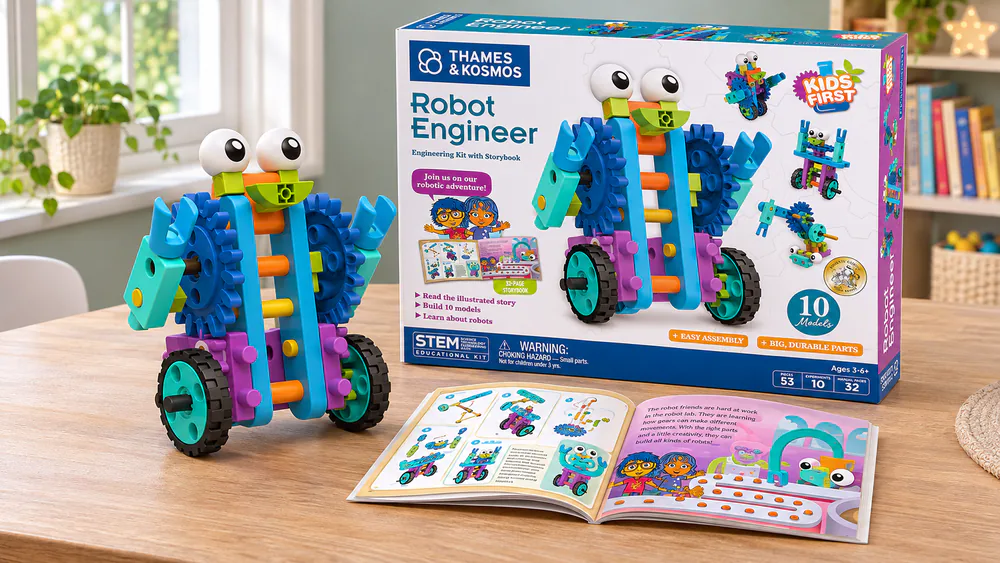
Thames & Kosmos Kids First Robot Engineer uses 53 chunky pieces and an illustrated storybook about a trip to a candy factory. A 4-year-old who cannot read yet can follow its pictures. Each robot really moves through gears and wheels with no motor, and our preschoolers raced them across the table. Check the parts list on day one, since a box occasionally arrives short a piece. It won a Parents' Choice Gold Award in 2016.
- Ages: 3-7
- Builds: 10 robots
- Power: none
- Value: Mid-priced
Best For
Kids ages 3 to 5 who love stories.
Skip It If
Your child is past early elementary. Stock also comes and goes.
How to Choose a STEAM Kit
Match the Kit to Your Child's Age and Reading Level
Age and reading level are the first things to consider when choosing among these ten kits. Box ages usually assume a child who reads the manual alone, so a strong reader can start early and a slower reader needs a parent longer. Picture-led manuals, like the Kids First storybook, work for non-readers.
Pick a Focus: Build, Code, Experiment or Create
Builders like LEGO Gadgets, coders want the mBot, experimenters love the geodes, and creators choose crystals or the Doodling Robot. For a mechanical build, the Smartivity Hydraulic Planes and Darts Launcher (ages 6 to 14) is a good alternative.
Parent tipWatch free play. A fort builder wants a structure kit, and a kid who stages shows wants the magic kit.
Check Mess, Setup Time and Adult Help
Chemistry and crystal kits need a covered table and a grown-up nearby, and geodes need goggles, a hammer and a hard outdoor surface. Under federal small-parts rules for toys, kits with small parts carry a choking warning.
Watch outMost of these kits contain small parts, so keep them away from toddlers.
Look for Replay Value and Expansion Sets
A kit with a growth path lasts longer in a busy house. Snap Circuits and the mBot take expansion sets, and LEGO Gadgets parts join a brick bin. One-time kits like the geodes are still worth it for the shared experience.
Quick Picks by Age
- Ages 3 to 5: Kids First Robot Engineer, or Magna-Tiles 32-Piece Magnetic Construction Set.
- Ages 6 to 7: LEGO Gadgets, the magic kit or the simpler Snap Circuits builds, each with an adult beside them.
- Ages 8 to 10: Snap Circuits, Gravity Maze, the geodes or the mBot (younger with a parent on the app).
- Ages 10 and up: crystals or Architectural Engineering.
STEAM vs. STEM: What the "A" Adds
STEM covers science, technology, engineering and math. STEAM adds the arts.
In practice, the "A" means design choices: styling a crystal display, placing a motor to shape a drawing, or making a tower look right. Kids keep what they make, which gives a kit a second life.
For circuits and code alone, see our best STEM kits for kids. For projects with supplies at home, try these STEM art projects for kids.
STEAM Kit FAQs
What age should kids start using STEAM kits?
Watch two readiness signals more than the box age: whether your child can follow a manual alone, and whether a grown-up will sit beside them. With an adult nearby, five- and six-year-olds handle simpler circuit builds and magic tricks, and a 4-year-old can follow photo steps. Quick Picks by Age above sorts the kits by band.
Are STEAM kits actually educational or just marketing?
The good ones teach a concept your child can watch working, like a circuit lighting a lamp or a gear train moving a robot. Look for a manual that explains why something happens, not just how to build it.
Are expensive STEAM kits better than cheaper ones?
Not always. Budget kits like Gravity Maze and LEGO Gadgets offer plenty of replay, while a Splurge kit like the mBot earns its tier by teaching real coding. Pay more for growth, not a bigger box.
What is the best STEAM kit for a 10-year-old?
Snap Circuits Jr. is our first choice for most 10-year-olds. Its harder projects still hold a sixth grader, so a 10-year-old has room to grow. A patient or design-minded child may prefer a 10-and-up pick.
Final Verdict
Snap Circuits Jr. SC-100 is the STEAM kit we would buy first for most families. A beginner needs little help after one session, and it keeps growing with the child.
For the art side, the crystal combo and Doodling Robot leave kids something to keep, and Architectural Engineering suits the young sketcher. Preschoolers do best with Kids First Robot Engineer, and kids ready for code should go to the mBot. Whichever you choose, match it to how your child already plays.