40 STEM Art Projects for Kids (Hands-On STEAM Activities)
Art and science belong on the same table. When kids mix colors, grow crystals, or build a wobbly paper tower, they are testing ideas, watching what happens, and problem-solving without ever calling it work. That is the whole promise of STEAM: the "A" turns a science lesson into something kids ask to do again.
We pulled together 40 hands-on STEM art projects that have earned a spot at our kitchen table, grouped by the discipline each one leans on. Some spark curiosity with a fizzy chemical reaction. Others build critical thinking through engineering challenges or quiet pattern math. Every idea here works at home or in the classroom, and most use supplies you probably already own. Our own kids keep circling back to a handful of these, and we will flag those favorites as we go.
Science Art Projects for Kids
Science is where art gets loud. These projects turn a chemical reaction or a bit of physics into color you can watch move across the page.
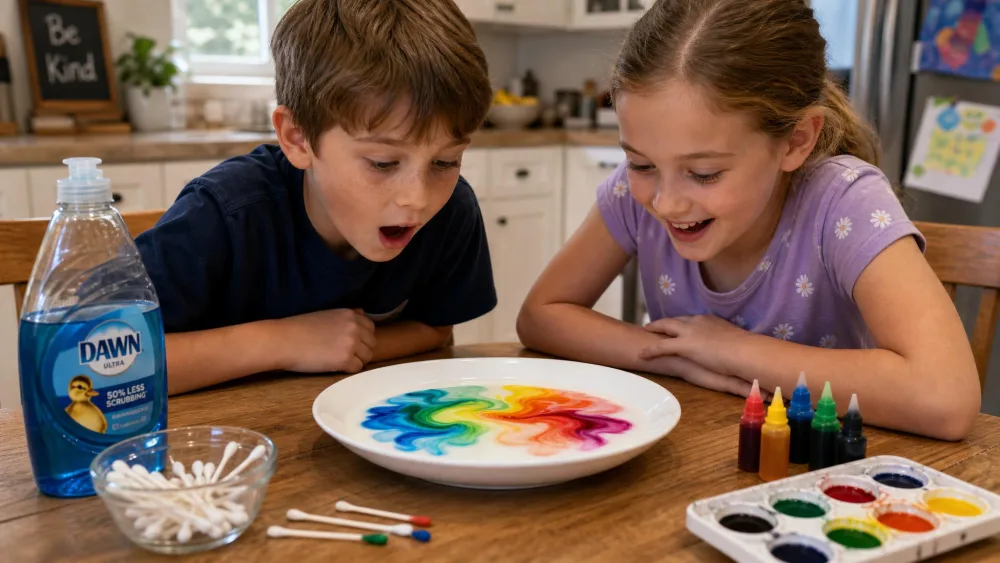
Chemistry & color-mixing projects (magic milk, fizzy art, chromatography)
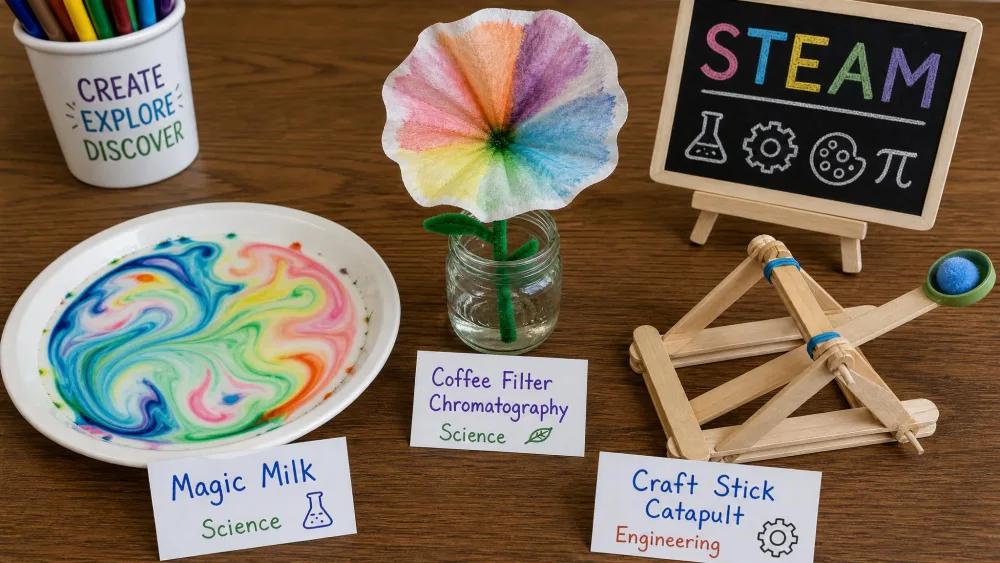
1. Magic milk. Pour a plate of whole milk, add drops of food coloring, then touch a soap-dipped swab to the surface. The colors burst and swirl on their own. The dish soap breaks the milk's surface tension, and the soap molecules chase the fat, pushing the color around. Use whole milk here. It fizzles out with skim or low-fat, because the fat molecules are what make the color burst work.
2. Marker chromatography. Draw a thick ring of washable marker near the center of a coffee filter, then let a few drops of water wick outward. Water climbs the paper by capillary action and separates the ink into its hidden component colors. It is both a water-wicking demonstration and a lesson in how pigments separate.
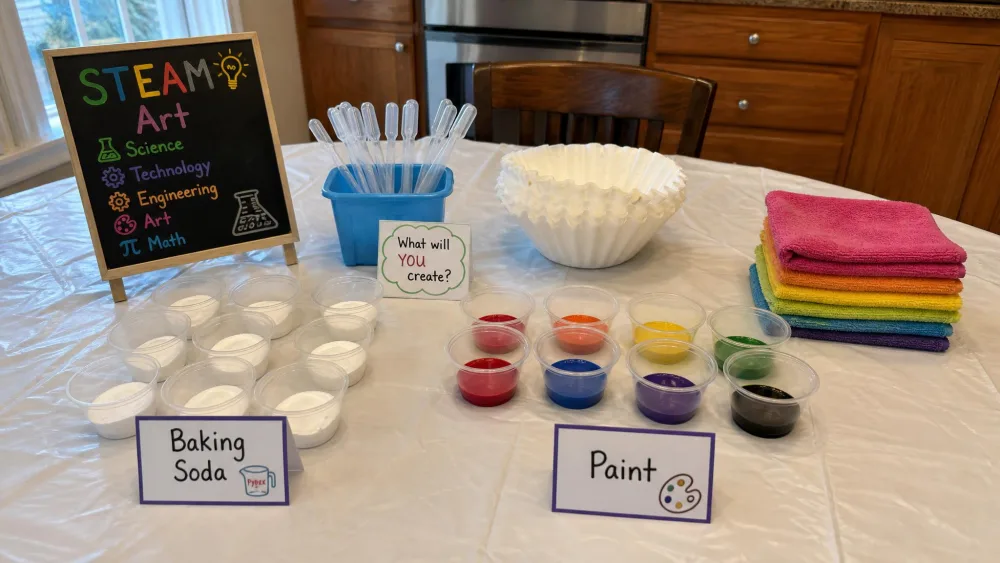
3. Baking soda and vinegar fizzy paint. Mix baking soda into colored paint, then squirt vinegar on top and watch it erupt. The base and the acid react to release carbon dioxide gas, which is the fizz. This one is genuinely messy, so take it outside with squirt bottles of vinegar and let the eruptions happen on a tray.
4. Lemon volcano art. A halved lemon becomes the reaction chamber. Poke the pulp, add baking soda and a drop of color, and the citric acid does the erupting for you. It is the same acid-base fizz with a built-in container.
5. Salt crystal painting. Draw with glue, sprinkle salt along the wet lines, then touch loaded watercolor to the salt and watch the color travel. The salt wicks the liquid along the raised lines by capillary action. This is a good one to start with. It is colorful, fast, and nearly mess-free, unlike the erupting projects. Kids love watching the paint run along the salted lines, and that visual motion is what keeps them going.
6. Borax crystals. Dissolve borax in hot water, suspend a pipe-cleaner shape, and let it sit overnight. The cooling supersaturated solution grows crystals right on the shape. The hot-water step means this is a with-a-grown-up project rather than a fully independent one.
7. Alcohol and watercolor drop painting. Paint a wet watercolor wash, then drop rubbing alcohol on top with a pipette. The color blooms outward into pale rings. It is a classic art-class favorite because the blooms are beautiful and fun to watch spread.
8. Crystallized watercolor. Mix epsom salt and table salt into watercolor, brush it on, and let it dry into a shimmering crystalline surface. Even preschoolers can manage this one, which makes it a great low-floor entry into science art.
Nature & weather-inspired art
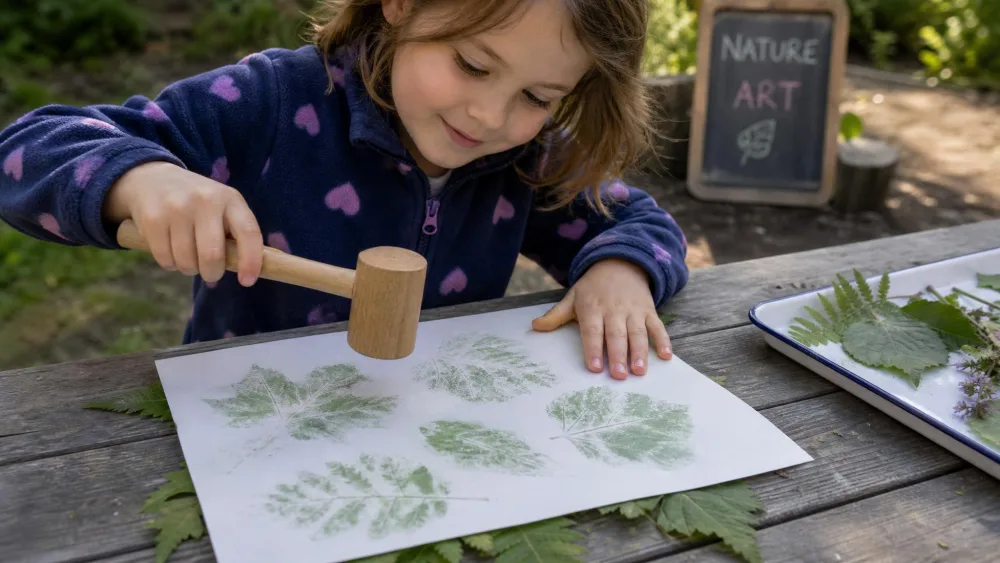
9. Leaf hammering prints. Lay fresh leaves under paper and tap them with a mallet to transfer the pigment. The prints reveal the plant's natural chlorophyll and connect straight to photosynthesis.
10. Watercolor and salt snowflakes. Paint a snowflake, sprinkle salt on the wet paint, and let the crystals bloom as it dries. The salt pulls the color into frosted patterns. This is a repeat favorite in our house that our kids ask to do over and over.
11. Chromatography flowers. Run the coffee-filter chromatography trick, then pinch and twist the dried filters into blossoms. Science becomes a bouquet.
12. Frozen paint art. Freeze watercolor into ice cubes with craft-stick handles, then paint as they melt. Kids watch solid turn to liquid while the color spreads.
13. Sun print paper. Arrange leaves and small objects on light-sensitive paper, set it in the sun, and rinse. The covered spots stay pale while the sun develops the rest.
Engineering & Building Art Projects for Kids
Engineering art asks a question with every build: will it stand, will it roll, will it fling? Kids test, watch it fail, and try again. That loop is problem-solving in its purest form.
Structures, 3D builds & simple machines
14. Paper Eiffel Tower. Roll, fold, and tape paper into a scaled tower and see how thin a base still holds it up. It is a real-world lesson in structural strength.
15. Paper sculptures. Cut slots, curl strips, and fringe edges to make flat paper stand in three dimensions. Kids learn that shape, not thickness, carries the load.
16. Craft-stick catapults. Stack craft sticks, add a rubber band and a bottle-cap cup, and launch pom-poms across the room. Move the fulcrum and the distance changes, which is levers in action.
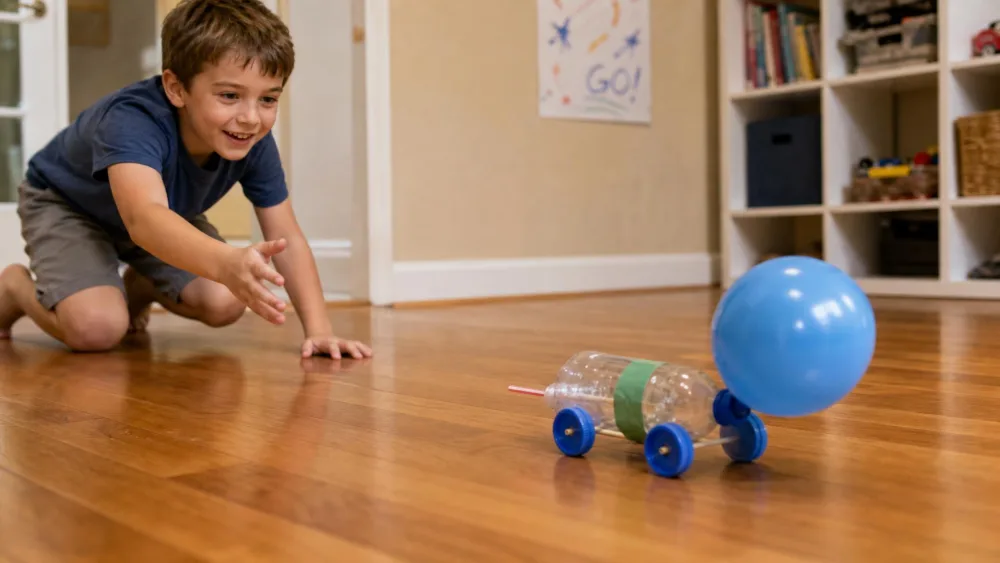
17. Balloon cars. Tape a balloon to a bottle-cap-wheeled chassis and let escaping air push it forward. It is Newton's third law rolling across the floor.
18. Simple machine art. Build a working lever, pulley, or ramp, then decorate it. Function and art share one project.
19. Straw-and-tape towers. Challenge kids to build the tallest freestanding tower from straws and tape. Triangles win, and they discover that on their own.
Magnetism, light & physics art
20. Magnet painting. Drop a paperclip in paint, set it on paper, and drag it with a magnet underneath. The unseen force draws the line.
21. Salad-spinner spin art. Clip paper inside a salad spinner, squeeze in paint, and crank. Centrifugal motion flings the color into starbursts.
22. Bicycle-wheel spin art. For a bigger, faster effect, tape paper to a kid's bicycle wheel and spin it. It scales up the salad-spinner idea into something dramatic.
23. Water-drop painting. Use a pipette to place fat water drops on waxy paper and watch surface tension hold each dome. Drop color in and the beads glow.
24. Glow-in-the-dark jellyfish. Paint with glow pigment and turn off the lights to reveal the shapes. It is a gentle way into light and bioluminescence.
25. Paintball water balloons. Fill balloons with watery paint and throw them at a canvas outdoors. They are reusable, high-energy, and get requested again and again. Save this for old clothes and the backyard.
Technology Art Projects for Kids
Technology art proves that circuits and code are creative tools. These projects introduce how machines and logic work without a single screen requirement.
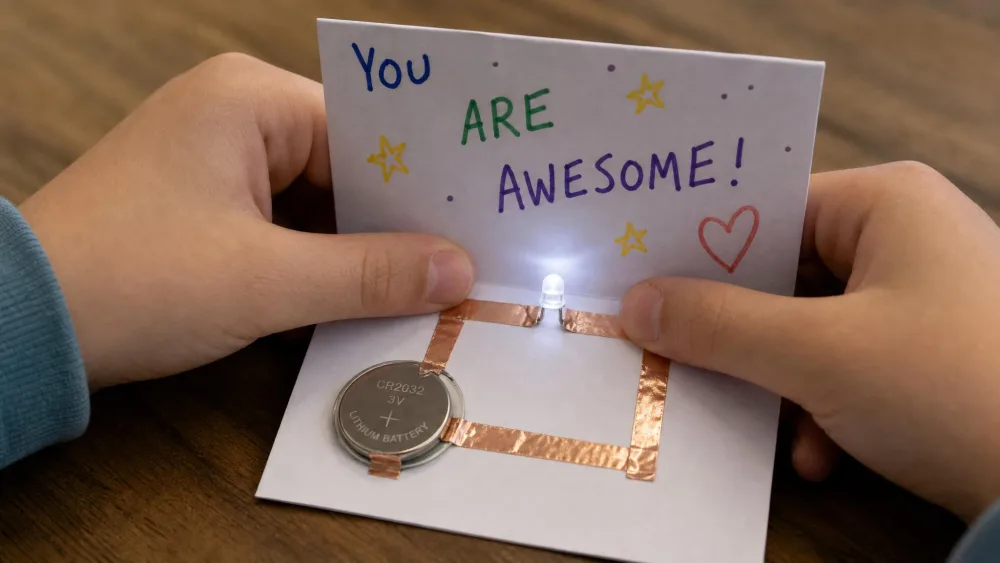
26. Paper circuit light-up cards. Use copper tape, a small LED, and a coin-cell battery to close a simple circuit inside a folded card. When the light glows, kids see a complete loop for the first time. Keep the parts general and let the glowing bulb do the teaching.
27. Art bots. Attach markers to a cup, add a small motor with an off-center weight, and let the wobble scribble. A motorized drawing robot makes its own art.
28. Color spinners. Color a paper disk in wedges, spin it fast, and the separate colors blend optically toward near-white. It is a live demonstration of how light mixes in the eye.
29. Pixel-grid coding art. Give kids a grid and a color key, then have them "decode" a picture square by square. It is unplugged coding that ends in a poster.
Math Art Projects for Kids
Math is the quiet discipline of STEAM, hiding inside every pattern, tiling, and symmetrical wing. These projects let kids feel the math before they name it.
Pattern, symmetry & geometry art
30. Tessellations. Cut one shape that repeats with no gaps and trace it across a page. Kids discover which shapes tile and which leave holes.
31. Tangrams. Rearrange seven flat shapes into animals, houses, and letters. It is geometry as a puzzle with endless answers.
32. Fibonacci-sequence art. Draw squares that grow 1, 1, 2, 3, 5, then sweep a spiral through them. The same pattern shows up in shells and sunflowers.
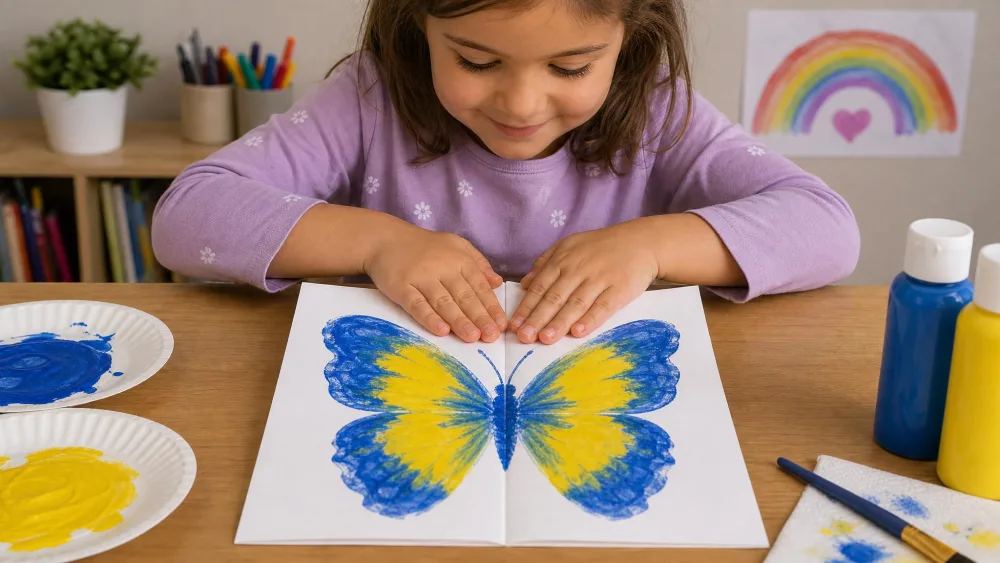
33. Symmetry paintings. Fold paper, paint one half, and press to mirror it into a butterfly. The fold line teaches reflection without a worksheet.
34. Geometry string art. Hammer nails into a grid and wrap string between points to reveal curves made of straight lines. Angles become a picture.
STEM Art Projects by Age
Not every project fits every age. Here is where to start based on who is holding the brush. As a rule, hands-on STEM art works from ages 2 and up and keeps scaling through elementary.
Preschool & toddler STEAM art
35. Crystallized watercolor. The salt-and-watercolor project from earlier is a preschool winner because the steps are few and the payoff is instant.
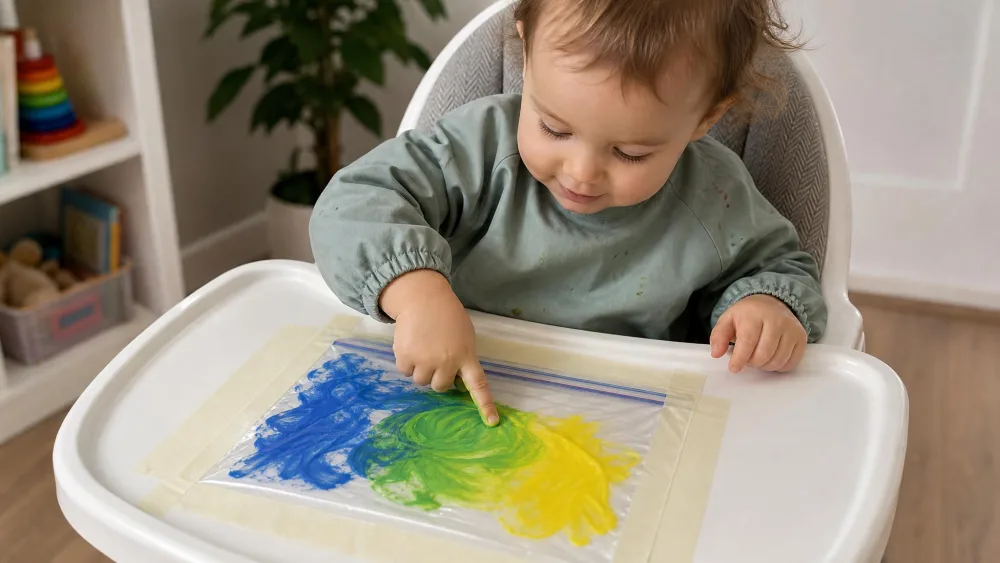
36. Squish paint bags. Seal paint inside a zip bag, tape it down, and let toddlers push the color around with no mess at all. It is color-mixing they can touch safely.
37. Sponge-stamp shapes. Cut sponges into circles, triangles, and squares for stamping. Little hands build patterns while naming shapes.
Elementary STEAM art
38. Chromatography bookmarks. Older kids can run the ink-separation experiment and trim the results into keepsakes, then explain why the colors split.
39. DIY kaleidoscope. Build a tube with mirrored angles and study how reflection multiplies a few beads into a pattern. It rewards precise measuring.
40. Constellation string art. Map a real constellation onto black paper, punch the stars, and thread glowing string between them. It blends astronomy, geometry, and craft in one sitting.
What Are STEM Art Projects? (Why STEAM Works)
STEM art projects are hands-on activities that pair a science, technology, engineering, or math concept with a creative, art-based result. STEAM = science, technology, engineering, art, and math, which is simply STEM with Art folded in. That added "A" is not decoration. It gives kids a reason to care about the concept, a way to make it visible, and a finished thing they are proud to show.
The pairing works because art lowers the stakes. A kid who freezes at a math worksheet will happily fold a symmetrical butterfly and, in doing so, absorb reflection and pattern. A child who thinks they dislike chemistry will beg to erupt fizzy paint one more time. When the science produces something beautiful, curiosity does the teaching. Groups like the National Science Teaching Association have long championed exactly this kind of integrated, hands-on learning, and it is easy to see why once you watch it happen at your own table.
Tips for Setting Up STEM Art at Home or in the Classroom
A little prep turns a chaotic afternoon into a smooth one. You do not need a dedicated craft room, just a wipeable surface and a plan for the mess.
Parent tipSort your projects by mess level before you start. Keep the low-mess wins like salt painting and crystallized watercolor for weekday tables, and save the fizzy paint and paintball balloons for the backyard on a warm day. Knowing which is which saves the cleanup dread that makes parents skip science art altogether.
Cover your surface with a plastic tablecloth or an old sheet, and dress kids in clothes you do not mind staining. Gather everything before you call the kids over, because the reaction projects wait for no one. For the classroom, set up stations so small groups rotate through, and pre-measure supplies into cups to keep the pace steady. Most of all, let the first attempt fail. The retry is where the real problem-solving lives, and it is where kids stop performing and start experimenting.
For the messiest chemistry, keep a bucket of soapy water and a stack of rags within arm's reach. For anything with hot water, like borax crystals, an adult runs that step start to finish. And when a project flops, name it out loud as data rather than failure. That framing is the difference between a kid who quits and a kid who adjusts the variable and goes again.
More STEM & Art Activities to Try
Once these 40 have made their rounds, there is a whole shelf of related ideas to pull from. If your kids gravitate toward the reaction projects, lean into more science art projects for kids and let them keep testing acids and bases. Nature lovers can move outdoors with nature art projects for kids, collecting leaves and blooms to print and press.
For families watching the supply budget, recycled art projects for kids turn bottle caps and cardboard into engineering builds. When you need a fast rainy-day win, our easy art projects for kids and simple art projects for kids collections keep the prep light. And for the afternoons when time is short, quick art projects for kids deliver a finished piece before dinner.
Frequently Asked Questions
What are STEM and STEAM art projects?
They are hands-on activities that connect a science, technology, engineering, or math concept to a creative, art-based result. STEAM is STEM plus Art, so a project like magic milk teaches surface tension while producing a swirl of color kids want to make again.
What age group are STEM art projects best for?
Hands-on STEM art suits kids from ages 2 and up and scales all the way into elementary. Toddlers do best with mess-free options like squish paint bags and sponge stamping, while elementary kids can handle multi-step projects like chromatography, string art, and paper circuits.
Why is art important in STEM, and what does the "A" in STEAM add?
The art gives kids a reason to engage and a way to make an abstract idea visible. A reflection lesson becomes a symmetrical butterfly, and a chemical reaction becomes fizzy paint. That creative payoff drives the curiosity that makes the science stick.
What materials do I need to get started?
Most projects here use pantry and craft-drawer staples: whole milk, food coloring, dish soap, baking soda, vinegar, salt, watercolors, glue, coffee filters, paper, and tape. A few reach for extras like borax, copper tape, LEDs, or a small motor, and those are worth buying only once your kids are hooked.
What are some easy STEM art projects for beginners?
Start with salt crystal painting or crystallized watercolor. Both are colorful, fast, and nearly mess-free, so they build confidence before you attempt the erupting chemistry projects. Magic milk is another gentle first win as long as you use whole milk.
How can I use these projects at home or in the classroom?
At home, sort projects by mess level and keep the fizzy ones for outdoors. In the classroom, set up rotating stations with pre-measured supplies so small groups move through at a steady pace. Either way, let the first attempt fail and treat the retry as the real lesson.