8 Best Rocket Kits for Kids in 2026
A rocket kit for kids can be anything from a foam stomp rocket a kindergartner launches with one jump to an Estes model rocket that a 10-year-old builds, loads with a solid-fuel engine and flies past 1,000 feet. In our home, the Estes engine rockets sent us looking for at least a baseball diamond or half a soccer field of open ground, because they go higher than any backyard allows. That gap is why age and launch space matter so much when you choose.
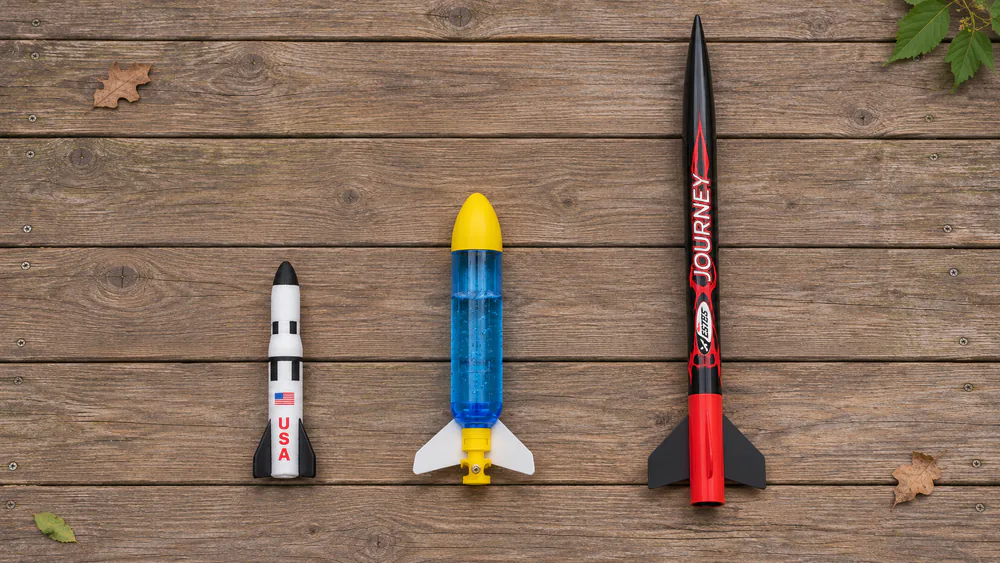
The part that trips families up is the fine print. Estes engine rockets need engines, igniters, recovery wadding and AA batteries, and all of those are sold separately.
Our eight picks range from stomp, air and water rockets for younger kids to build-it-yourself Estes kits for tweens and teens. For each kit, we explain what else you need on launch day.
Our Top Picks at a Glance
Heights below are the maker's top figure on the strongest engine or setting.
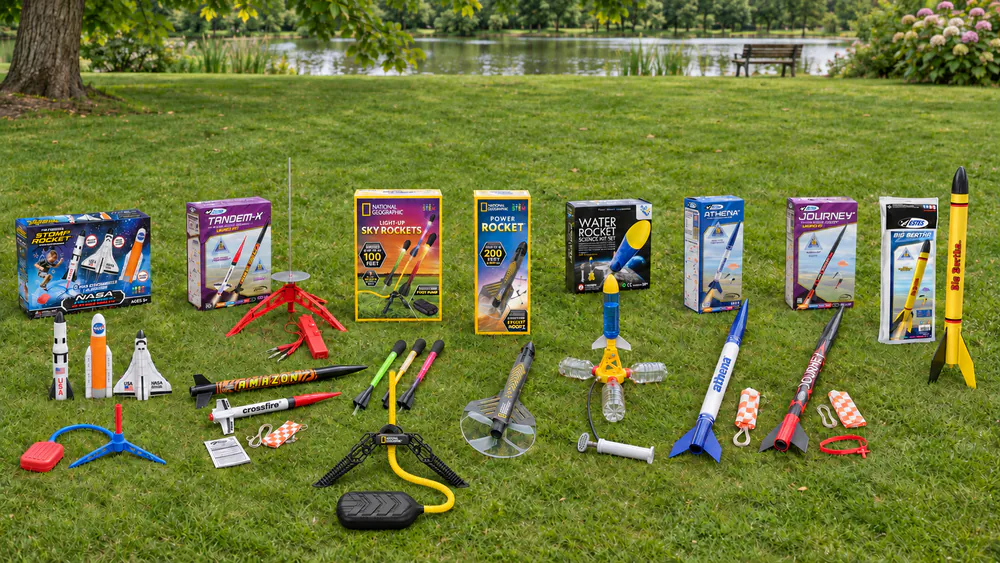
| Kit | Best for | Ages | Power type | Max altitude | Build required | Extras needed |
|---|---|---|---|---|---|---|
| Estes Tandem X Launch Set | Overall, siblings sharing | 10+ | Solid-fuel engine | 600 ft / 1,150 ft | Assembly (two rockets) | Engines, igniters, wadding, 4 AA |
| Stomp Rocket NASA Collection | Little kids, park trips | 5+ | Stomp/air | About 100 ft | None | None |
| National Geographic Air Rocket LED | Early grades, dusk play | 8-12 (younger with help) | Stomp/air | 100 ft | Minimal setup | None |
| National Geographic Motorized Rocket Launcher | No-flame launches | 8-12 | Motorized air (propeller) | 200 ft | Minimal setup (decals) | None (USB charging) |
| PLAYSTEM Water Rocket | Water-pressure science | 8+ | Water and air pressure | Around 100 ft | Light assembly | Water, 3 ballast bottles |
| Estes Athena Ready-to-Fly | Budget first engine rocket | 10+ | Solid-fuel engine | 1,125 ft | Ready-to-fly (15 minutes) | Engines, igniters, wadding, pad and controller, 4 AA |
| Estes Journey Launch Set | First build-it-yourself | 10+ | Solid-fuel engine | 1,100 ft | Assembly (1 hour) | Engines, igniters, wadding, 4 AA |
| Estes Big Bertha | Advanced build, tweens and teens | 10+ | Solid-fuel engine | 500 ft | Assembly plus drying and paint | Engines, igniters, wadding, pad and controller, 4 AA, glue, paint |
1. Estes Tandem X Launch Set – Best Overall Rocket Kit
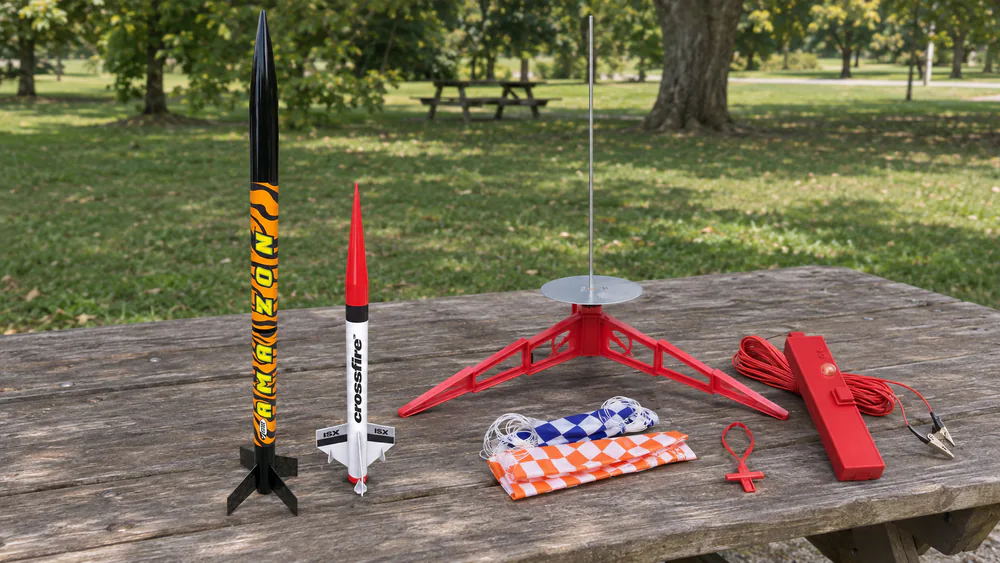
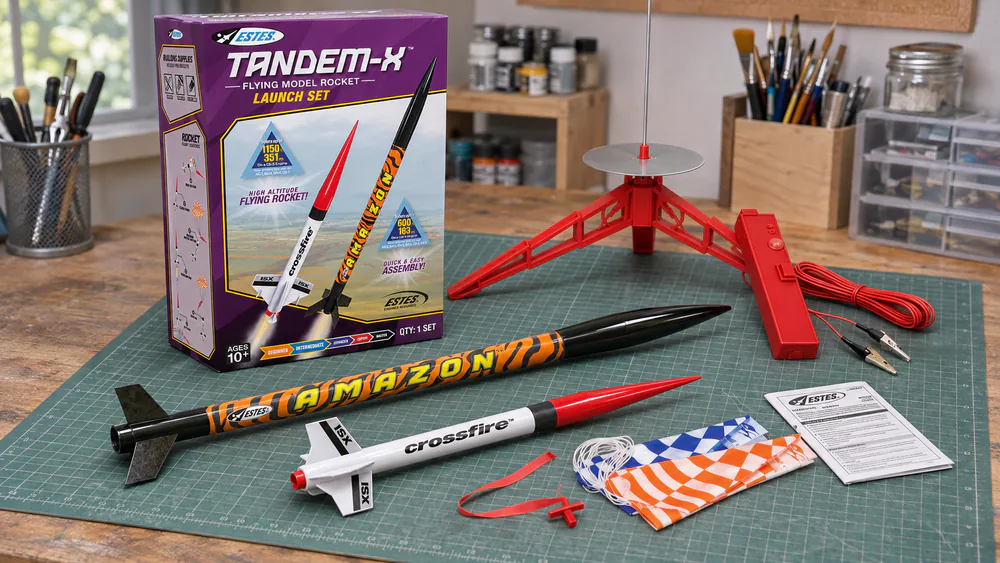
The Estes Tandem X Launch Set gives you two real model rockets and a complete launch system in one box. The larger rocket stands 30 inches tall, with precolored plastic fins and self-stick graphics. The second rocket, the Crossfire ISX, is a slimmer 15.6-inch build with laser-cut wood fins.
We watched a 10-year-old put the plastic-finned 30-inch rocket together in about 45 minutes to an hour, with most of that time spent carefully lining up the decals. That made it the right first build of the pair. The Crossfire ISX was a different job, because its wood fins need white glue and careful alignment, so it suits the older or more patient sibling. On launch day, one child prepped a rocket while the other launched, which kept things moving without turn-taking fights.
The 30-inch rocket has a projected altitude of 600 feet on a C6-5 engine. The Crossfire ISX has a projected altitude of 1,150 feet on a C6-7 engine.
Who It's Best For
The Tandem X is rated for ages 10 and up, with adult supervision recommended under 12. It fits a family with two kids close in age, or one child who is ready to grow into a second, harder rocket.
On a C6-7, the Crossfire ISX drifts several hundred feet downwind, and the walk to recover it can stretch to a quarter mile. A8-3 engines make calmer first flights and shorter walks.
What Else You'll Need to Launch
The box includes two rockets, two parachutes, the Porta-Pad II launch pad and the Electron Beam launch controller with a safety key. The pad itself holds up well.
Engines, starters (igniters), recovery wadding and 4 AA alkaline batteries for the controller are sold separately. The 30-inch rocket takes B4-2, B4-4, B6-2, B6-4, C5-3, C6-3 and C6-5 engines. The Crossfire ISX takes A8-3, B4-4, B6-4, C6-5 and C6-7 engines.
Pros
- Two rockets with very different flight heights
- Complete pad and controller included
- Plastic-finned rocket is a quick first build
- Reusable nose cones and body tubes
Cons
- Controller can arrive dead or quit after heavy use
- Engines, igniters, wadding and batteries cost extra
- Launch rod seam can snag the launch lug, so smooth it before the first flight
2. Stomp Rocket NASA Collection – Best for Little Kids, Ages 5 and Up
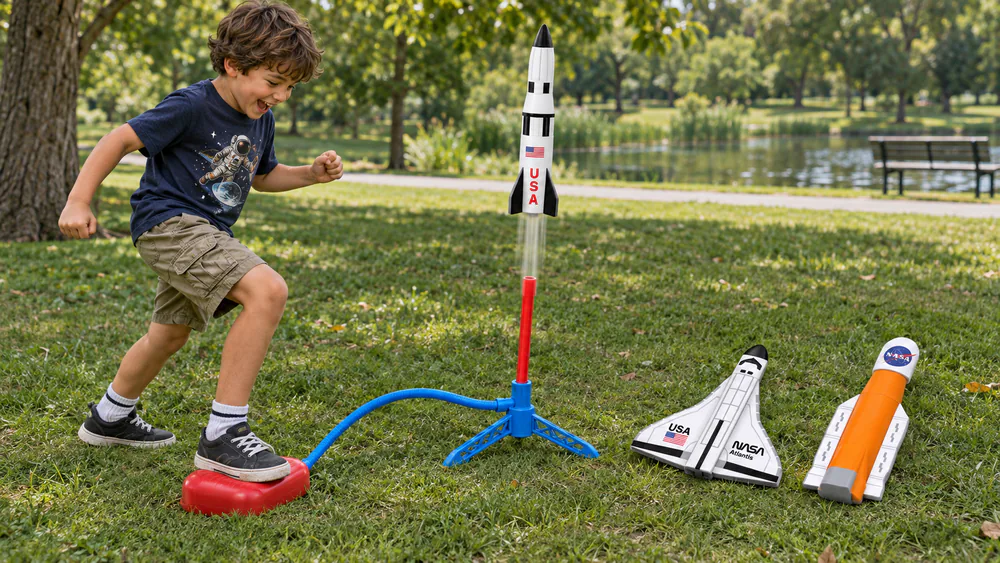
Where the Tandem X asks for engines and a big field, the Stomp Rocket NASA Collection asks for one jump. We tried it at the park, and having three different NASA rockets turned the outing into a contest over which one flew highest. It set up and packed away in a couple of minutes. When a foam rocket came down on a head, the soft foam didn't hurt.
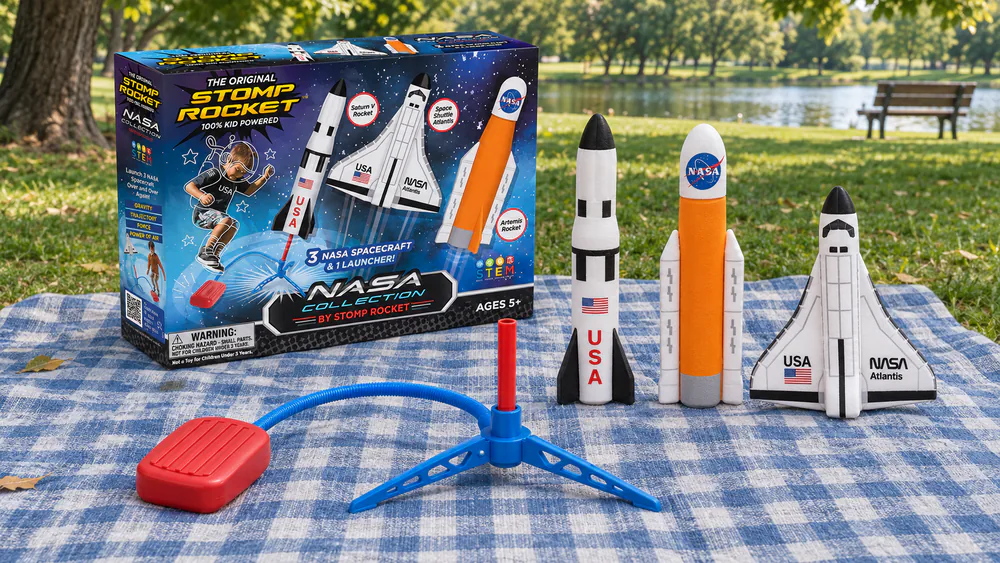
The set comes with 3 foam NASA rockets (the SLS, the Space Shuttle Atlantis and the Saturn V) plus an adjustable launch stand. A stomp on the air pad sends a jet of air up the hose and into the launch tube, and the rocket flies up to about 100 feet. That height depends entirely on the stomper's weight and force, so small children get well under the top figure while a parent's stomp sends it much higher.
The set launched in February 2024, first through Target and specialty toy shops. Look for model number 40020 so you get the NASA set rather than a plainer Stomp Rocket line.
Who It's Best For
The NASA Collection is recommended for ages 5 and up. A 3- or 4-year-old can still stomp with help, and the hands-on part is simple enough for a preschooler to understand right away.
It also works for a mixed-age family, and a child who loves space vehicles gets real rocket names that a plain foam rocket lacks.
Durability and Replacement Rockets
The launch base is the sturdy part, which matters with little kids who jump with their whole body. The rockets are the part that wears. After about a week of daily use by young kids, the foam on a rocket starts to wear, so it pays to keep the three rockets off the floor between sessions.
Pros
- No batteries and no assembly
- Three recognizable NASA rocket shapes
- Launch base shrugs off hard stomps
- Travels easily to a park or beach
Cons
- NASA rockets aren't sold as refills the way basic Stomp rockets are
- Little stompers get well under the top height
- Rockets land on roofs and in trees if you launch near them
3. National Geographic Air Rocket LED – Best Air-Powered Rocket for Early Grades
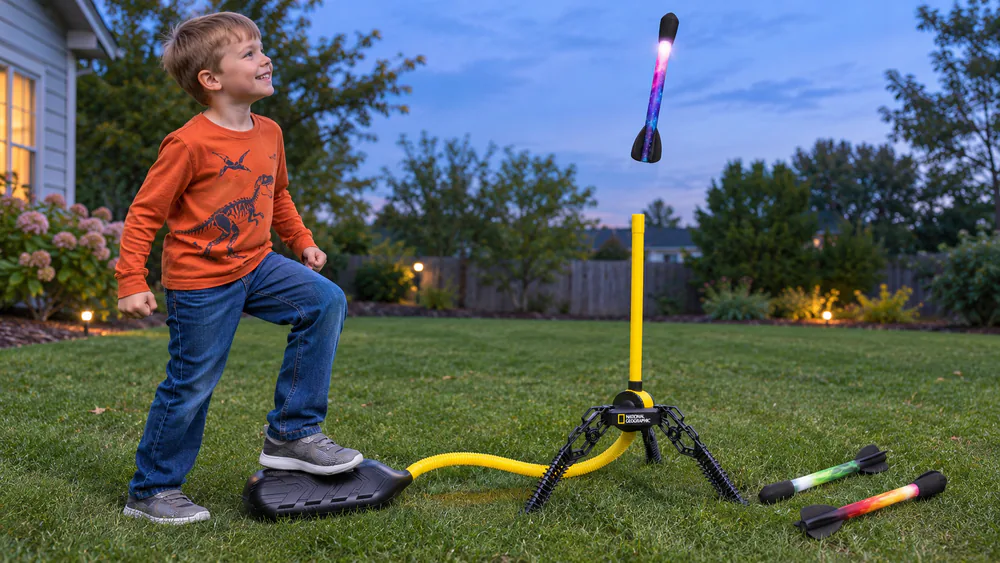
The National Geographic Air Rocket LED keeps the jump-to-launch idea of the NASA set and adds lights. We watched a six-year-old new to rockets open the National Geographic Air Rocket LED and launch on her own within about five minutes. When she hit the pump hard, the rocket whistled on the way up. We kept launching into dusk, when the glowing rockets were easy to spot and collect. One landed on the roof, so we now keep a ladder or a long pole handy.
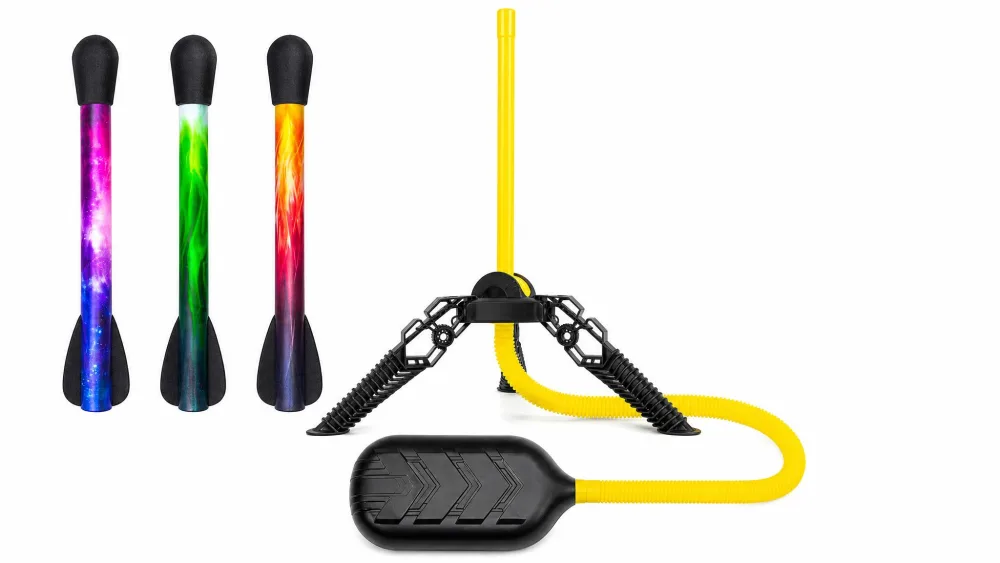
Kids jump on an extra-large foot pump, and the foam-tipped rockets fly up to 100 feet. No batteries are needed for launching. The set includes the foot pump, an adjustable-angle launch tube, a set of foam-tipped rockets with switchable LED lights, and a learning guide with flight experiments on motion and aerodynamics. Blue Marble makes it under the National Geographic name.
Who It's Best For
The printed age band is 8-12, yet younger children use it easily with a grown-up nearby, so the right age is a judgment call. Preschoolers around 4 to 5 love jumping on the pump, and when a bigger kid or an adult jumps, the rockets go noticeably higher. In practice it shines for the early grades, roughly 6 to 8, where a child can run every launch alone.
Durability is uneven from set to set, and the cons below list the weak points. Replacement foam rockets are sold separately by the maker.
Indoor vs Outdoor Use
At up to 100 feet, the Air Rocket LED is an outdoor launcher for a yard, park or field, not a living room. Outdoors, tilting the launch tube to about 45 degrees sends rockets farther across the yard, while straight up gives the most height.
Pros
- Lights make dusk launches easy to follow
- No batteries needed to launch
- Adjustable tube angle invites experiments
- Learning guide includes flight experiments
Cons
- Foam fins can tear off, and they compress after around fifty hard stomps
- Pump tube can crack, and the stand's legs can snap under rough handling
- An occasional rocket's LED flickers or never lights
4. National Geographic Motorized Rocket Launcher – Best Motorized Launcher for Ages 8 to 12
If the foot pump feels too gentle, the National Geographic Motorized Rocket Launcher doubles the Air Rocket LED's 100 feet with a rechargeable propeller and no flame. We watched the helicopter-style rotor blades spin it down like a maple seed, and landings stayed gentle even on gravel. One charge covered about twenty launches, which was enough for a full afternoon of turns. In a mild breeze, though, the light body drifted and even tipped over at launch, so it wants near-calm air.
It flies up to 200 feet on its highest setting, and kids choose from 3 flight settings with a push button. The low setting reaches about 50 feet, which suits a backyard. The middle setting is around 100 feet, and the top setting needs a field.
The box includes the motorized rocket, a launch pad, a charging cable, decals and LED lights for dusk flights. Glowing rockets at dusk turn an evening launch into a neighborhood event.
Who It's Best For
The Motorized Launcher is rated for ages 8-12. It's a good fit for a child who wants more height than a foam stomp rocket but isn't ready for solid-fuel engines, or for a family that would rather skip flame entirely. A child headed for real model rocketry will want an Estes kit next.
Batteries and Supervision
The rocket runs on a built-in rechargeable battery, so there are no AAs to buy. It recharges over USB in roughly 40 minutes to an hour, though recharge time varies with the charger and how drained the battery is.
Supervision is simpler than with an engine rocket because there's no flame, but an adult should still choose the spot and the setting.
For a similar launcher with a parachute, try the Rceico 200 ft Rocket Launcher. One button press sends it to about 100 feet, and two presses send it to about 200 feet. A 3-second delay after pressing launch gives the child time to step back, and a five- or six-year-old can run it solo. Its battery gives roughly 25 launches per charge, depending on which height mode you use. The parachute strings come loose and tangle, though, and wind can carry it 80 yards or more into trees or the neighbor's yard.
Pros
- No flame, igniters or engines to buy
- Three height settings fit yard or field
- LED lights for dusk flights
- USB charging, with no batteries to replace
Cons
- Fins and body panels must be fully seated, or it spins out and crashes
- Flight heights vary, and the foam deforms after many launches
- Teaches nothing about building or engines
5. PLAYSTEM Water Rocket – Best Water-Powered Science Kit
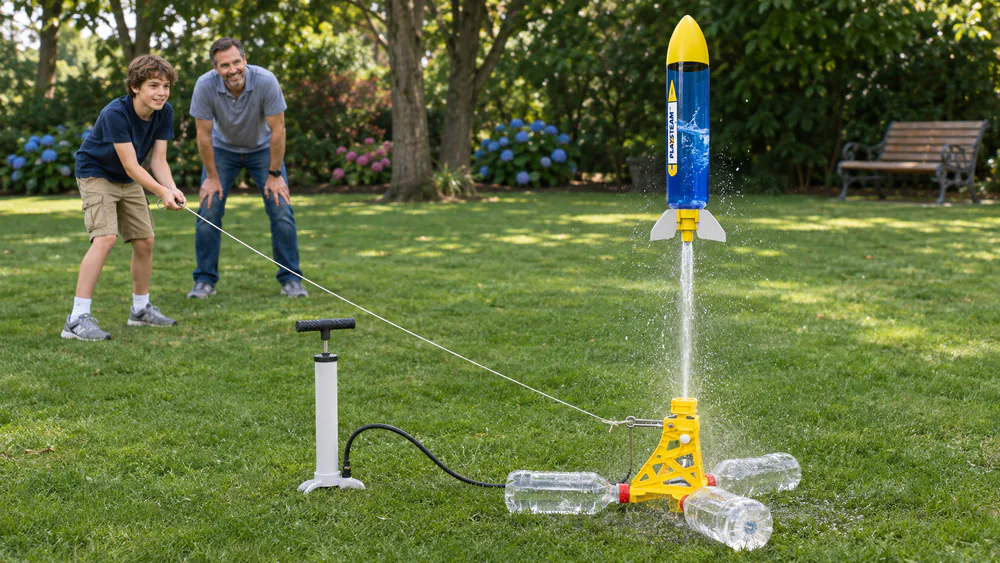
The Motorized Launcher needs a charger, while the PLAYSTEM Water Rocket needs only water, air and a pump. Before our first launch, we weighted the light launch pad down with three bottles of water, because it won't stay put otherwise. At liftoff everyone nearby got sprayed, which is why we launch over grass rather than a slick patio. Our kids liked controlling the pressure themselves, and on a hot afternoon we saw noticeably higher flights than on a cool morning.
You fill the rocket about halfway with water, pump it up and release it with a pull cord. On a good pump it flies around 100 feet, though height swings with water volume, pump pressure and air temperature, so there's no single fixed figure.
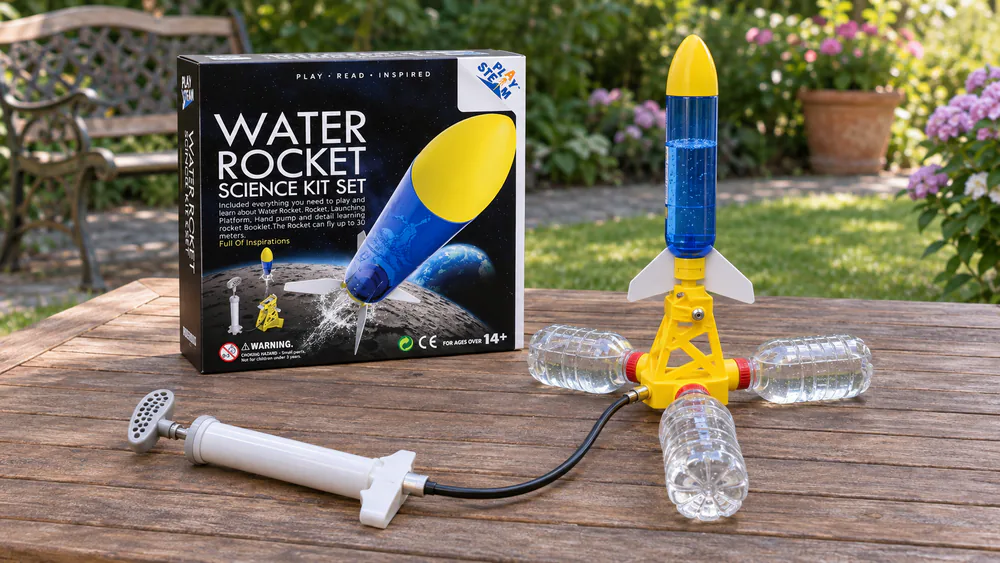
The set includes a rocket body, tail fins, a hand pump, a launch pad, a pull-cord release, a safety valve against over-pressure and a science learning booklet.
Who It's Best For
The PLAYSTEM Water Rocket is rated for ages 8 and up. It fits a child who likes to tinker and ask why, because every launch changes when you change the water or the pump count.
It's also a natural summer pick, since nobody minds the spray when it's warm out. Most of its weak spots come down to seals and the trigger, and the cons below list them.
What Kids Learn From It
The water rocket turns a basic physics idea into something kids can see. Air pumped into the bottle pushes on the water, and when the release opens, the water rushes out one way while the rocket shoots the other way.
The best lessons come from changing one thing at a time. Flight heights vary widely, from impressive to a few feet, depending on water level and how well the seal holds, so a notebook of results quickly shows what works.
A child can test a quarter, half and three-quarters full, count pumps, and compare a hot afternoon against a cool morning. The booklet gives them a starting point, and launching over a pool or toward a hula hoop target turns the experiment into a game.
Pros
- No batteries, engines or flame
- Easy to run real experiments
- Works with a recycled 2-liter bottle
- Includes a safety valve against over-pressure
Cons
- Air line can pop out, and the loose O-ring bleeds pressure
- Nose cone is flimsy
- Yanking the pull cord too hard can break the trigger lever
6. Estes Athena Ready-to-Fly – Best Budget First Model Rocket
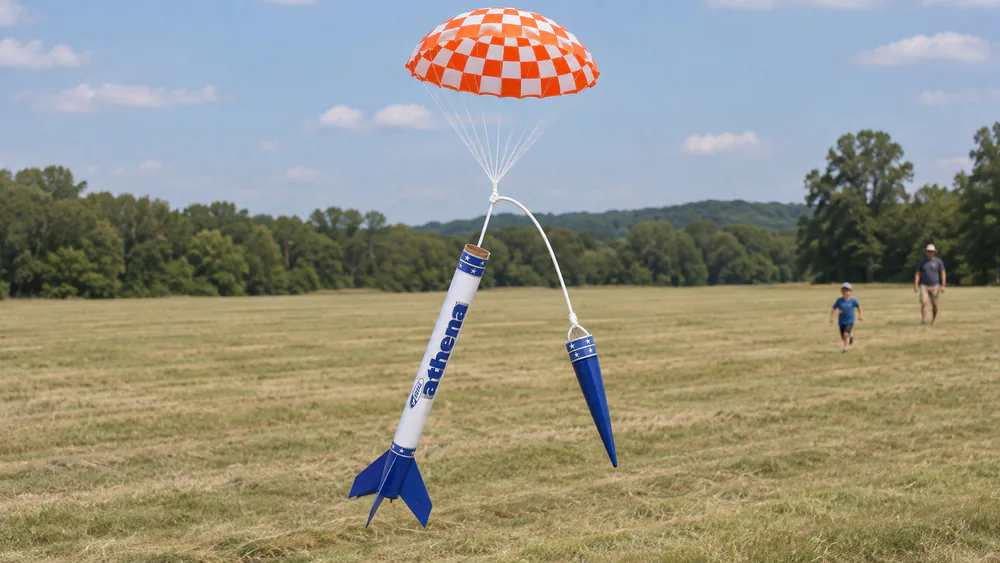
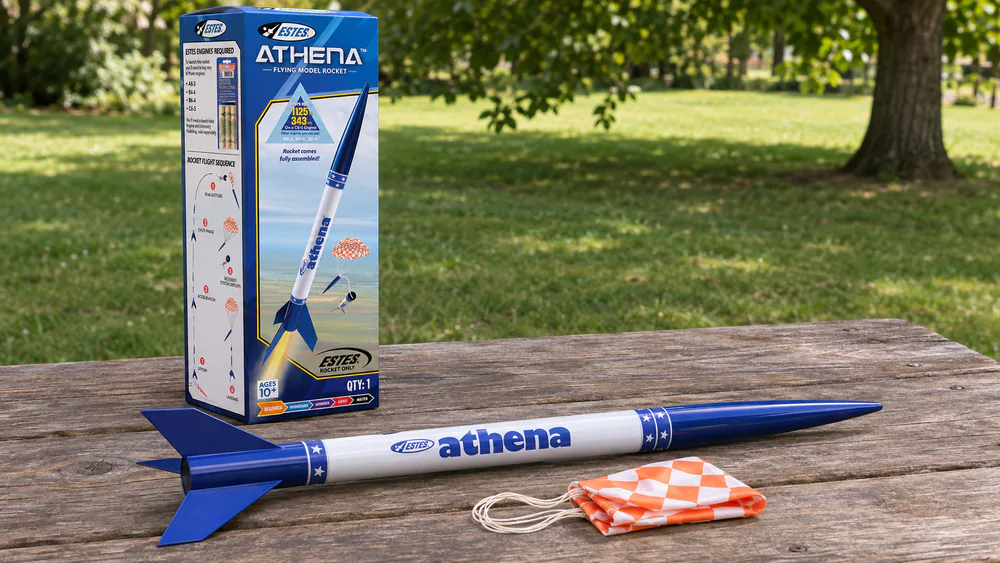
After four launchers that skip engines entirely, the Estes Athena Ready-to-Fly is the quickest way into real engine rocketry. Estes calls it about 15 minutes of preparation. When we tried it, the rocket went from box to launch pad in under 20 minutes, because the only real assembly was tying the parachute to the nose cone. It took off quickly and flew straight, and a bright 12-inch parachute brought it down for a safe landing. It held up to a half-dozen or more flights with only light scuffing.
The Athena has a projected altitude of 1,125 feet (343 m) on a C6-7 engine.
Who It's Best For
The Athena is rated for ages 10 and up, with adult supervision recommended under 12. It suits a child who is excited to launch but doesn't have the patience for a glue-and-dry build yet.
It's also a good second rocket if you already own a pad and controller from a Tandem X or Journey set.
On a C6-7, the Athena climbs so high that it's easy to lose. A8-3 or B6-4 engines keep recovery walks short. It takes A8-3, B4-4, B6-4, C6-5 and C6-7 engines.
What Else You'll Need to Launch
The Athena needs engines, starters, recovery wadding, a launch pad and controller (the Porta-Pad II and Electron Beam), and 4 AA alkaline batteries, all sold separately. The classic first-time mistake is ordering the Athena without a launch pad and controller.
Durability is not uniform from rocket to rocket, and the cons below cover what to watch.
Pros
- Arrives fully assembled
- No glue, paint or tools needed
- Cheap enough that losing one to a tree stings less than losing a rocket you built
- Wide engine range for small or large fields
Cons
- Metal engine clip can pop off after a flight or two
- Parachute doesn't always open fully
- A few rockets break on the second launch
7. Estes Journey Launch Set – Best First Build-It-Yourself Kit
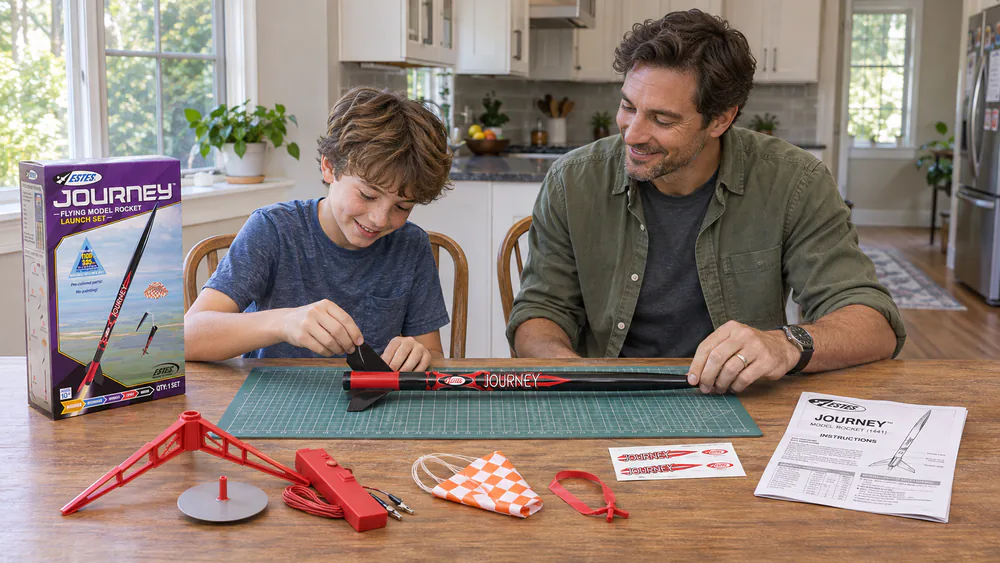
The Athena lets a child fly a rocket, and the Estes Journey Launch Set is where a child moves from flying one to building one. We spread its one-hour build over two evenings to let the glued parts set properly. Working side by side made it a shared parent-and-child project. On launch day, we watched an A8-3 engine take it to about 400 feet, and it landed roughly fifty yards from the pad. Because of the drying time, we start a Journey a few days before launch day.
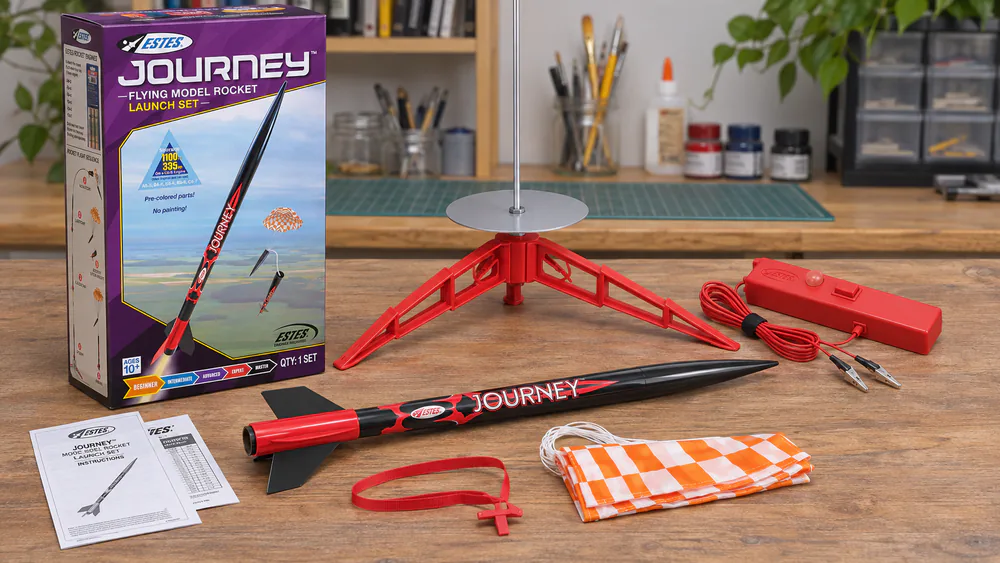
The Journey takes approximately 1 hour of assembly, and it includes the Porta-Pad II launch pad and Electron Beam launch controller, so you're ready to fly once the glue dries. The box holds the rocket parts with molded plastic fins, a nose cone, a shock cord, a parachute, precolored pieces and self-stick decals.
The Journey flies up to 1,100 feet (335 m) on a C6-7 engine, and B6-4 engines push it to 700 to 800 feet.
Who It's Best For
The Journey is rated for ages 10 and up, with supervision recommended under 12. With a parent building alongside, kids from about 8 to 11 stay engaged through the build. It's the right pick for a child who has watched a ready-to-fly rocket launch and now wants to make one.
The biggest engine in a stiff wind can carry it clear into a neighboring cornfield or neighborhood. The Porta-Pad II has an adjustable angle, which lets kids tilt slightly into the wind and keeps the rocket from drifting into trees.
The Journey takes A8-3, B4-4, B6-4, C6-5 and C6-7 engines. Engines, starters, recovery wadding and 4 AA alkaline batteries are sold separately.
Building Skills It Teaches
The Journey teaches the core habits of model rocketry: lining up and gluing fins, attaching a shock cord, folding a parachute and packing recovery wadding.
Launch day teaches skills too. Igniters misfire more in humid weather, so storing them dry and carrying spares saves the day. Rechargeable AAs don't fire the controller reliably, while fresh alkalines do.
If your child wants a faster build, the Estes Taser Launch Set is a good alternative. It takes about 10 minutes of preparation, and its molded plastic fin unit stays looking almost new after many flights. It flies around 1,000 to 1,100 feet on a C6-7. The motor tube fits engines tightly, so ease them in rather than forcing them, and use plastic model cement rather than a foaming glue.
Pros
- Beginner build with molded plastic fins
- Pad and controller included
- Great shared parent-and-child project
- Wide engine range for small or large fields
Cons
- Glue needs time to dry before launch
- A loose controller battery case can cause no-fires
- Big engines need a very large field
8. Estes Big Bertha – Best Advanced Build for Tweens and Teens
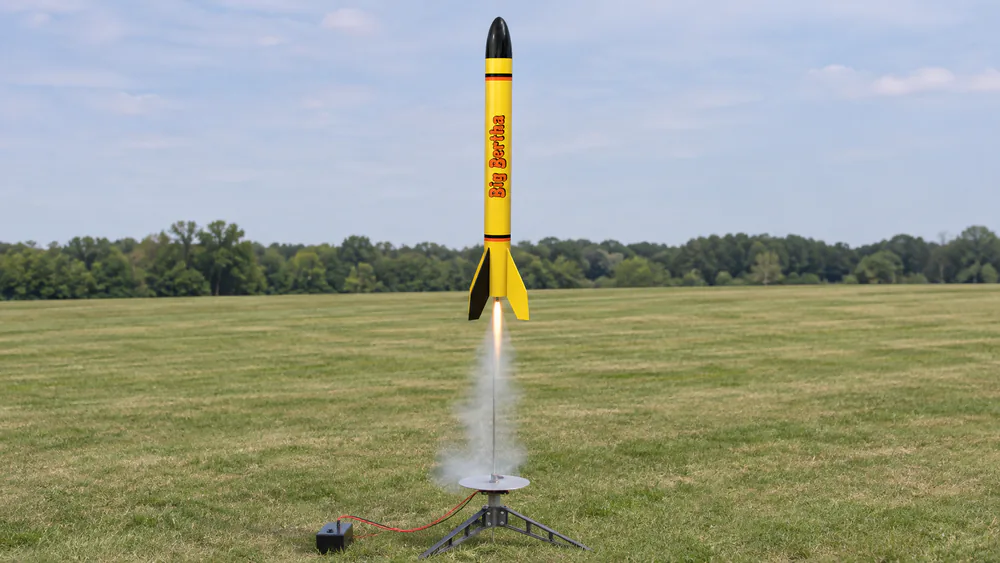
If the Journey is a first build, the Estes Big Bertha is the step after it. We watched it lift off slowly and dramatically, and the big body was easy to follow all the way up and down. At 500 feet it stayed in sight the whole flight. It usually landed within a few hundred feet of the pad, so it suits a smaller field.
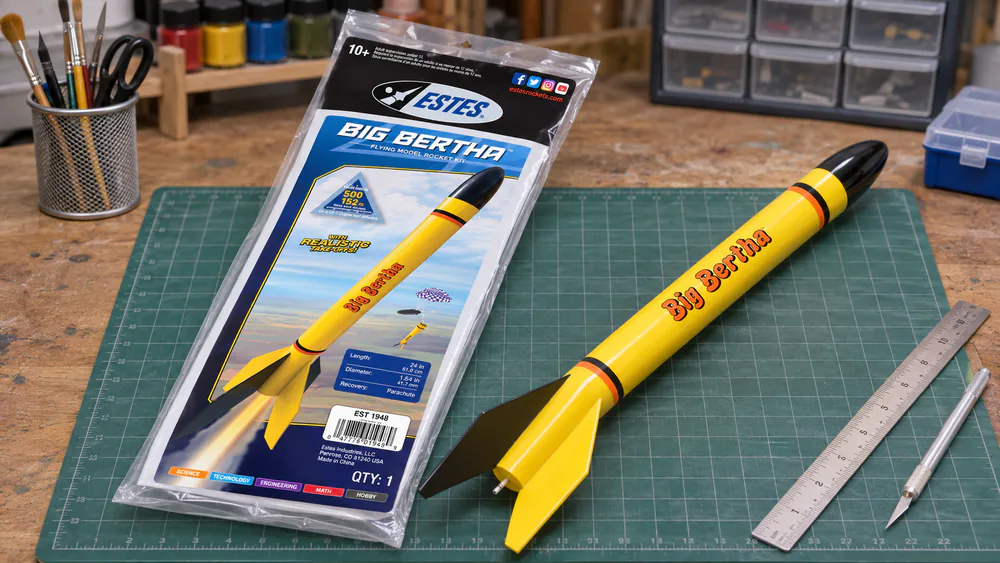
Big Bertha is one of the original Estes designs, and the company has made model rockets since 1958 as a family-owned business. The kit includes a body tube, a molded plastic nose cone, four laser-cut balsa fins, waterslide decals and an 18-inch recovery parachute. It has a projected altitude of up to 500 feet (152 m) on a C6-5 engine.
The wide body tube makes packing the wadding and parachute easy for small hands.
Who It's Best For
Estes sells Big Bertha as an intermediate kit for ages 10 and up. That puts it a step above the beginner Journey and makes it the most advanced build in our lineup. It's the right next project for a tween or teen who has flown a ready-to-fly rocket or built a beginner kit.
The build needs scissors, a pencil, a ruler, fine sandpaper, carpenter's glue, a hobby knife and masking tape, plus paint if you want the classic finish. The fins are the hardest part, and a fin alignment guide makes them much easier. Painting adds a second, slightly fussy stage after the build.
Assembly takes about 1 hour, with extra time needed for drying and painting.
Engine Choice and Safety
Big Bertha takes B4-2, B4-4, B6-2, B6-4 and C6-5 engines. A B engine is a sensible first flight, and the C6-5 is the top of the range.
There's no launch system in the box. Big Bertha needs engines, starters, recovery wadding, a launch pad and controller, and 4 AA alkaline batteries, all sold separately. If you already own a Porta-Pad II and controller from a Tandem X or Journey set, you're set.
A tree at the field edge can claim it on the very first flight if any wind is blowing, so launch from the middle of your field and wait for calm air.
Pros
- One of the original Estes designs
- Laser-cut balsa fins and waterslide decals
- 18-inch parachute for a gentle descent
- Classic build that teaches real skills
Cons
- A hard landing can loosen the glued motor mount
- The parachute can tear
- Overstuffing the wadding can keep the nose cone from popping
How to Choose a Rocket Kit for Your Child
The right rocket depends on your child's age, your launch space and how much building they want.
Match the Rocket Type to Your Child's Age
Rocket types fall into clear age bands. Here is how they line up:
- Ages 3 to 6: stomp and foot-pump air rockets, with a grown-up helping the youngest. They have no engines and soft foam rockets.
- Ages 6 to 8: air rockets a child can run alone, such as the National Geographic Air Rocket LED, and the simplest motorized launchers.
- Ages 8 to 12: motorized launchers with height settings and water rockets that invite experiments.
- Ages 10 and up: Estes ready-to-fly rockets and beginner build kits, with adult supervision recommended under 12.
- Tweens and teens: intermediate builds like Big Bertha that need sanding, gluing and painting.
Heights climb with each step. Air and stomp rockets reach roughly 100 to 200 feet, water rockets roughly 100 to 150 feet, and beginner Estes engine rockets roughly 500 to 1,150 feet depending on engine. If your child wants to understand why, NASA's Beginner's Guide to Rockets explains thrust and flight in plain terms.
Ready-to-Fly vs Build-It-Yourself Kits
Ready-to-fly rockets like the Athena arrive assembled, which suits kids who want to fly right away.
Build-it-yourself kits like the Journey and Big Bertha take an evening or more, and the skills carry over to every rocket after.
A rocket your child built flies differently in their eyes than one that came out of the box ready.
Many families do both, and the Tandem X includes one of each style in a single box.
Engines, Igniters and Other Ongoing Costs
Every engine flight uses up an engine, an igniter and some recovery wadding, and that ongoing cost is easy to underestimate.
NoteEstes engine codes follow a simple pattern. The letter shows the engine's power, so an A8-3 is gentle and a C6-7 is the strongest engine these beginner rockets use. The final number is the delay, in seconds, before the parachute ejects. Engines come in small packs, so cost per launch stays in the budget range, but a full afternoon of flights adds up.
Air, stomp, water and motorized rockets skip these costs.
Every Estes Electron Beam controller runs on 4 AA alkaline batteries, so add a fresh pack to every engine-rocket order.
Launch Space, Weather and Safety Rules
Stomp, air and the low motorized settings work in a backyard. Estes engine rockets need a full-size field, and the safety code ties that field size to engine power.
The NAR Model Rocket Safety Code sets out the core rules. Spectators stay at least 15 feet from the launcher for D motors or smaller, and 30 feet for larger. The launch rod points within 30 degrees of vertical. Launch only when wind is under 20 miles per hour, and never into clouds, near aircraft or at targets.
The code has long tied field size to engine power, with a minimum site dimension of 200 feet for B motors and 400 feet for C motors. The NAR has revised its code over the years, so check the exact current table on the NAR page before your first launch. Your site should also be clear of tall trees, power lines, buildings and dry brush.
Watch outAn adult should supervise every engine-rocket launch. Keep engines and igniters stored dry and away from heat, and only insert the safety key when everyone has stepped back. Estes instructs launchers to stand back at least 15 feet, insert the safety key and give a countdown. Pick an open field, wait for calm weather, and follow the NAR Model Rocket Safety Code linked above.
Here is our launch-day checklist:
- Rocket with parachute packed and nose cone sliding freely
- Engines matched to your field size, plus spare igniters stored dry
- Recovery wadding
- Launch pad, controller, safety key and fresh 4 AA alkaline batteries
- A wind check (calm air, well under 20 miles per hour)
- A ladder or long pole for roof and tree landings
- Water and snacks for the walk to recover
- A bright streamer or colorful decal on a pale rocket, since bright orange, yellow and red rockets are far easier to find in tall grass than muted colors
Recovery Systems: Parachutes and Streamers
Every rocket needs a way to come down slowly. Engine rockets like the Athena, Journey and Big Bertha use parachutes, from the Athena's 12-inch canopy to Big Bertha's 18-inch one. A bigger parachute means a gentler descent but more drift in the wind.
Streamers are the other option. They bring a rocket down faster, so it drifts less and lands closer to the pad, which helps in small fields or breezy weather.
Stomp and air rockets simply fall on soft foam, and the National Geographic Motorized Rocket uses rotor blades.
Whatever the system, fold the parachute loosely, use enough wadding to protect it, and don't overstuff the body tube.
A beginner telescope for kids turns clear launch evenings into stargazing, a kids' drone uses the same open field, and the LEGO Technic NASA Mars Rover Perseverance is a good rainy-day space build.
Frequently Asked Questions
What age is right for a model rocket kit?
Estes engine rockets start at age 10, and the box recommends adult supervision only until 12. Past 12, we still keep an adult on the field for every engine launch.
Are model rockets safe for kids?
The lowest-risk start is a rocket with no flame at all, since stomp, air, water and motorized launchers need no engines or igniters. Engine rockets are safe too when an adult runs each launch by the safety rules in the section above.
Do you need FAA approval to launch a model rocket?
Not for a hobby model rocket. Under the FAA rules for amateur rockets (14 CFR Part 101), a Class 1 model rocket uses no more than 125 grams of slow-burning propellant, is made of paper, wood or breakable plastic, and weighs no more than 1,500 grams. Section 101.27 exempts these rockets from the FAA's air traffic control notification rule, but you must still fly without creating a hazard to people, property or aircraft.
How high do kids' rocket kits fly?
With engine rockets, the engine matters as much as the rocket. On the same Estes Journey, an A8-3 reaches about 400 feet while a C6-7 reaches 1,100 feet, so start small and step up as your field allows.
What do you need to launch a model rocket besides the kit?
The classic miss is the launch pad and controller. The Athena and Big Bertha don't include one, so order a Porta-Pad II and Electron Beam controller unless you already own them from a launch set.
What weather do you need to launch a model rocket?
Clear skies and near-calm air make the difference between a short walk and a lost rocket. Summer's long evenings are the easiest launch windows.
Final Thoughts
Here is our bottom line by age.