Thames & Kosmos Pinball Machine Maker Review: Gumball Rally STEM Kit
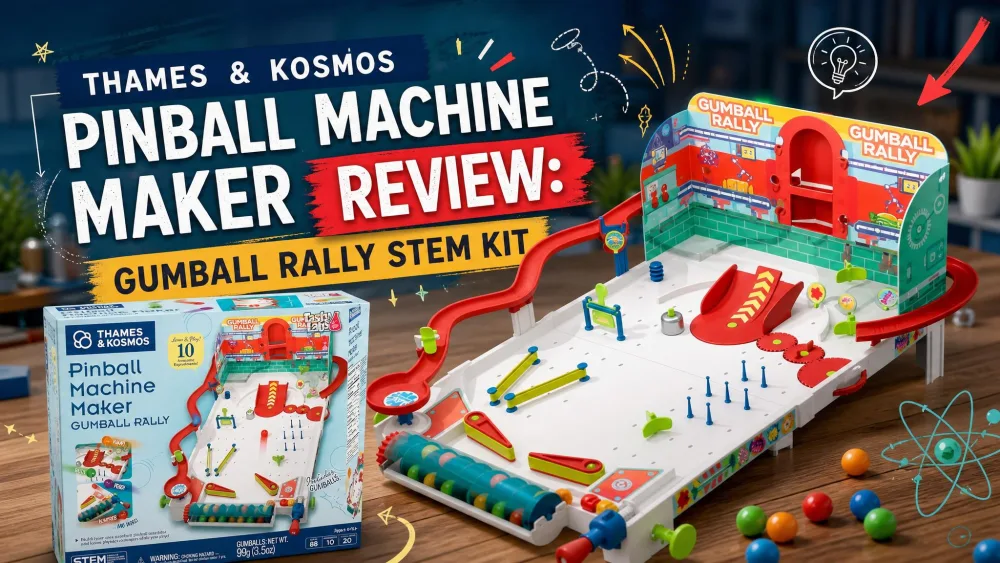
The first thing our kids did when the machine was built was reach for the sweet reward at the bottom: the gumballs they had been launching around the playfield were the same ones they got to eat. That payoff is the hook, and it is the question every parent really asks. Is the Thames & Kosmos Pinball Machine Maker: Gumball Rally worth the money, or a gimmick that fades after an afternoon? We built it and played it to see.
What Is the Pinball Machine Maker: Gumball Rally?
The Thames & Kosmos Pinball Machine Maker: Gumball Rally is a build-it-yourself, fully working pinball machine that uses edible gumballs as the pinballs. You build the playfield, load the gumballs, pull back the spring launcher, and the ball rattles through pegs, bumpers, spinners, and slingshots before an Archimedes-screw return lifts it back to the top.
The part that surprised us most is that it really works. You play it like any tabletop pinball game, and the kids eat the ball when the round ends. One reviewer called that "two toys for the price of one," and after a week in our kitchen, that felt right.
What's in the Box
The kit lands at a friendly $39.95 MSRP, part of why it punches above its weight as a gift. Inside is a reconfigurable, reusable playfield, a spring launcher, flippers, and a rotating central ramp feeding three elevated areas, plus the pegs, bumpers, spinners, slingshots, bells, and targets that make the ball behave unpredictably. There are No batteries required.
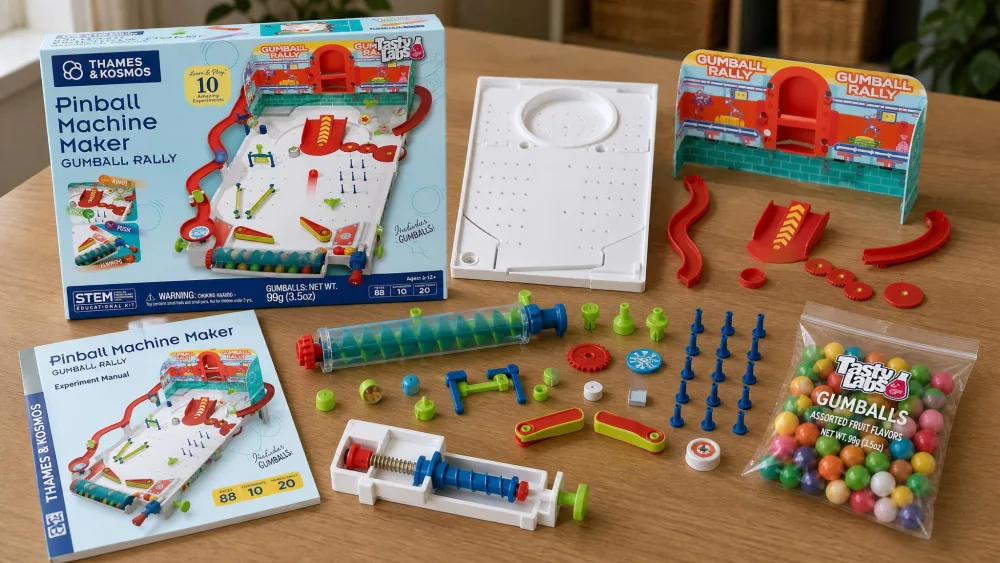
88 Pieces, 10 Experiments, and 45 Edible Gumballs
By the numbers, the kit holds 88 pieces and 10 experiments. It ships with approximately 45 gumballs, which works out to 99 grams of candy, and a 20-page full-color manual guides the build step-by-step. When the starter gumballs run out, you refill with standard 16-mm machine-size gumballs from any candy aisle. The model number is 550105 and the UPC is 814743018747.
Building and Customizing the Machine
First you snap the frame together, then mount the launcher, and once it is built you drop in obstacles wherever you like. The instructions are pretty easy to follow, though we wished each piece were labeled, because hunting for the right part slowed us down most. A few plastic pieces needed scissors or a nail file to free them, worth knowing before you hand the box to an excited six-year-old.
Watch outThe gumballs are edible candy and double as the pinballs, so small parts and loose gumballs are a choking risk for younger siblings. Keep toddlers away during play, and supervise the snacking afterward.
The Spring Launcher, Obstacles, and Archimedes-Screw Gumball Return
The real fun starts with the obstacles. Targets and accessories reposition quickly into countless configurations, so the playfield never feels the same twice, and that reconfigurability is the biggest reason it earned repeat play in our home. One honest caveat: during longer, energetic sessions, some pieces did not stay together. We learned to seat the trickier obstacles firmly before a big run.
The machine actually works, and when the round is over the kids get to eat the ball. That is the whole pitch, and it lands.
The STEM & Physics Concepts Kids Learn
Underneath the candy, this is a genuine physics toy. As the gumball drops, ricochets, and climbs the Archimedes screw, kids see force, motion, gravity, collisions, and kinetic energy in action, plus a tour of simple machines. It is a hands-on way to explore lessons in physics that a worksheet never delivers.
NoteAs homeschooling parents, what we appreciated most is that the learning is sneaky. Our kids thought they were chasing a high score, but every adjustment they made to slow a gumball down was a small physics experiment they ran themselves.
Force, Motion, Gravity, Collisions, and Simple Machines
The 10 challenges are where the concepts click. Tasks like slowing the gumballs down or landing them on the upper deck push kids toward problem-solving and patience. We watched our kids fail a challenge, study where the ball went wrong, move a slingshot two inches, and try again. That loop of trial and error is exactly what the kit rewards.
Who It's For: Age Range, Build Difficulty, and Awards
The box says ages 6-12+, and that range is honest if you know the split. Younger children around six need adult help to build it, while patient twelve-year-olds manage with minimal help.
Parent tipBuy a small bag of 16-mm gumballs when you buy the kit. A cheap refill bag keeps the machine running for months and saves a special trip later.
Pros and Cons
Pros
- Edible-gumball novelty genuinely delights kids; the candy doubles as the reward
- Reconfigurable, reusable playfield keeps replay value high
- Strong force, motion, and simple-machines learning in an award-winning design
- Affordable at $39.95 with no batteries to buy
Cons
- Ongoing gumball restock is a small recurring cost
- The age range skews young; older kids may move on faster
- Assembly takes patience, and some pieces can loosen during play
How It Compares to Other Thames & Kosmos STEM Kits
If the Pinball Machine Maker is the sweet, fast-playing entry point, its siblings trade that candy hook for more depth. The closest relative is the Thames & Kosmos Gumball Machine Maker review kit, which keeps the gumball theme but focuses on stunts and dispensers. For far more scope, the Thames & Kosmos Physics Workshop review set is a much larger, older-skewing build.
| Spec | Pinball Machine Maker | Gumball Machine Maker | Physics Workshop |
|---|---|---|---|
| Age range | 6-12+ | 6-12+ | 8+ |
| Pieces | 88 | 55 | 305 |
| Experiments | 10 | 12 | 37 |
| Price | $39.95 | ~$66.90 | ~$50 |
For a candy-free motion companion, the Thames & Kosmos Orbital 3D Maze review kit is worth a look.
Frequently Asked Questions
What age is the Pinball Machine Maker for?
Ages 6-12+, with younger kids needing adult help to build it.
How many gumballs come with it, and can I restock them?
Roughly 45 edible gumballs (99 grams); refill with standard 16-mm machine-size gumballs.
How many pieces and experiments are included?
88 pieces and 10 experiments, guided by a 20-page full-color manual.
Is the machine reusable?
Yes. The playfield is fully reconfigurable, and obstacles reposition into countless layouts.
Does it need batteries?
No batteries are required; it runs on a spring launcher and gravity.
Is it worth buying?
For $39.95, yes. It is a Toy of the Year Finalist that made the 2024 STEM 10 list and won a 2024 TTPM Best Artisan Toy honor.
Final Verdict