Thames & Kosmos Gumball Machine Maker Review: Is This STEM Kit Worth It?
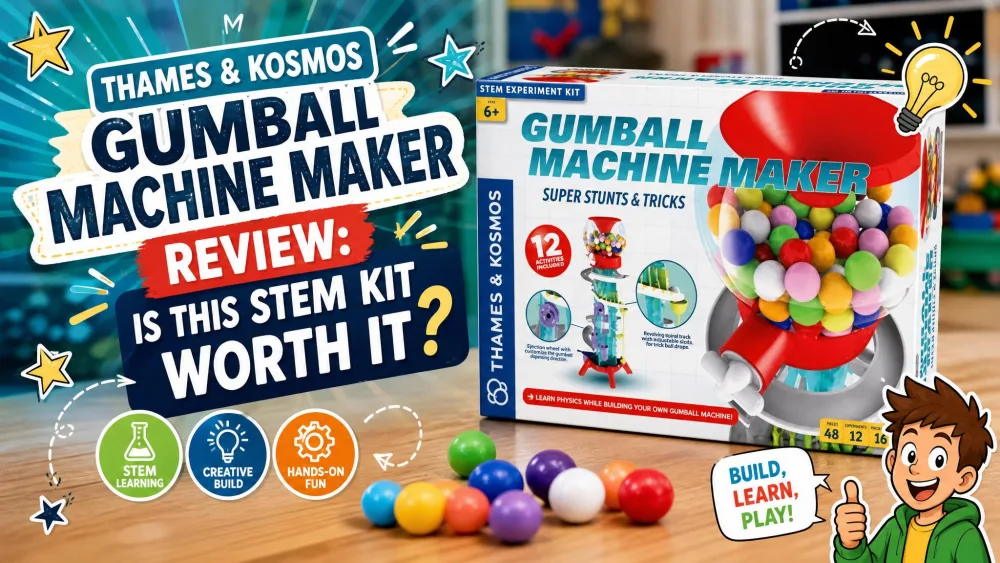
Most "educational" kits get built once and abandoned in a closet by the weekend. The Thames & Kosmos Gumball Machine Maker promises something stickier: a working gumball machine your child builds, with real physics in every twist of the track. We wanted to know whether the learning holds up once the novelty fades, and whether a six-year-old can manage the build.
So we put it in front of our own kids. Our crew spans the whole 6-12 age window this kit targets, which let us watch it play to a younger and an older builder in one afternoon. Here's what we saw, plus the owner feedback behind it.
Quick Verdict
The Gumball Machine Maker earns its keep when you treat it as an open-ended physics sandbox rather than a one-and-done build. The track segments snap into dozens of layouts, the hand-crank is satisfying, and the lessons land because kids see exactly why a gumball stalls or flies off the rail. The catch is build quality that varies unit to unit.
Pros
- Modular track rewards real experimentation, not one fixed build
- Teaches force, motion, momentum, and gravity through visible cause and effect
- Hand-crank and collection cup make a tidy reset loop for repeated play
- Edible-gumball payoff keeps younger kids motivated through the build
Cons
- Assembly can frustrate the younger end of 6-12 without adult help
- Some pieces don't stay snug; certain stunts are finicky to nail
- Included gumballs can arrive brittle; refills depend on 16 mm sizing
What It Is
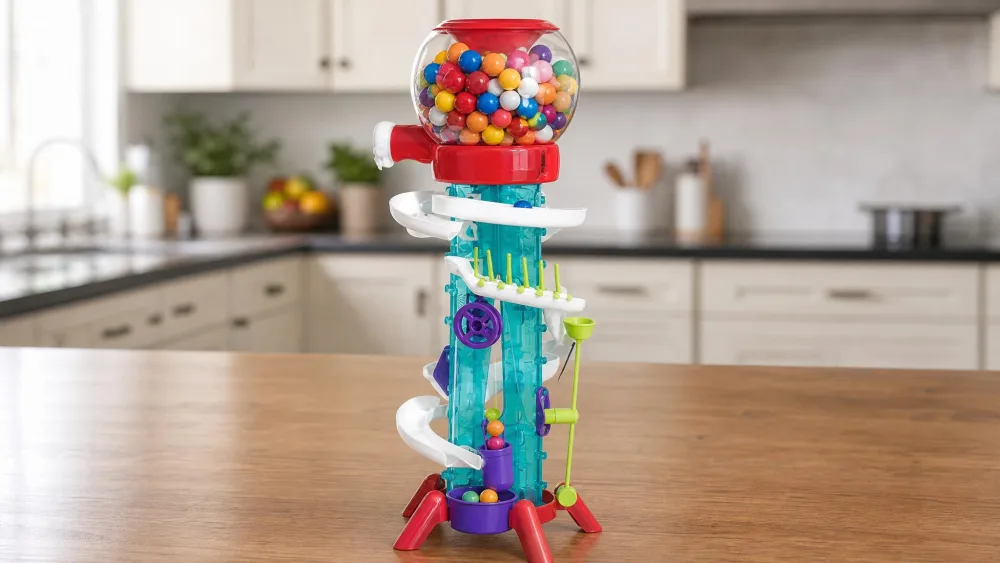
The Gumball Machine Maker is a build-it-yourself STEM kit that becomes a working gumball dispenser, with each segment of track teaching a different lesson in mechanical physics. A hand-crank dispenses one gumball at a time from a clear globe, the ball runs your chosen course, and a collection cup lets kids scoop everything back for the next run. It was a 2020 Toy of the Year finalist in the STEM/STEAM category. The brand was founded in 2001 by a science museum director and her son.
What's in the Box
You get 55 pieces: modular track segments, the dispensing mechanism, the clear globe, the collection cup, and a starter supply of gumballs. The parts stage real stunts, including a pulley lift, a pendulum, a centripetal-force funnel, and a variable-slope ramp. A printed manual covers the experiments, and QR codes on the box link to short explainer videos that mirror each one, which helped in our house when the printed steps felt thin.
Ages and Skill Level
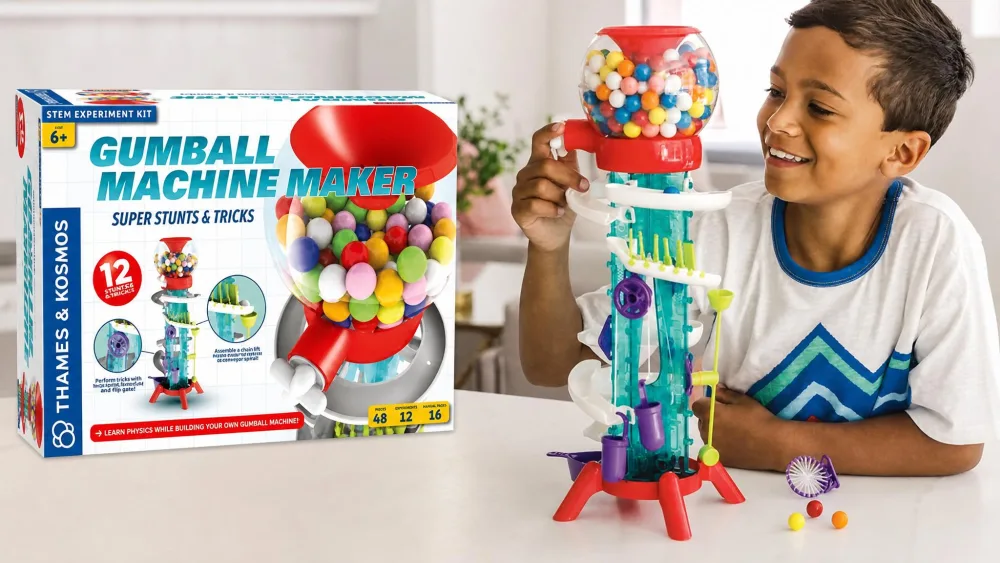
The kit is built for ages 6-12+, and that range is honest. Our older builder breezed through assembly and started inventing layouts; our younger one needed a hand pressing pieces onto pegs and reading the trickier steps. If your child is at the young edge, plan to sit beside them for the first build.
Watch outThis kit uses standard 16 mm (5/8 inch) gumballs, which are a choking hazard for younger siblings. Keep both the gumballs and the smaller track parts well out of reach of toddlers.
Building Experience
Assembly means pushing and pulling plastic pieces onto pegs, and we'll be honest: there were moments we wondered whether a part would snap as we forced it on. None did, but the fit can feel stiff. Some parents find the pieces easy, others find the instructions unclear; the QR-code videos closed most of that gap for us.
The first full build is an afternoon project. After that, the real time sink is the fun part: kids enjoy combining simple machines to route the gumballs, and ours invented several designs once they understood how each segment behaved.
Parent tipSort the track segments into piles by type before you start. Hunting for the right piece mid-build is where the youngest builders lose patience, and a two-minute sort keeps the momentum going.
The Physics & STEM Learning
This is where the kit shines. Each segment explores a different topic: simple machines, force, motion, momentum, gravity, Newton's laws of motion, and energy transfer. Because the gumball is right there, the lessons are visible rather than abstract. When a ball stalls on a shallow ramp or rockets off a funnel, your child sees the physics happen and adjusts. That instant feedback made the learning stick in a way a worksheet never has.
The lesson lands because your child can watch a gumball stall, flick off a funnel, or pick up speed on a steeper ramp, then change the design to fix it.
The kit includes 12 experiments that build on each other, from smooth and momentum tracks up to inclined planes and the centripetal-force funnel. We treated the 12 as a starting menu, then let the kids remix segments into layouts the manual never showed.
Play Value and Replayability
A lot of STEM kits die after the first build. This one held attention because the reset loop is tidy and the track is endlessly rearrangeable. The hand-crank dispenses one gumball at a time, the collection cup returns them to the globe, and kids can rerun the same course or rebuild. That keeps it off the closet shelf, though replayability leans on a refill supply once the starter gumballs run out.

Tech Specs
- Price: $39.95 from the manufacturer
- Ages: 6-12+
- Pieces: 55
- Experiments: 12
- Gumball size: 16 mm (5/8 inch) standard machine-size, starter supply included
- Manual: a roughly 20-page printed guide, plus QR-code explainer videos
Once it's built, the machine measures about 11.5 inches (292 mm) wide and stands roughly 16.5 inches (419 mm) tall, with the assembled toy a fair bit taller than the flat retail box it ships in. It weighs around 2 lb (about 900 g), though retailer listings put it closer to 1.8 lb, so treat the weight as approximate rather than exact.
What Parents and Kids Are Saying
The warmest feedback centers on engagement and the physics. Plenty of parents report their kids "had a blast building their own gumball machine," and reviewers call the kit well made with many cause-and-effect lessons. Our own kids landed in this camp: routing gumballs through their own designs kept them coming back.
The other cluster of reviews is less rosy. Some owners report that pieces don't stay together during play, that gumballs can fall off the track, and that certain stunts (the domino segment in particular) sometimes don't work at all. A few note that the included gumballs arrived old and brittle, though others say theirs tasted fine and got eaten. Owner sentiment is genuinely split, so set expectations accordingly.
How It Compares to Similar Kits
The sibling Pinball Machine Maker: Gumball Rally runs the same $39.95 and also uses edible gumballs, but it leans into pinball-style scoring with 10 experiments instead of 12. If your child is more into machines than marble runs, the Thames & Kosmos Mega Cyborg Hand STEM kit is a water-powered hydraulic build for ages 7+ at $44.95, teaching pneumatics rather than gravity and momentum. For a physics-of-motion focus with a repeatable payoff, the Gumball Machine Maker is the pick.
Where to Buy and Price
The Gumball Machine Maker lists at $39.95 on the manufacturer's site, mid-range for this much replay value. It's widely stocked, and you can check current price on Amazon since prices shift with sales. Budget a little extra for a bag of 16 mm gumballs once the starter supply is gone.
Frequently Asked Questions
What size gumballs does it use?
Standard machine-size 16 mm (5/8 inch) gumballs, with a starter supply in the box. Any standard 16 mm refill works when those run out.
What ages is it best for?
Ages 6-12+. Older kids can build it solo, but six- and seven-year-olds want an adult nearby for the trickier assembly.
How hard is it to assemble?
You press plastic pieces onto pegs, and the fit can feel stiff. Younger builders need help, but the QR-code videos clear up the confusing steps.
What physics concepts does it teach?
Simple machines, force, motion, momentum, gravity, Newton's laws, and energy transfer. The lessons stick because kids watch the gumball respond and adjust.
How many experiments come with the kit?
There are 12, building from smooth and momentum tracks up to inclined planes and a centripetal-force funnel. Most kids invent their own layouts beyond them.
Is it worth the price?
At $39.95, yes, if your child enjoys tinkering and you'll sit in on the first build. Replay value is strong, though build quality varies.
Final Verdict: Who Should Buy It
If you want a STEM kit that earns repeated play instead of a single Saturday, the Gumball Machine Maker delivers, with the caveat that quality varies box to box.