Thames & Kosmos Architectural Engineering Review: Is This STEM Building Kit Worth It?
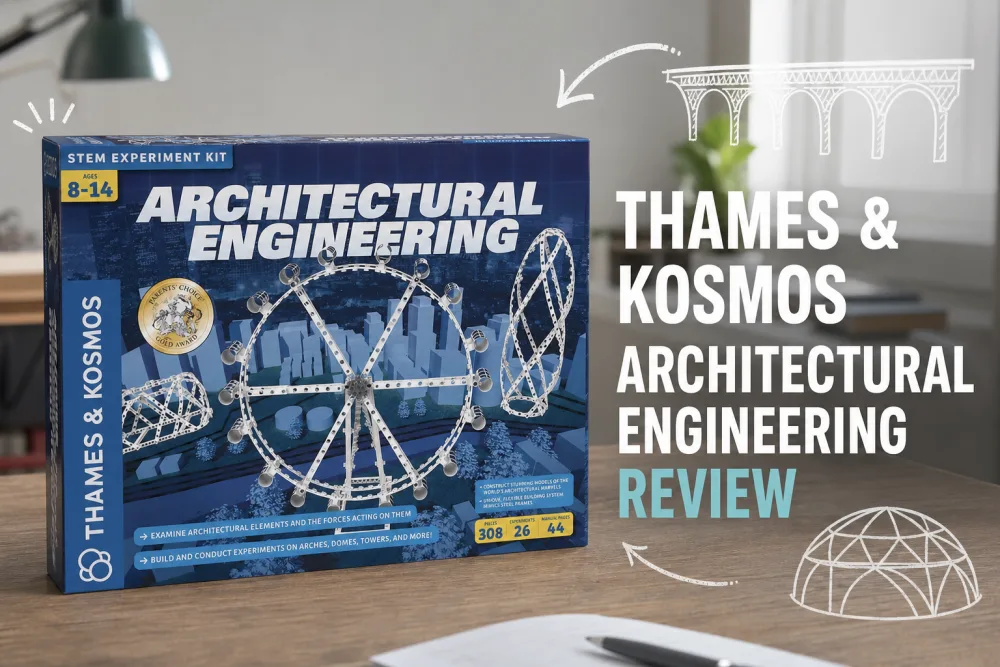
Wondering whether a $49.95 building kit can hold an 8-year-old's attention past the first wobbly tower and actually teach some engineering along the way? We put the Thames & Kosmos Architectural Engineering kit on our homeschool table for a month and worked through the 26 models with our kids, from the plainest trusses to the scaled Sydney Opera House. The short answer is that it earns its spot for the right child: a methodical builder aged roughly 8 to 12 who likes a real challenge and doesn't mind a bit of adult help on the stiff connectors. It is genuinely the most design-focused engineering set we have handled, and the 44-page manual carries the weight.
What Is the Thames & Kosmos Architectural Engineering Kit?
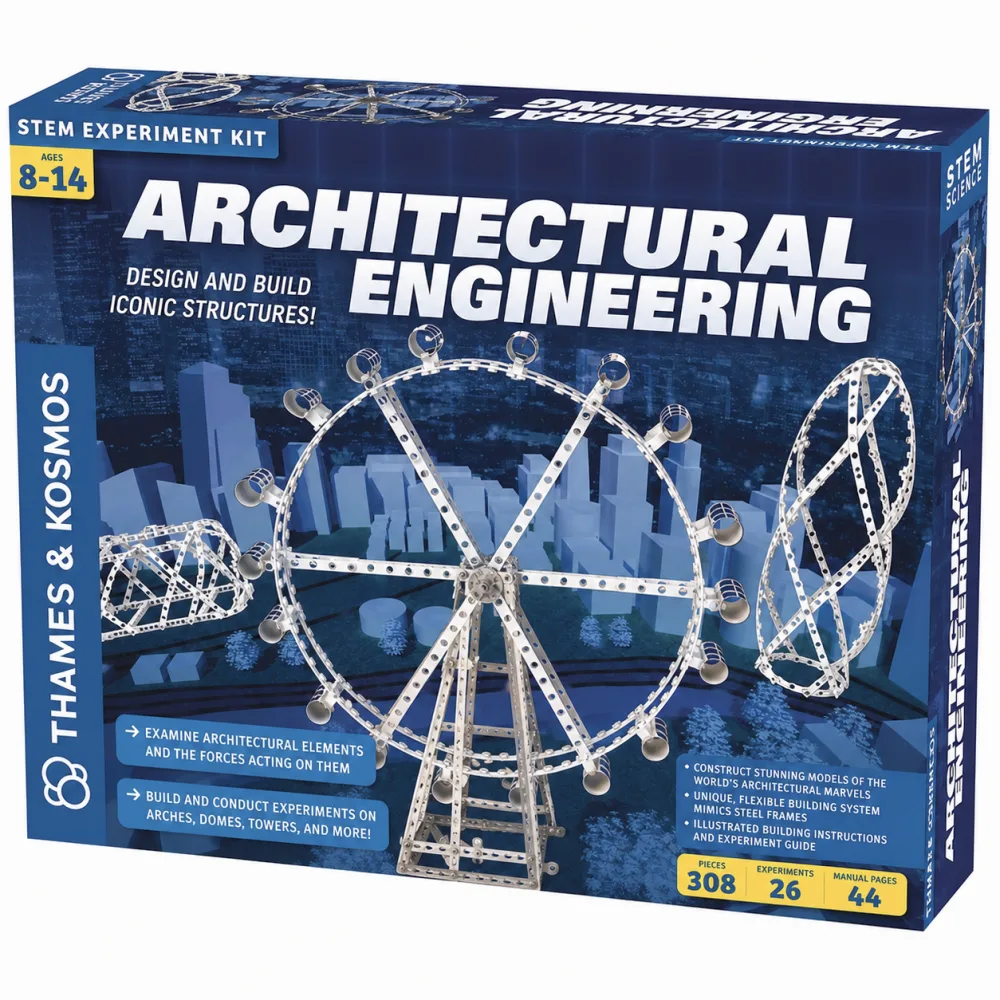
The Architectural Engineering kit (item 625416) is a single-box STEM building set that asks a child to play the role of architect and engineer, working from basic structural elements up to scaled versions of real-world buildings. You get 308 pieces, including a set of new flexible building parts designed to mimic the way a steel frame flexes and carries load, plus a 44-page full-color manual that walks through guided exercises and then nudges the builder into open-ended challenges. It won a 2019 Parents' Choice Gold Award, and the parts are compatible with other Thames & Kosmos engineering and physics kits, so the box is a starting point rather than a closed system.
What sets it apart from the rod-and-connector crowd is the focus on architecture rather than free play. The builds progress from trusses and arches to domes, and finally to recognizable landmarks: the Eiffel Tower, a stadium, a skyscraper, even a Ferris wheel. That arc, from abstract principle to a model your child wants to put on a shelf, is the heart of the kit.
Specs at a Glance
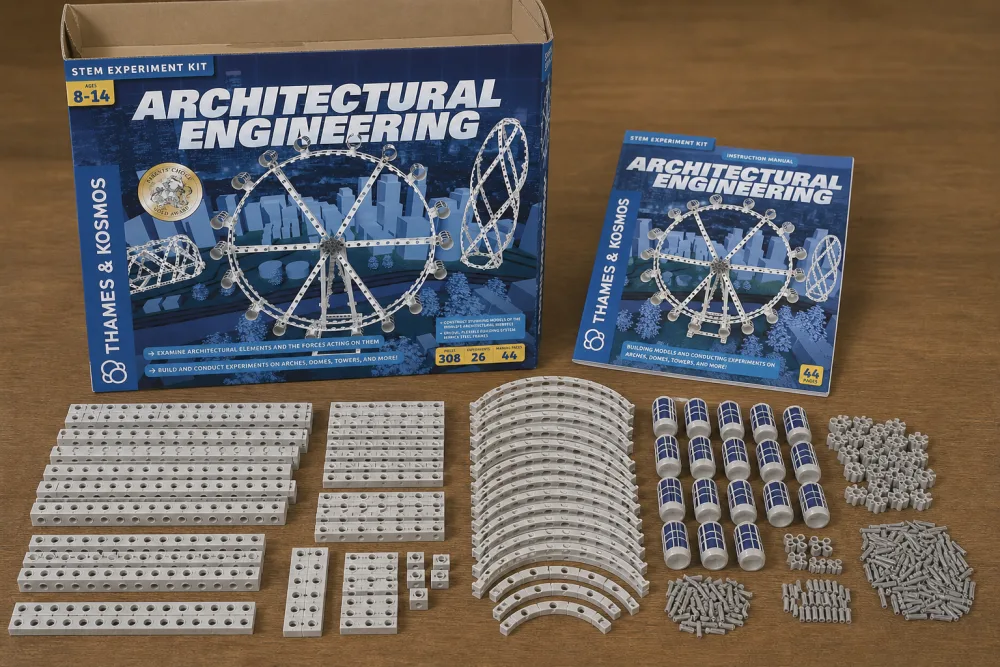
The headline numbers are easy to read off the box, but a couple deserve a footnote before you buy, so we have spelled those out below.
NoteThe box and marketing title promise 26 models, and that is the figure we use throughout this review. Worth knowing: the 44-page manual contains 20 step-by-step guided builds, with the remaining models presented as open-ended challenges (tallest tower, biggest dome, longest bridge) rather than numbered instructions.
Recommended Age and Skill Level
The official age rating is 8+, and that is the floor we would trust. In practice the kit skews toward the upper end of its range. Several retailers frame it as best for ages 8 to 12, others stretch it to 8–14, and we found the reason quickly: a younger eight-year-old can manage the simple trusses alone, but the multi-step landmark builds and the stiffer connections usually want an adult alongside. If your child is a confident, patient builder, eight is fine. If they tend to abandon a project at the first frustration, lean older or plan to sit with them.
What's in the Box (26 Models, 44-Page Manual)
Inside you get 308 plastic building pieces, the flexible "steel-frame" parts that give the structures their realistic give, a double-ended tool for prying stiff connections apart, and the 44-page full-color manual. No batteries are required, and the box runs roughly 14.6 inches on its longest side, so it stores like a board game. Because every part follows the standard Thames & Kosmos engineering system, anything from a sibling kit drops straight in.
NoteThe pieces are compatible across the Thames & Kosmos engineering and physics line, so a child who outgrows the 26 models can pool parts from another set and build far beyond what one box allows. That cross-compatibility is one of the kit's quiet strengths.
How It Compares: Architectural vs. Structural Engineering (Bridges & Skyscrapers)
The kit most often cross-shopped against this one is its sibling, the Structural Engineering: Bridges & Skyscrapers kit (item 625414). They share the same part system and the same Parents' Choice Gold pedigree, but they teach different things. Architectural Engineering is about the geometry of standing structures, arches, domes, and trusses, and the buildings that use them. Structural Engineering is narrower and more force-focused: it has your child build 20 bridge and skyscraper models while exploring compression, tension, shear, and bending. If your kid is drawn to landmarks and shapes, start here. If they are fascinated by why a bridge holds, start with the sibling.
| Feature | Architectural Engineering | Structural Engineering: Bridges & Skyscrapers |
|---|---|---|
| Age range | 8+ (skews 8–14) | 8–14+ (Grades 3–8) |
| Number of builds | 26 models (20 guided in manual) | 20 models |
| Manual | 44-page, full-color | 36-page, full-color |
| Pieces | 308 | 320+ |
| Skills / principles | Arches, domes, trusses, load distribution, geometry | Force, load, compression, tension, shear, bending |
| Real-world models | Sydney Opera House, Eiffel Tower, stadiums, Ferris wheel | Truss, arch, cantilever, rope, suspension bridges, skyscrapers |
| Cross-kit compatibility | Yes | Yes |
| Price | $49.95 (MSRP) | ~$45.99 (retail) |
Prices move around, so treat those figures as a guide. The sibling kit's 36-page manual is what its main retailer lists, though a few aggregators quote a slightly longer edition, and its retail price hovers near $45.99 rather than a confirmed MSRP.
Building Experience: From Trusses and Arches to Domes
This is where the kit either wins a child over or loses them, so it is where we spent the most time. The early builds are deliberately plain: a flat truss, a simple arch, a small dome. They look unremarkable on the table, but they are the vocabulary for everything that follows, and skipping them leaves the landmark builds feeling like guesswork. Once a child has felt how an arch pushes load out to its feet and how a truss spreads weight across its triangles, the Eiffel Tower stops being a pile of parts and starts making sense.
The payoff builds are what kept our kids coming back. Setting a finished Sydney Opera House or a towering arch on a shelf is a real motivator, and it carried engagement well past the first basic models. Independent testers in 2026 round-ups reached the same conclusion we did, calling this the most design-focused engineering kit on the shelf, strong on open-ended challenges rather than a single right answer.
NoteWhat stood out after working through all 26 models is how the manual quietly shifts gears. The first half hands you instructions; the second half hands you a goal, build the tallest tower or the longest span, and lets your child fail and retry. That is where the real engineering thinking showed up in our home.
Setup and Following the Manual
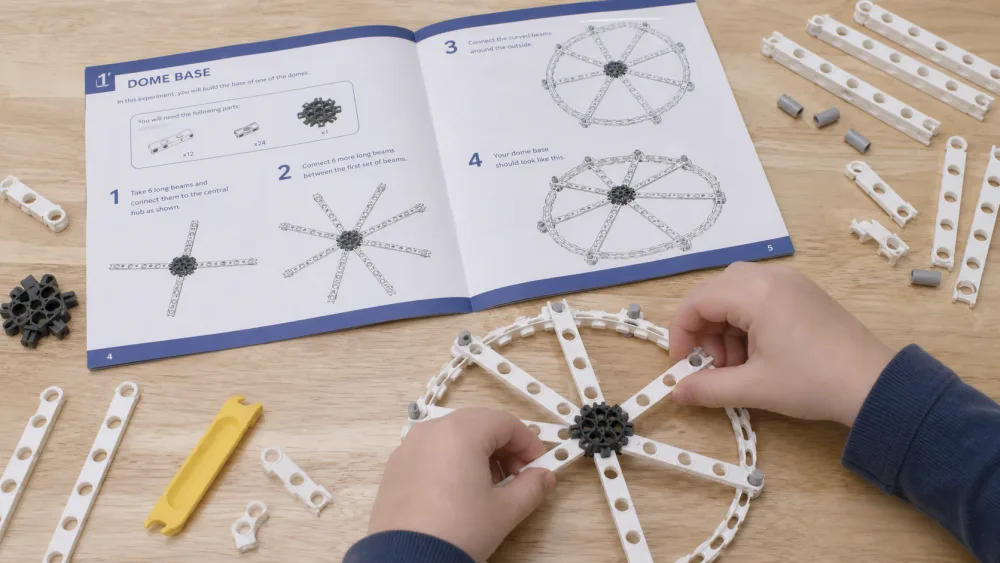
There is no real setup beyond sorting the 308 pieces, which is a five-minute job and a worthwhile one, because the manual references parts by shape and color. The 44-page full-color manual is the strongest part of the package. The diagrams are large, the steps are clearly numbered, and the progression from element to landmark is logical. A confident reader aged eight or nine can follow most guided builds independently; a younger or more easily frustrated child will want a parent nearby to keep the part-finding from stalling momentum.
Difficulty Curve and Time per Build
The difficulty curve is gentle at the start and then climbs steeply once the landmarks arrive, which is exactly what you want from a kit meant to grow with a child. The early elements are simple single structural pieces, a truss, an arch, a small dome, and they go together quickly: the instructions are clear enough that a child can often put the basic builds together without much assistance. The friction and the real time investment concentrate at the other end of the manual. The showcase landmarks, the Eiffel Tower and the Sydney Opera House, are the giant, multi-step models in the box, and between their many steps and the stiff connections they are substantially more involved than anything early on. We found those builds work best treated as a single sitting and a shared project rather than something a child knocks out alone.
What Kids Actually Learn (STEM Value)
The STEM value here is real, not a sticker on the box. Because the builds are organized around principles rather than products, a child absorbs how arches, domes, and trusses each handle load in a different way, and why a curve can be stronger than a straight line. The kit is explicitly about how architectural engineers apply scientific principles to building design, and that framing comes through in the manual's exercises.
Beyond the named concepts, the bigger gains are the quiet ones. Working a structure from a flat diagram to a standing model builds spatial reasoning, and the open-ended challenges are pure problem-solving: there is no single correct tower, only one that stands or one that topples. Parents who have used it describe the builds as properly challenging and a genuine shared project, a good chance for an adult and child to sit together and talk about what makes a structure strong. That conversation is the part that sticks.
There is no single correct tower, only one that stands or one that topples. That is where the engineering thinking lives.
Engineering Concepts Covered
The principles run from the concrete to the surprisingly deep: arches, domes, and trusses; load distribution and load-bearing design; structural integrity; and the geometry of curves and angles. For families who care about curriculum fit, the open-ended design challenges map cleanly onto the engineering-design practices in the NGSS engineering-design standards, where defining a problem, building, testing, and improving a structure is the whole point. We have leaned on that alignment in our homeschool planning.
Build Quality and Durability
The parts are solid plastic and the structures, once built, hold their shape well enough to handle, move, and display. The flexible steel-frame pieces are the clever bit, giving tall builds a realistic, slightly springy stability instead of a rigid snap. For everyday building, the quality is what you would expect from a Parents' Choice Gold winner.
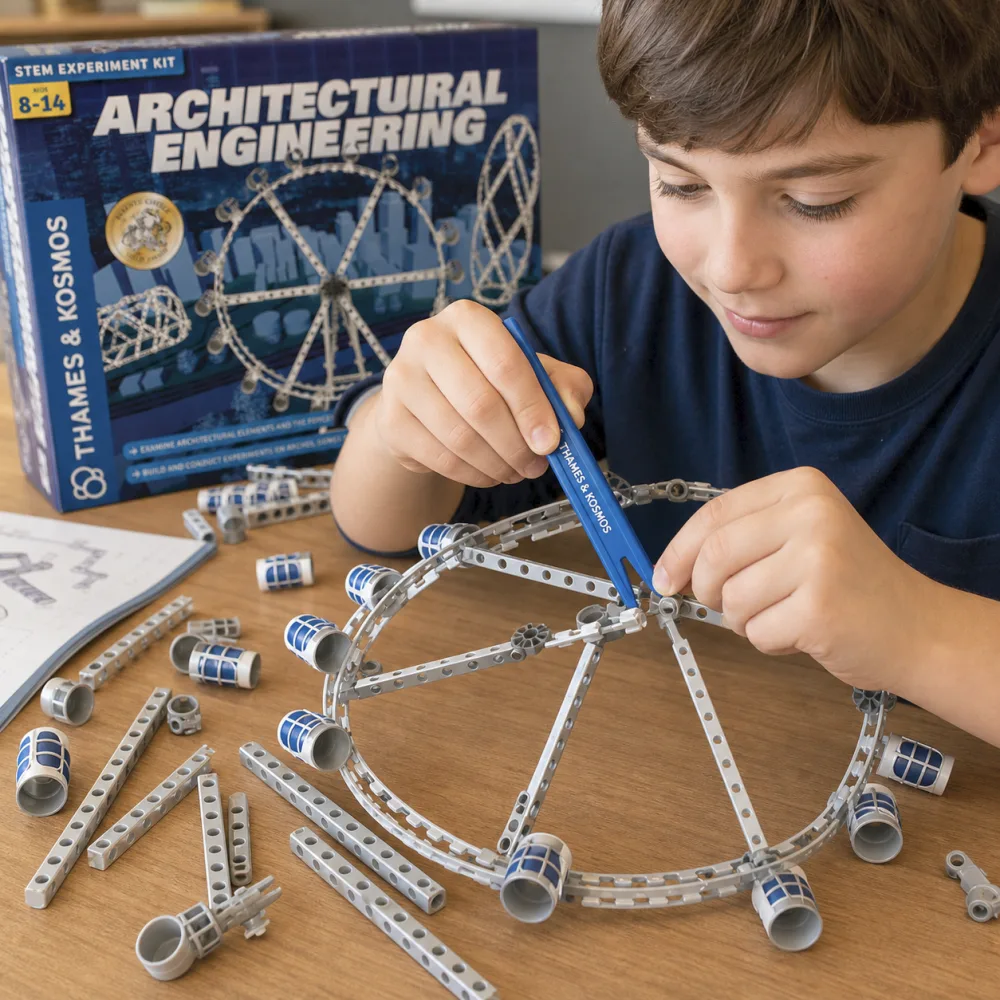
The honest caveat is the connections. New from the box, the connectors are stiff and can be hard for smaller hands to push together, though they loosen and get noticeably easier after a piece has been assembled and pulled apart a few times. Teardown is the other friction point: prying tight joints apart is fiddly, and while the included double-ended pry tool helps, several reviewers and our own rebuilds confirm it is not a magic fix. The most important warning sits below.
Watch outA recurring complaint, and one worth taking seriously, is that plastic parts can crack or break when an over-tight connector forces too much pressure onto a piece as it is pushed into place. Reviewers flag this as a design and quality issue rather than just rough handling, so coach younger builders to seat parts gently and use the pry tool for teardown rather than yanking.
Pros and Cons
Pros
- Genuinely educational: builds spatial reasoning, problem-solving, and real load-distribution concepts
- The most design-focused engineering kit we tested, with a satisfying arc from trusses to landmarks
- Excellent 44-page full-color manual with clear, well-illustrated guided builds
- Recognizable real-world models (Eiffel Tower, Sydney Opera House) keep motivation high
- 308 parts compatible across the Thames & Kosmos engineering line, so it grows with your child
- Parents' Choice Gold Award winner with no batteries needed
Cons
- Connectors are stiff from new and hard for younger hands until they loosen
- Plastic parts can crack if over-tight connectors are forced
- The included pry tool makes teardown easier but is not very effective on the tightest joints
- Skews to the older end of 8+; younger builders need adult help on landmark builds
Who Is It Best For?
This kit is best for a methodical, patient child roughly 8 to 12 who enjoys following a build and then being set loose on a challenge, especially one who lights up at recognizable landmarks. It is an outstanding choice for homeschoolers and any family wanting a STEM toy with real curriculum bones. It is a weaker fit for a younger or easily frustrated child working alone, simply because the stiff connectors and complex builds reward a bit of company. If your child loved this and wants more, the cross-compatible sibling kits are the natural next box.
Frequently Asked Questions
What age is the Architectural Engineering kit for?
The official rating is 8+, and that is the age we would trust as a floor. It skews to the older end of its range, so retailers commonly frame it as 8 to 12 or 8–14. A confident eight-year-old can manage the simple builds alone, but the stiffer connectors and complex landmark models usually benefit from adult help.
How many models can you build, and what are they (arches, domes, trusses)?
The box advertises 26 models, which is the figure we use. Of these, 20 are step-by-step guided builds in the 44-page manual, and the rest are open-ended challenges. The builds run from basic structural elements such as trusses, arches, and domes up to scaled real-world buildings like the Eiffel Tower, the Sydney Opera House, stadiums, and a Ferris wheel.
Is the 44-page manual easy to follow for beginners?
Yes. The 44-page full-color manual is one of the kit's strengths, with large diagrams and clearly numbered steps that progress logically from simple elements to landmarks. A confident reader aged eight or nine can follow most guided builds independently, while a younger child will want a parent nearby to help locate parts.
Are the parts compatible with other Thames & Kosmos engineering kits?
Yes. The 308 building pieces follow the standard Thames & Kosmos engineering part system, so they are compatible with other Thames & Kosmos engineering and physics kits (sold separately). A child can pool parts across sets to build well beyond the 26 models in this one box.
How does it differ from Structural Engineering: Bridges & Skyscrapers?
They share the part system and the Parents' Choice Gold pedigree but teach different topics. Architectural Engineering focuses on the geometry of standing structures, arches, domes, and trusses, and famous buildings. The sibling Structural Engineering: Bridges & Skyscrapers kit narrows in on 20 bridge and skyscraper models and the forces of compression, tension, shear, and bending.
Final Verdict
After a month on our table and all 26 models built, the Architectural Engineering kit earns a confident recommendation for the right child. It is the most thoughtful, design-led engineering set we have used, and the landmark payoffs keep a kid engaged long after a new toy would normally lose its shine. The stiff connectors and the crack risk on over-tightened parts are real and worth coaching around, but they do not undo the value. For a patient builder aged 8 to 12, especially in a homeschool, it is money well spent. You can compare it against the official Thames & Kosmos product page and the listing at specialty STEM retailer Fat Brain Toys before you buy.