Thames & Kosmos Bionic Robotic Arm Review: Is This STEM Kit Worth It?
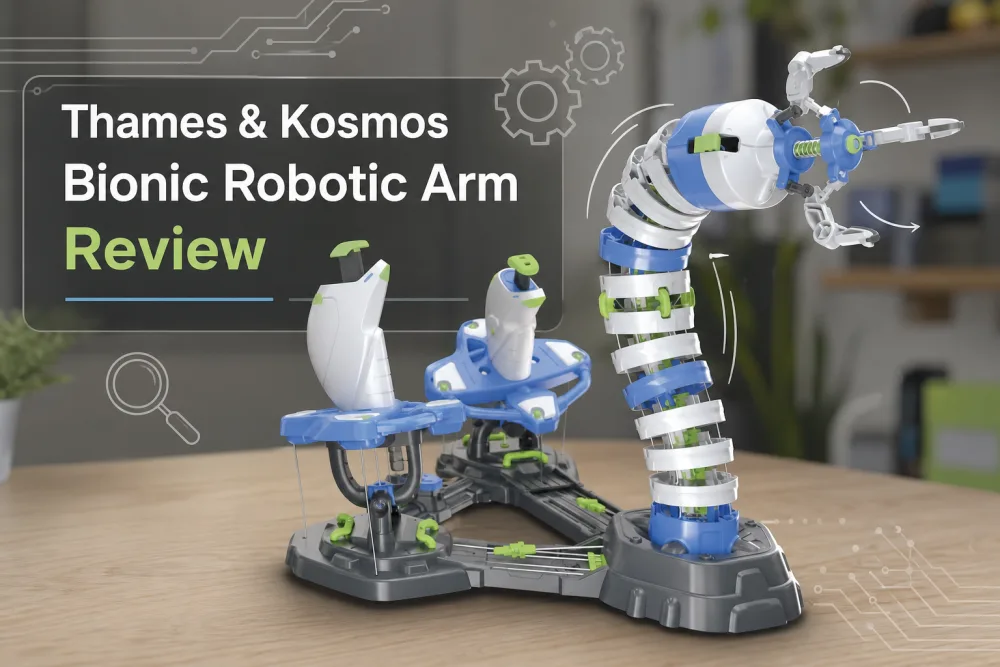
Our 11-year-old spread nearly 300 plastic pieces across the dining table, and two evenings later we had a segmented mechanical arm that grabs, rotates, and swings on nothing but hand power. The Bionic Robotic Arm is a Thames & Kosmos STEM kit you build from parts, then drive with two joysticks that pull nylon cables, no batteries or motors required. It earned a 2025 Educational Toy of the Year finalist nod. So is it worth roughly $54.95 and the hours it takes? Mostly yes, with one honest caveat.
Quick Verdict: Is the Bionic Robotic Arm Worth It?
What Is the Thames & Kosmos Bionic Robotic Arm?
The Bionic Robotic Arm is a hand-powered, sci-fi-inspired mechanical arm you build from a kit. There are no batteries, motors, or electricity anywhere in it. Instead, a pair of joysticks pulls and releases nylon cables threaded through the segmented arm, mimicking how tendons move muscles.
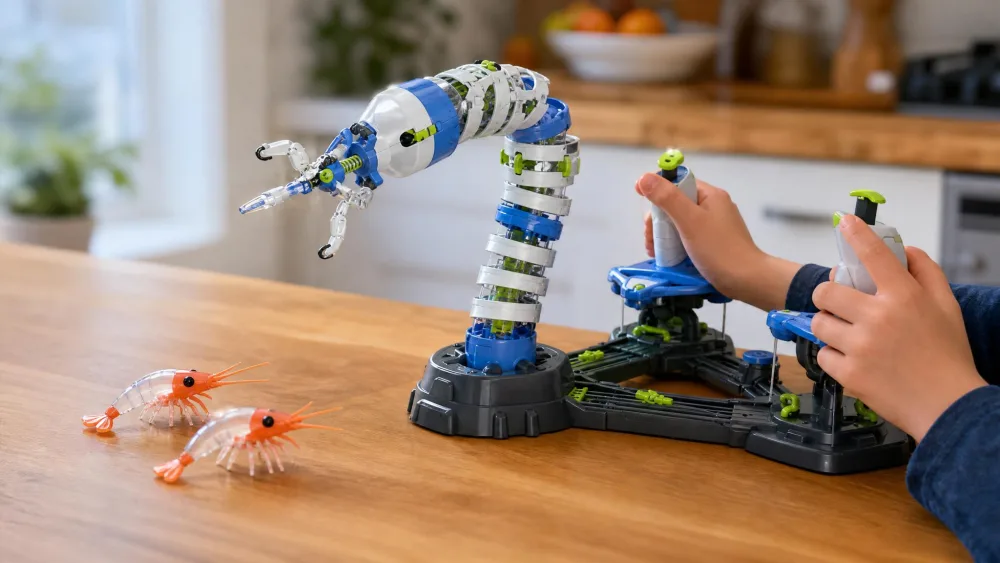
The right joystick drives the upper body, the left drives the lower body, and buttons open, close, and rotate the claw. Swap the claw for the bionic eel head and the arm becomes a slithery eel that kids use to catch the included shrimp models.
Key Specifications
| Spec | Detail |
|---|---|
| Piece count | Nearly 300 (297 in spec tables) |
| Age range | 10+ with help, 14+ independent |
| Power source | None (no batteries or motors) |
| Control | Dual joysticks pulling nylon "tendon" cables |
| Motion | 360° horizontal, 180° vertical |
| End effectors | Gripper claw + bionic eel head |
| Manual | 56-page full-color, step-by-step |
| Price | ~$54.95 |
Building It: The ~300-Piece Assembly
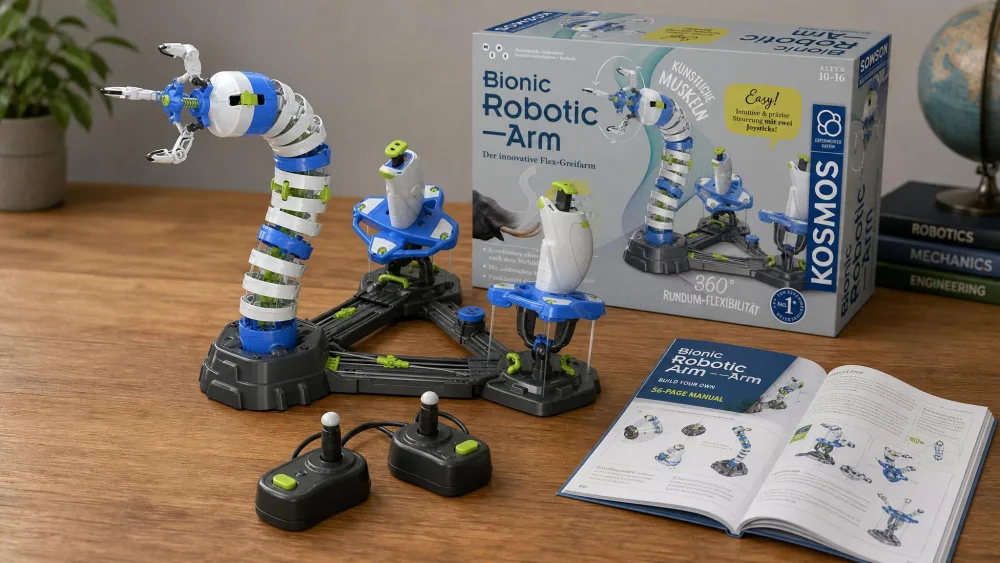
Be honest about this up front. Assembling nearly 300 pieces is focused, sit-down work, not a quick afternoon build. We treated it as a project spanning more than one sitting, which made it enjoyable. The building itself is the lesson: by the time the arm stands up, a kid has felt how a mechanism goes together.
How Long the Build Takes and How Hard It Is
There's no official build-time figure, so we'll describe it the way we lived it: roughly two evenings of steady work. Threading the nylon cables through the segments is the fiddly stretch where attention matters most. Route a cable wrong and the arm won't move as the manual promises, so going slowly here pays off.
Parent tipSort every piece into bowls or a muffin tin before you start, and budget two evenings rather than one. The cable-threading steps reward a calm, well-lit table over a rushed session.
Manual Quality and Age Fit (10+ with help, 14+ independent)
The 56-page full-color manual is genuinely good. It walks assembly step by step and folds in real science about robotic arms, biomimicry, and mechanical engineering, so it reads like a build guide and a lesson at once.
On age, we'd trust the conservative guidance on the box. Although it's labeled 10+ with help, the piece count and threaded cables mean an adult realistically sits alongside a 10-to-13-year-old, and 14+ is the honest age for building it solo. One retailer shelves it as 8+ with help, but the manufacturer's 10+ and 14+ are the accurate read. The box holds the pieces, the two end effectors, the shrimp models, and that thick manual.
How It Works: Joysticks, Nylon Cables, and the Eel Head
Once assembled, the control is the payoff, and it's surprisingly instinctive. Two joysticks pull the cables running the length of the arm, and within minutes our kids were driving it without thinking about which stick did what. The arm sweeps through a 360-degree horizontal and 180-degree vertical area, and the claw rotates 180 degrees with about a 2.5-inch grip.
The hand-powered tendon mechanism is the standout moment. You can watch the cables tense and release as the joints move, which visibly shows how tendons move muscles. That's the feature our kids kept showing off. Click on the eel head instead of the claw, and the arm becomes an eel hunting the shrimp models across the table.
Play Value and What Kids Learn
Play value splits into two halves. First the build, hours of methodical engineering practice. Then the driving, where the gripper-and-eel transformation keeps kids coming back. In our home the eel-head swap pushed it from a shelf project to a thing we pick up again.
STEM Concepts: Biomimicry and Mechanical Engineering
The learning is woven into the design. The tendon-cable system is a hands-on lesson in biomimicry, copying how a biological system solves a mechanical problem. As kids operate the joints, they work through the same control logic that drives the industrial robotic arms used on factory floors. Robotics, mechanical engineering, and problem-solving all show up naturally.
Pros and Cons
Pros
- No batteries, motors, or electricity required; runs entirely on hand power
- The nylon-cable "tendon" mechanism is a memorable, teachable wow moment
- Nearly 300 pieces means real build depth and engineering practice
- Gripper-to-eel-head transformation refreshes the play
- 2025 Educational Toy of the Year finalist
Cons
- Long, multi-session build that isn't a quick win
- At 10+ it realistically needs adult help; 14+ for solo building
- Mixed durability sentiment; the cable-and-spring mechanism is the fragile point
- The lone public rating is a single 2.0/5 review flagging weak spring-return against cable friction
About that rating, because it matters. The only public star score we found is a single 2.0/5 review on RobotShop's judge.me page. That reviewer reports the spring-return mechanisms are too weak to overcome friction along the nylon tendons, so even after careful assembly the arm doesn't operate as intended. They re-checked the instructions repeatedly and it still didn't work, pointing at a design issue rather than user error. It's one reviewer, not a consensus, since Target shows zero reviews and the kit is new. We read it as a real warning, and we'd treat the assembled arm as a demonstration piece, not a toss-it-around toy.
How It Compares to Other STEM Robotics Kits
Weighed against its Thames & Kosmos siblings, the closest relative is the Mega Cyborg Hand, the other articulated-mechanism build in the family.
| Kit | Price | Age | Pieces | Build | Power | Mechanism |
|---|---|---|---|---|---|---|
| Bionic Robotic Arm | ~$54.95 | 10+ (14+ solo) | ~297 | Multi-session | None | Tendon-cable arm; claw + eel head |
| Mega Cyborg Hand | ~$44.95 | 7+ | 203 | Several hours | None | Hydraulic gripping hand |
| Architectural Engineering | retailer | 8+ | 308 | Multi-model | None | Structural models |
| Air-Power Turbo Racer | ~$30 | 8+ | 91 | Quick | None | Air-pump race car |
| Gumball Machine Maker | ~$59.99 | 6+ | 55 | Quick | None | Gumball stunt track |
The Bionic Robotic Arm is the deepest, oldest-skewing build of the bunch. For a younger or less patient kid, the Thames & Kosmos Mega Cyborg Hand review is the gentler entry point, while quick wins live with the Air-Power Turbo Racer review or the Gumball Machine Maker review. For structural building over articulated motion, the Architectural Engineering review covers that sibling.
Frequently Asked Questions
Does the Bionic Robotic Arm need batteries or motors?
No. It uses no batteries, motors, or electricity. You drive it by hand with two joysticks that pull nylon cables, working like tendons that move muscles.
What age is it for?
The official guidance is 10+ with help and 14+ for independent play. In practice, a 10-to-13-year-old needs an adult alongside them, and 14+ is the honest age to build it solo.
How many pieces is the build, and how long does it take?
It's nearly 300 pieces (297 in retailer spec tables). There's no official build-time figure, but it's a focused, multi-session project. Budget two evenings rather than one quick sitting.
Can it transform into the bionic eel?
Yes. Swap the gripper claw for the included bionic eel head and the arm becomes a slithery eel you can use to catch the included shrimp models.
How does the tendon-cable, dual-joystick control work?
Two joysticks pull and release nylon cables threaded through the arm. The right drives the upper body, the left drives the lower body, and buttons open, close, and rotate the claw, giving a 360-degree horizontal and 180-degree vertical range.
Is it durable, and why the low RobotShop rating?
The only public rating is a single 2.0/5 review noting weak spring-return against cable friction. It's one reviewer, not a consensus. Treat the assembled arm as a demonstration piece rather than a rough-play toy; the cable-and-spring mechanism is the fragile point, not the structure.
Is it worth the price?
At around $54.95 it's strong value for the build depth if you want the most involved kit in the family. For less money and a faster, younger-friendly build, the Mega Cyborg Hand is the lighter alternative.
Final Verdict and Who Should Buy It
So, is the Thames & Kosmos Bionic Robotic Arm worth it? For the right kid, yes. We'd give it an 8 out of 10. It's a deep, no-battery engineering build that teaches biomimicry and mechanical thinking, and the joystick-and-cable control is a satisfying payoff once the work is done. The eel-head swap keeps it in rotation, not on a shelf.
Buy it for a patient builder 10 and up, with an adult ready to help thread cables for the under-14 crowd. Skip it if you want a quick, knockabout toy or a solo project for a younger child. Expect careful work over instant gratification, and at about $54.95 it's a kit we're glad we built.