Thames & Kosmos Physics Workshop Review: Is It Worth It?
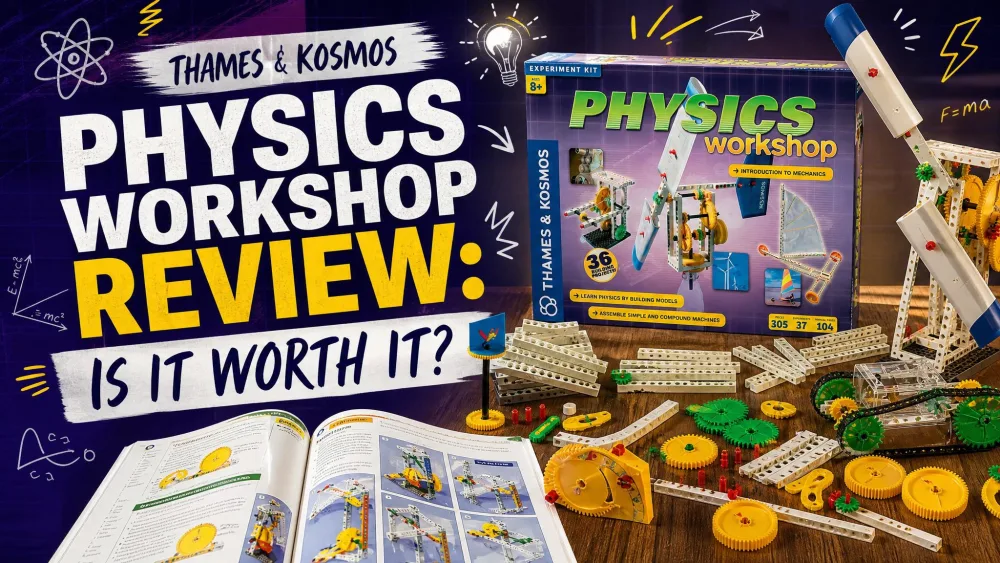
Most families have a chemistry set in a cupboard, but a physics set is rarer. The Thames & Kosmos Physics Workshop fills that gap: a build-and-experiment kit for ages 8+ that turns 300+ pieces into 36 models, each explaining a law of mechanical physics. It is built to pull a curious child in for an afternoon. Our verdict: capable, educational, and best for a child who likes to build. Whether it is worth $59.95 comes down to which child you have in mind.
What Is the Thames & Kosmos Physics Workshop?
The Physics Workshop is the physics counterpart to the chemistry set: you build a model, then experiment on it. It comes from Thames & Kosmos, founded in Rhode Island in 2001 as the US arm of Kosmos, a German publisher from 1822.
What's Inside the Box
Pieces and Build System (~300+ Pieces)
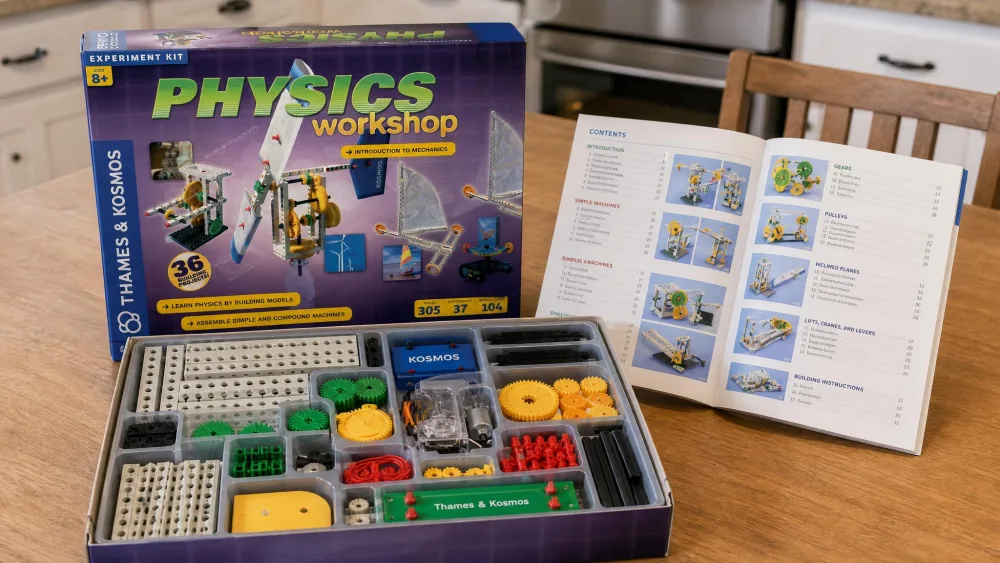
Inside is a tray of plastic parts, gears, pulleys, a small motor, and the manual. Most retailers say 300+ pieces; some spec sheets list 305, so we hedge to "300+" like the official page. The sturdy parts work across other Thames & Kosmos physics and engineering kits.
The Illustrated Manual (64- vs 104-Page Editions)
The manual is the heart of the kit: full-color and easy-to-follow, each build adding the physics, vocabulary, and science facts behind it. Most listings show a 64-page manual, others 104; with no official version mapping, treat both as edition-dependent.
NoteSpecs vary across sellers: 305 pieces (often "300+"), 36 models, and a 64-page manual are most-cited, but some listings show 104 pages and 73 "experiments and activities." These look like edition differences, so we keep the conservative count.
Specifications at a Glance
| Specification | Physics Workshop |
|---|---|
| Pieces | 300+ (some spec sheets list 305) |
| Models you can build | 36 |
| Experiments / activities | 37 (some listings say 73 "experiments and activities") |
| Manual | Full-color; 64-page on most listings, 104-page on some editions |
| Age range | 8+ (Seton lists it as grade 6) |
| Special parts | Motor, gears, and pulleys (mechanical, no solar) |
| Award | 2005 Parents' Choice Silver Award |
| Item / SKU | 625412 |
| Official list price | $59.95 (retail varies) |
The Models You Can Build
Simple Machines (Pulleys, Levers, Gears)
The early builds are gentle. A fixed pulley, a simple lever, a basic gear train: each isolates one idea so cause and effect stays clear.
Advanced Builds (Windmill, Two-Speed Crane, Mars Robot, Centrifuge)
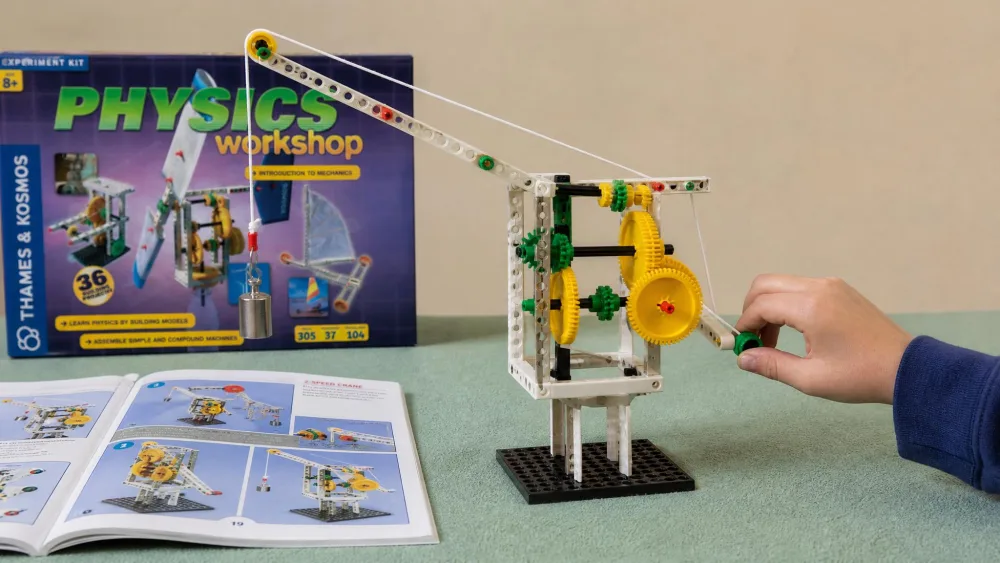
This is where the kit earns its keep, working up to a windmill, two-speed crane, force scale, sail car, mars robot, centrifuge, pinball game, ship's lantern, and pendulum clock, plus dozens more. Each stacks two or three concepts, so a child sees the rules combine.
What Kids Actually Learn (Physics Concepts Covered)
Forces and Simple Machines
The models cover a tidy syllabus of simple machines: gears, levers, screws, inclined planes, pulleys, and wheels and axles. A child does not just read about mechanical advantage, they feel it when a pulley makes a heavy lift easy.
Energy, Motion, and Mechanical Advantage
They also cover gravity, friction, centripetal force, energy, power, work, and the equations behind them. None of it is dry theory: the pendulum clock teaches gravity, the centrifuge centripetal force, the windmill energy conversion, all of it real mechanical physics.
A pulley does not teach mechanical advantage. Lifting a real weight with one, and feeling it turn easy, does.
Age Range and Difficulty
The official age is 8+, and Seton Books files it under grade 6. One reviewer found it "a little more involved than expected" for their 9-year-old, and it leans to the upper end of the range.
The friction point everyone mentions is the fit of the parts. They snap together so tightly that younger children often cannot push them in alone, and once an adult assembles a model, the child may struggle to take it apart. Even so, the payoff can be remarkable: one reviewer's 9-year-old grandson stayed absorbed for three hours one Christmas morning, building a dozen models.
Watch outPlan on adult help for the tighter joints and complex later builds, even with the easy-to-follow manual. For a child at the younger end of 8+, this is a kit you do together.
Physics Workshop vs Physics Solar Workshop (and Other TK Kits)
The kit most often confused with this one is the Physics Solar Workshop, a smaller, solar-panel kit. If your child loves renewable energy, the Solar Workshop fits better; for breadth and machines, the Physics Workshop wins on scope.
| Feature | Physics Workshop | Physics Solar Workshop (V2.0) |
|---|---|---|
| Pieces | 300+ (some sheets list 305) | About 140 |
| Models you can build | 36 | 5 (solar-powered) |
| Experiments / activities | 37 (some say 73) | 10 |
| Manual | 64-page (some 104-page), full-color | 48-page, full-color |
| Age range | 8+ | 8+ |
| Special parts | Motor, gears, pulleys | Solar panel, motor, battery holder |
| Award | 2005 Parents' Choice Silver Award | — |
| Official list price | $59.95 | About $69.95 |
The shared building system combines with the Thames & Kosmos Architectural Engineering review set, and if your child prefers robotics, our Thames & Kosmos Mega Cyborg Hand STEM kit review is a hands-on sibling.
Pros and Cons
Pros
- Excellent breadth: 36 structured models plus dozens more from the pieces
- Teaches simple machines and core physics through building, not reading alone
- Carries a 2005 Parents' Choice Silver Award and a full-color, easy-to-follow manual
- Compatible building system that works with other Thames & Kosmos kits
Cons
- Spec figures are inconsistent across sellers (pieces, manual length, experiment count)
- Parts fit so tightly that younger kids struggle to assemble models alone
- Needs adult help for the later, more complex builds
Is the Physics Workshop Worth It? (Final Verdict)
The Physics Workshop is one of the best-value mechanical-physics kits on the shelf: broad, instructive, and able to hold attention. Budget for hands-on help, and aim it at a child who enjoys building.
Frequently Asked Questions
Does the Physics Workshop need batteries, or what does the motor run on?
Models are hand-powered or driven by the small included motor, so supply the batteries it needs. Unlike the solar version, there is no panel; the motor, gears, and pulleys do the work.
Can an 8-year-old build it independently, or is an adult always needed?
The kit is designed so a child can work alone, and several kids can team up on the harder machines. Still, the tight joints and later builds want an adult, which is why we lean it toward 9 and up for solo building.
Do the pieces combine with other Thames & Kosmos kits?
Yes. The plastic building system is shared across Thames & Kosmos physics and engineering kits, so parts mix with sets like the Architectural Engineering kit.
Should I buy this or wait for an older child?
If your child loves to build and follow instructions, buy it now and help with the tight joints; the breadth lasts for years. If they tire of step-by-step assembly, the snug parts may frustrate them, and a year of hand strength makes a difference.