Thames & Kosmos Orbital 3D Maze Review: Is This 3D Marble Maze Worth It?

The pitch on the Orbital 3D Maze makes our kids lean in: build a space-themed marble maze yourself, then steer a metal marble through it with two handles to the “Mission Capsule.” It's a 2026 preorder, so we're sizing it up the way we do any kit before it lands in our home, leaning on what the maker says and the marble mazes we already know.
So is it worth roughly $35? Here's what's in the box and where it fits.
What Is the Thames & Kosmos Orbital 3D Maze?
The Orbital 3D Maze is a build-it-yourself, space-themed 3D maze. You assemble it onto a spherical base, then tilt and rotate the whole sphere to send a metal marble to the Mission Capsule. It's gravity-driven and mechanical, with no screens, and the clever part is the three swappable modules that change the run. It debuted at the 2026 Toy Fair; the company was founded in 2001.
Key features at a glance
You steer with two handles and thumb wheels that rotate and tilt the maze across multiple axes, finishing at the spacecraft's Mission Capsule. The maker calls it easy to play but hard to master, and one reseller notes it needs no batteries.
What's in the box
Based on reseller listings, you get the spherical base, three buildable modules, two handles with thumb wheels, a marble launcher, and one metal marble, though there's no official parts list. The product carries SKU 620404 and GTIN-12 810172680968.
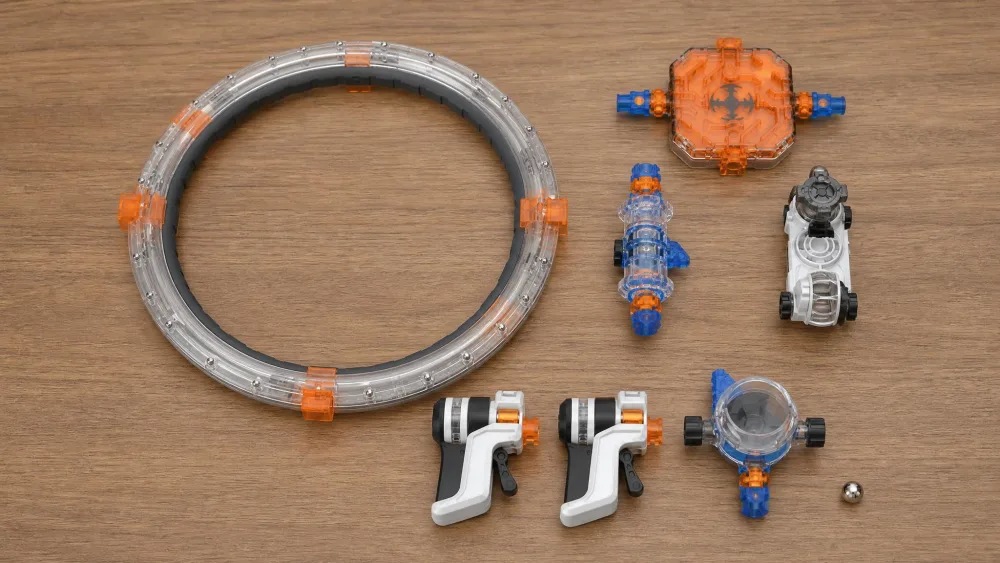
Building It: Assembly and First Impressions
Before you play, you build: the modules click onto the spherical base, and the controls attach so you can tilt and spin it. On comparable buildable Thames & Kosmos kits, parts are snap-together plastic guided by a step-by-step manual, and assembly reads more like a mix of Legos and a model car than a chore.
One honest caveat carries across this category: printed instructions can occasionally be confusing, and some parents reach for a video to sort out a step. So expect an approachable build, with maybe one fiddly module.
How long the build takes
There's no published build time yet, since there are no hands-on reviews, so we won't invent a number. Snap-together kits in this range usually go from box to first run in one sitting, not an afternoon-long project.
Difficulty and adult help needed
The maker's guidance is the anchor: 8 and up with help, 12 and up for independent play. That tracks with a build-then-steer toy, where younger kids enjoy it but want help on assembly.
How It Plays
The gameplay loop and challenge level
Once built, play is fast to grasp: launch the marble, then work the handles to walk it through. Early runs feel approachable, then a clean run turns out harder than it looks. On the gravity mazes we've played, that curve produces productive struggle, not frustration, and a marble that won't run cleanly first try is part of the loop, not a flaw.
The marble starts easy and ends humbling. That gap between “I've got this” and “wait, how do I finish?” is the appeal.
If this maze plays the way its category cousins do, the draw is that same easy-to-start, hard-to-master rhythm, and the older, independent end of the age band is usually where it hooks hardest.
Swappable modules and replayability
This is where the three modules earn their keep: swap one out and the run changes, and the difficulty levels give a path from “just learning” to “showing off,” keeping every session different.
What Kids Learn (STEM Value)
Engineering and spatial reasoning
The learning is baked into the play. Building the modules is light engineering, and steering the marble is a workout in spatial thinking, as kids read the maze in three dimensions, predict where gravity sends the marble, and adjust.

Problem-solving and persistence
Because a clean run is genuinely hard, kids practice trying, failing, and trying again without it feeling like homework, and the loop builds hand-eye coordination and fine motor skills.
Who It's Best For
Recommended age range
Age is the one spot where listings disagree. The maker's framing is best around 8 and up with help, and independent play closer to 12. Some resellers list 6-12 or 9-12+, but we'd lean on the maker: a capable 8-year-old will love it with help, and a tween can run it solo.
Skill level and attention span
This is a toy for kids who like a puzzle that pushes back. If your child gives up the moment something gets hard, it may frustrate; for a tinkerer, the modules let it grow with them.
Pros and Cons
Pros
- Build-it-yourself assembly makes setup part of the fun
- Three swappable modules add real replay value and a difficulty ladder
- Hands-on STEM: gravity, spatial reasoning, and fine motor skills in play
- No batteries to chase down; purely mechanical
- Space theme and Mission Capsule finish give kids a clear goal
Cons
- A single metal marble means a lost marble can stall play
- The 8+/12+ framing means younger kids will likely need help
- It's a preorder, so availability is uncertain right now
- Module durability is still unproven for this new product
How It Compares to Other 3D / Marble Mazes
We didn't run a head-to-head, so we'll keep this category-honest. The closest public analog with real reviews is the ThinkFun Gravity Maze, which uses challenge cards instead of swappable modules. Both reward spatial thinking, but the Orbital 3D Maze leans harder into build-and-steer. For other build-heavy Thames & Kosmos kits, see our Thames & Kosmos Architectural Engineering review and Thames & Kosmos Bionic Robotic Arm review.
Orbital 3D Maze vs. classic gravity mazes
| Feature | Orbital 3D Maze | ThinkFun Gravity Maze (analog) |
|---|---|---|
| Type | Build-it-yourself 3D spherical marble maze | Grid-based gravity logic maze |
| Age framing | 8+ with help, 12+ independent | 8+ |
| Build | Build three modules onto a sphere | Place towers per card |
| Reconfigurable | Yes, three modules swap | Yes, challenge cards |
| Marble | One metal marble | Metal marbles (multiple) |
| Price (list) | Around $35 | Varies |
Price, Availability, and Where to Buy
The official list price is $34.95, so plan on around $35, though resellers range from $34.99 up to $42.99.
NoteThis is a brand-new 2026 release on preorder. Books-A-Million lists availability around October 1, 2026, while the official store shows it backordered with no firm date. Treat October as an estimate, not a guaranteed ship date.
Frequently Asked Questions
What age is the Orbital 3D Maze for?
The maker frames it as best around 8 and up with help, and independent play closer to 12. Some resellers list 6-12 or 9-12+, but we'd lean on the maker.
How long does it take to build?
There's no published build time yet, since this is a brand-new release, though the modules click on rather than screw together, which usually keeps the build to a single sitting.
Are the modules reusable and reconfigurable?
Yes. Three swappable modules click in and out of the base, each with a different difficulty.
How is it different from a regular marble run?
A marble run drops a marble down a fixed track; here you steer a metal marble through a 3D maze with two handles.
When is it available?
It's listed for preorder, with availability expected around October 1, 2026. Check the retailer for current status.
Final Verdict