Snap Circuits Magnet Kit Review: Is the Magnet Fun Lab Worth It?
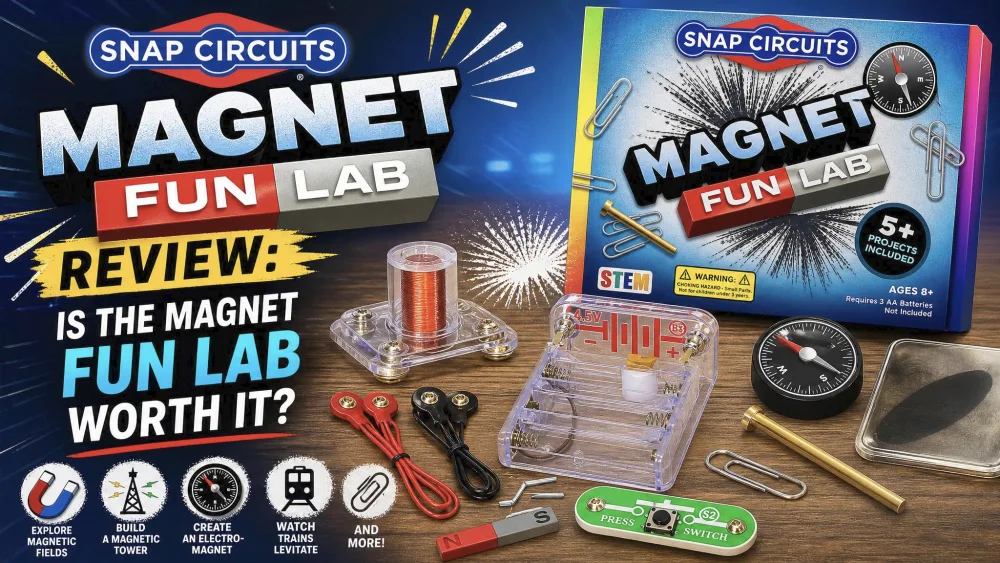
We pulled the Magnet Fun Lab onto the homeschool table on a slow afternoon, batteries already loaded, to see how a single-topic Snap Circuits kit would land with our kids. It is small, focused, and priced at about $30, which is unusual for a brand known for sets running into the hundreds of projects.
Quick Verdict
The Snap Circuits Magnet Kit, sold as the Magnet Fun Lab, is a narrow but well-made introduction to magnetism for kids 8 and up, packing a working electromagnet, a compass, iron filings, and 5+ guided projects into one tidy box. It will not replace a big general-electronics set, and it is not meant to. As a focused first look at magnetic poles, fields, and electromagnets, it does its one job cleanly.
What Is the Snap Circuits Magnet Kit?
The Snap Circuits Magnet Kit is the magnetism-focused member of Elenco's snap-together STEM family, sold at retail as the Magnet Fun Lab (model SCMM1, UPC 756619014920). Where the larger sets teach broad electronics, this one zooms in on a single theme: how magnets and electromagnets work, and how they power everyday technology.
The pitch is simple. Snap the labeled parts onto the base, follow the picture manual, and build experiments that show poles attracting and repelling, a compass finding north, and a coil becoming a magnet when current flows. It turns an abstract science-unit page into something a child can hold.
What's in the Box (5+ Projects)
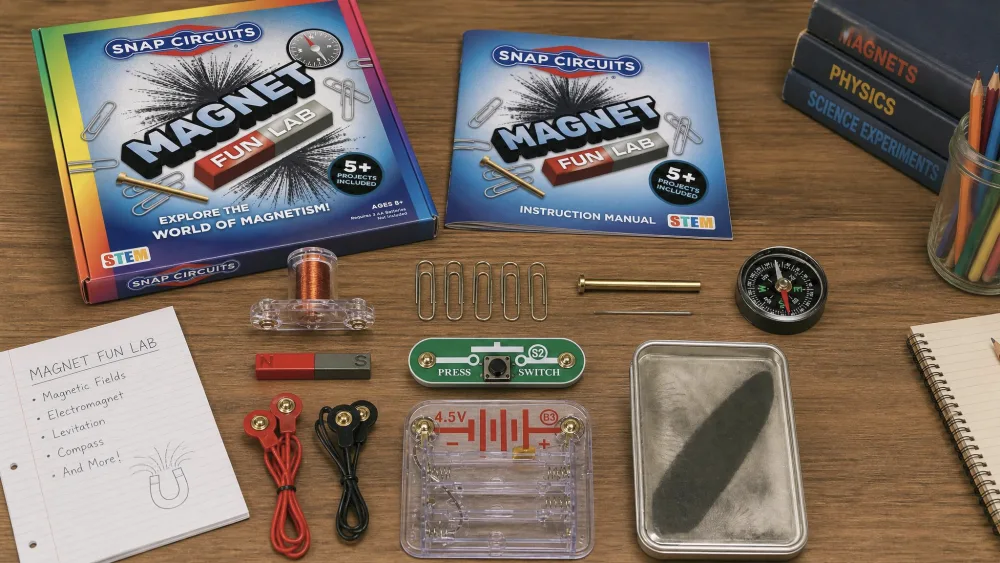
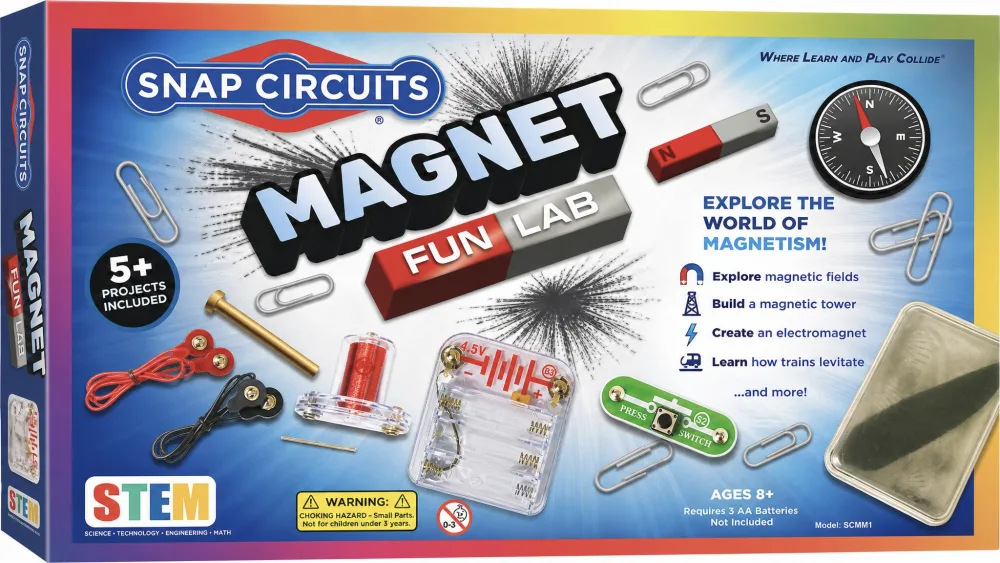
The kit ships with 16 pieces and a kid-friendly paper instruction manual. Inside you get a battery holder, a compass, a pack of iron filings, a red jumper wire and a black jumper wire, an electromagnet, an iron core rod, four paperclips, two magnets, a press switch, and a thin rod. Those parts combine into 5+ interactive magnet science projects, including the headline build: a working electromagnet.
That part count is deliberately lean: the kit hands a child exactly what they need to explore magnetism and nothing they do not. One practical note before you sit down: AA alkaline batteries are required and not included, so have a few on hand.
Recommended Age and Skill Level (Kids 8+)
Elenco rates the Magnet Kit for ages 8 and up, the same 8+ rating that runs across most of the Snap Circuits line, and eight is a sensible floor. The snap-together connection works like Lego, so the mechanical part is easy, but the concepts (poles, fields, electromagnetism) reward a child who can read the manual and think about cause and effect.
Younger kids can absolutely join in. In our experience with the broader Snap Circuits system, children under 7 usually need a parent beside them for the first few projects before they go solo. With magnetism specifically, the payoff comes when a child can connect what they see to a why, which lands best from about age 8.
Hands-On Review: Building and Testing
The first thing that strikes you about any Snap Circuits set is how forgiving the assembly is. The snap-together connection works like building with Lego, so even pre-readers can assemble parts after a parent starts the first project. The paper manual is easy to follow, which lets kids problem-solve independently rather than waiting for an adult to translate every step.
The Magnet Fun Lab follows the picture diagrams the same way, and an 8-year-old works through them much like Lego build steps, largely on their own. There are four guided magnet activities plus extras, 5+ in total, running in a sensible order: simple magnet and compass play first, then the magnetic-field work, then the powered electromagnet, and finally a magician-style trick. That gentle ramp keeps a first-timer moving without an adult narrating every snap, and the iron filings were the early hit in our house, shifting and lining up inside their clear container so the field appears in front of them.
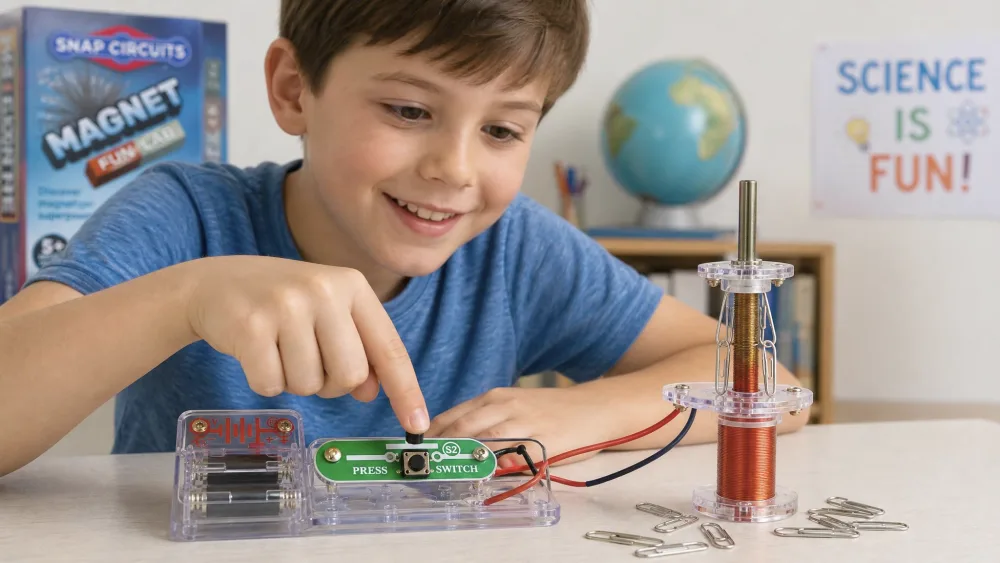
The electromagnet build is the moment that lands, though. The iron core rod slides into the coil, the battery holder and press switch snap in, and pressing the switch makes the coil grab the paperclips and drop them the instant you let go. That on-again, off-again cause and effect is the payoff our kids replayed long after the build was finished.
NoteAcross our time with the Snap Circuits system, two things hold true and shaped how we read this kit. Once a child is shown the snap connection, even a five-year-old can finish a project on their own, because the parts fit one way and the picture manual carries the load. And finished builds rarely get packed away straight off; our kids treat a working circuit as a new toy and keep playing for days, exactly the behavior a magnetism kit wants to spark.
Setup and Ease of Use
Setup is genuinely quick. Load the AA batteries, open the manual to project one, and snap. With Snap Circuits sets in general, kids built a working circuit within about ten minutes of opening the box, and the Magnet Fun Lab follows the same pattern: few parts, clear pictures, no tools.
The one snag worth knowing across the Snap Circuits range is that connection points on multi-pin pieces are not always labeled, which can briefly stall a child mid-build until a parent points to the right snap. Once the first project clicks, the rest is smooth.
Parent tipHave your AA batteries ready before project one. They are not included, and nothing stalls a build faster than an empty holder once the parts are snapped together.
The Magnet, Compass, and Electromagnet Projects
The projects walk a child from simple to satisfying. Early builds use the two magnets and paperclips to show poles attracting and repelling. The compass project demonstrates how a magnetized needle finds north, the same principle sailors relied on for centuries, and the iron filings make the invisible visible: scatter them near a magnet and the field lines appear.
The centerpiece is the electromagnet, a clean and repeatable demonstration of how an electromagnet works: wrap current through the coil and iron core, press the switch, and an inert rod lifts paperclips. That moment, when a child realizes electricity made a magnet, is the whole point of the kit.
What It Teaches (Magnetic Poles, Fields, Electromagnetism)
The science here is tightly scoped and useful, and what we appreciate most is the order: the kit builds intuition first (poles, then fields you can see), then introduces the electromagnet as the payoff that ties electricity to magnetism, and finally connects it all to how magnets power everyday technology like doorbells and motors. That progression mirrors how the concepts actually connect, which makes the learning stick better than a worksheet does.
Durability and Build Quality
Snap Circuits has a strong reputation for build quality, and the engineering is the same here. The plastic base grid resists cracking even when dropped, and the snap connectors hold up to repeated reconnection, rated for thousands of connections. Parts get pulled apart and rebuilt constantly, and the system is designed for exactly that.
The honest caveat, drawn from the wider line, is that small pieces can feel fragile and a few instructions could use more detail, particularly the unlabeled connection points on multi-pin parts. One quality note is specific to the magnet builds: electromagnet strength varies from unit to unit. Most are plenty strong, and a working one can be lively enough to knock magnetic letters off the fridge as it passes, but a weaker one turns up now and then. None are dealbreakers, just the rough edges to expect.
NoteThe Magnet Fun Lab is a new release, so there are no customer star ratings yet at major retailers. We are judging it on the kit's design, the components in the box, and our hands-on experience with the Snap Circuits system, not on an aggregate score.
Who Should Buy It (and Who Should Skip It)
What makes the Magnet Fun Lab work is that its narrowness is deliberate, and that choice points at one kind of buyer. If you have a child mid-way through a magnetism science unit, this kit matches a curriculum chapter almost one to one: poles, fields, compass, electromagnet, in roughly the order a teacher would introduce them. The same fit makes it a strong gift for the science-curious child who does not yet own anything from the brand, because it is the lowest-cost door into a system they can grow inside later. Homeschoolers get a third bonus: it runs as a single sit-down activity with no prep, no tools, and a manual a child can follow alone.
It is just as important to be honest about who should walk past it. A child who wants to keep inventing new builds for weeks will exhaust this box in a session or two, because magnetism is the entire scope. That buyer, and anyone wanting a single do-it-all electronics lab, is better served by a broader set from the start; the Magnet Fun Lab is a specialist, not the only kit on the shelf. The pros and cons grid below lines up the trade-offs at a glance.
Pros
- Hands-on magnetism learning: poles, compass, fields, and a working electromagnet
- Snap-together ease with no tools and a fast first success
- Classroom- and homeschool-friendly with a clear paper manual
- Affordable entry to the Snap Circuits system at around $30
Cons
- Small project count (5+) and narrow scope versus larger sets
- Requires AA batteries that are not included
- A few project instructions could use more detail
How It Compares to Other Snap Circuits Kits
The Magnet Fun Lab only makes sense next to its siblings: it is the cheapest and narrowest of the bunch, built around one science topic rather than general electronics. The table below lines it up against the three sets we have reviewed in depth, plus Snaptricity, the one other Snap Circuits kit that covers magnetism.
| Product | Age range | Project count | Magnetism concepts | Price tier |
|---|---|---|---|---|
| Magnet Fun Lab (SCMM1) | 8+ | 5+ | Magnetic poles, compass, fields, electromagnet | ~$30 |
| Snap Circuits Classic SC-300 | 8+ | 300+ | None (general electronics) | ~$76 |
| Snap Circuits Jr. SC-100 | 8+ | 100+ | None (intro electronics) | ~$38 |
| Snap Circuits Beginner SCB-20 | 5-9 | 20+ | None (switches/circuits) | budget |
| Snaptricity SCBE-75 | 8+ | 75+ | Magnetic fields, electromagnetism, electricity | ~$71 |
Magnet Kit vs Snap Circuits Classic SC-300
The Snap Circuits Classic SC-300 review covers the brand's flagship: over 300 projects and 60+ parts for general electronics like AM radios, alarms, and motor builds, around $76 and rated 8+. It is the better buy if you want one kit that lasts years, but it does not focus on magnetism the way the Magnet Fun Lab does.
Magnet Kit vs Snap Circuits Jr. SC-100
The Snap Circuits Jr. SC-100 review is the value pick: over 100 projects and 28 parts for around $38, rated 8+. It is broader and a stronger first general-electronics set, but it teaches intro electronics, not magnetism.
Magnet Kit vs Snap Circuits Beginner
The Snap Circuits Beginner review covers the younger-child entry kit, with over 20 projects and 14 parts. Most retailers list it for ages 5-9, though the broader line carries an 8+ rating, and its larger connectors suit smaller hands. It covers switches and basic circuits, not magnetism, so it complements rather than competes with the Magnet Fun Lab.
Magnet Kit vs Snaptricity (SCBE-75) for Magnetism
Snaptricity is the closest sibling on subject. With over 75 projects and 40+ parts for around $71, it teaches both electricity and magnetism: fields, electromagnetism, static electricity, and how home circuits work, and its manual ties magnetism to things kids recognize like doorbells and maglev trains. If you want magnetism plus the wider electronics story, Snaptricity is the deeper buy; if you want just magnetism at a third of the price, the Magnet Fun Lab wins on focus and cost.
Is the Snap Circuits Magnet Kit Worth Buying?
For the right buyer, yes. The Magnet Fun Lab earns its $30 by delivering a real electromagnet, a compass, visible fields, and a clean conceptual progression, all with the snap-together ease the brand is known for. The value is not in how many hours it fills but in how cleanly it makes one slippery topic concrete, which is exactly what a focused kit should do. It stops being the right call only when your need turns broad. Judged on its own terms, the Magnet Kit is a confident recommendation.
Frequently Asked Questions
Do I need extra Snap Circuits parts to get more out of it?
No, the Magnet Fun Lab is complete on its own for the projects it ships with, and you do not need add-ons to finish them. The parts use the same snap-together system as the rest of the line, so if you already own a bigger set, you can keep tinkering with magnets and coils past the guided builds.
Is the electromagnet strong enough to be useful or just a demo?
It is a real, working electromagnet, not a token gesture. A good one picks up the supplied paperclips on demand and can be lively enough to knock magnetic letters off a fridge as it passes. Strength varies from unit to unit, so most are plenty strong while a weaker one turns up now and then, but the core lesson, electricity making and unmaking a magnet, comes through clearly either way.
Does it require soldering or any tools?
None at all. Every part snaps onto the base grid by hand, the same way the rest of the line works. There is nothing to solder, screw, or glue, which is a big part of why an 8-year-old can run the projects without an adult doing the fiddly bits.
Which AA batteries does it need, and how many?
The kit uses standard AA alkaline batteries, and they are not included, so plan to supply your own before you build. The official and retail listings we checked confirm AA cells are required but do not state the exact number, so check the battery holder or manual when your kit arrives and have a few AAs ready just in case.
Is the Magnet Kit compatible with other Snap Circuits sets?
It uses the same snap-together system as the rest of the line, so parts behave the same way. We did not find an official statement confirming guaranteed cross-set part interoperability for this specific kit, so treat it as snapping like other Snap Circuits rather than a confirmed expansion module.
Can it be used in classrooms or for homeschool?
Yes. It is designed to be classroom- and homeschool-friendly, with no tools required and a kid-friendly paper manual, which makes it easy to run as a focused magnetism activity.
Final Verdict
The Snap Circuits Magnet Kit knows exactly what it is: a focused, affordable magnetism starter for kids 8 and up. For about $30, a child gets a real electromagnet, a compass, visible fields, and the satisfying moment when electricity makes a magnet. It earns its place with the homeschooler teaching a magnetism unit and the gift-giver who wants the lowest-cost door into the Snap Circuits system. If you want breadth instead of focus, reach for Snaptricity or a larger general-electronics set; but judged as the specialist it is, the Magnet Fun Lab is an easy kit to recommend.