Sillbird 12-in-1 Solar Robot Building Kit Review: Our Hands-On STEM Test
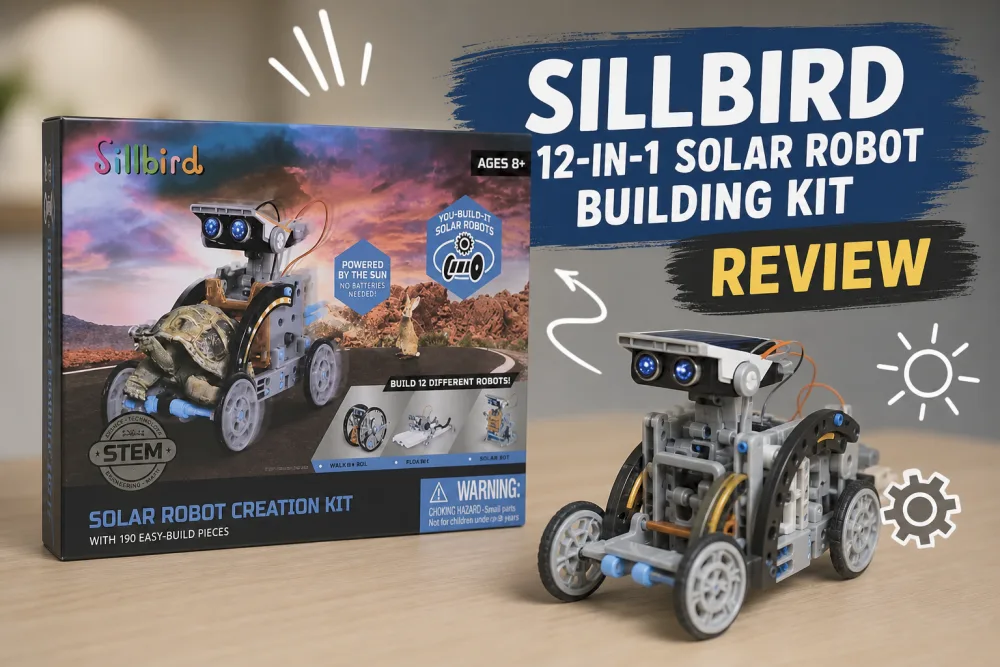
We pulled the Sillbird 12-in-1 Solar Robot Building Kit out of its box on a sunny Saturday and let our nine-year-old start with the simplest of the 12 designs. By the time the first builds were done, the solar panel was driving a little robot across the porch, and the questions about how the sun moved the motor started rolling in. That is the screen-free afternoon we hoped for when we bought this kit ourselves.
This is a budget STEM kit, so we went in with measured expectations. After working through a chunk of the 12 builds and testing the solar panel in sun, shade, and indoor flashlight, we have a clear sense of where it earns its popularity and where it asks for patience.
NoteWe bought the 190-piece Sillbird 12-in-1 kit with our own money and built it alongside our nine-year-old over a couple of weekends. We worked through several of the 12 designs, ran the solar panel outdoors in direct sun and indoors under a flashlight, and noted what slowed us down and what kept our kid coming back.
Quick Verdict
For the price, the Sillbird 12-in-1 is one of the best value entry points into robotics and renewable-energy STEM we have tested. It is screen-free, reconfigurable across 12 builds, and powered by the sun, which sparks real conversations about how energy works. It is not flawless: the parts are soft, the manual is small, and cloudy days stall progress. But as a first solar robot for a curious 8-to-13-year-old, it delivers far more than its price suggests.
How We Tested It
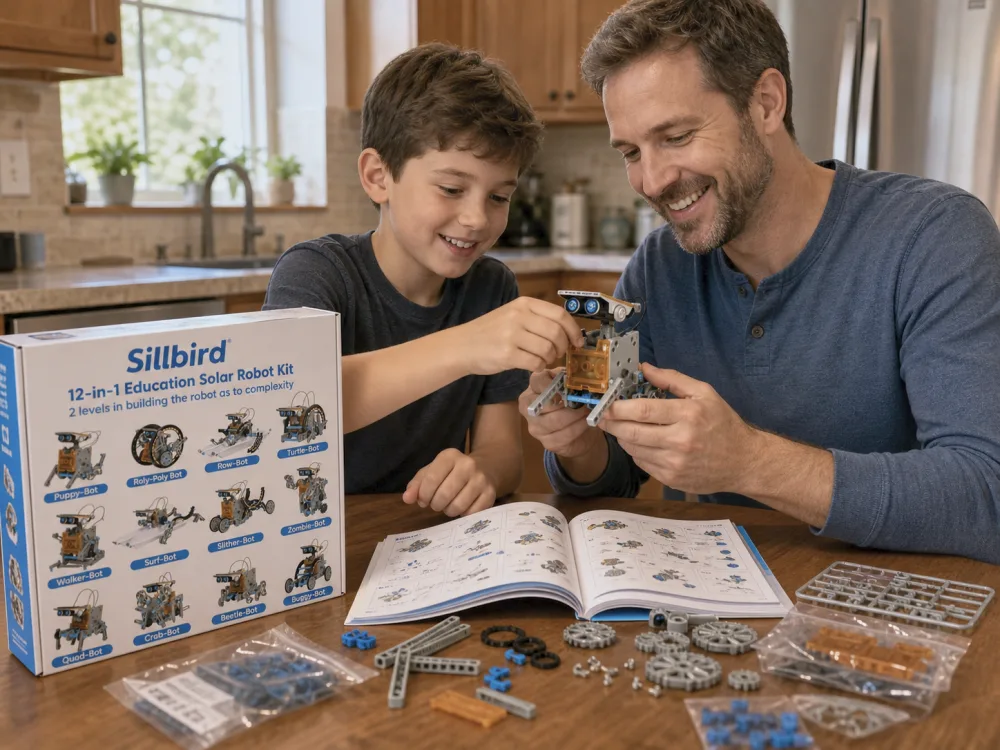
We bought the 190-piece kit ourselves and built it at our kitchen table with our nine-year-old, working through several of the 12 designs across two weekends. We started with the Level 1 builds, then moved into the slower Level 2 ones to see how the difficulty curve felt for a kid in the middle of the 8-13 band. We ran the finished robots in direct sun, in shade, and indoors under a flashlight, scoring on build experience, instruction clarity, solar performance, durability, and value.
What Is the Sillbird 12-in-1 Solar Robot Building Kit?
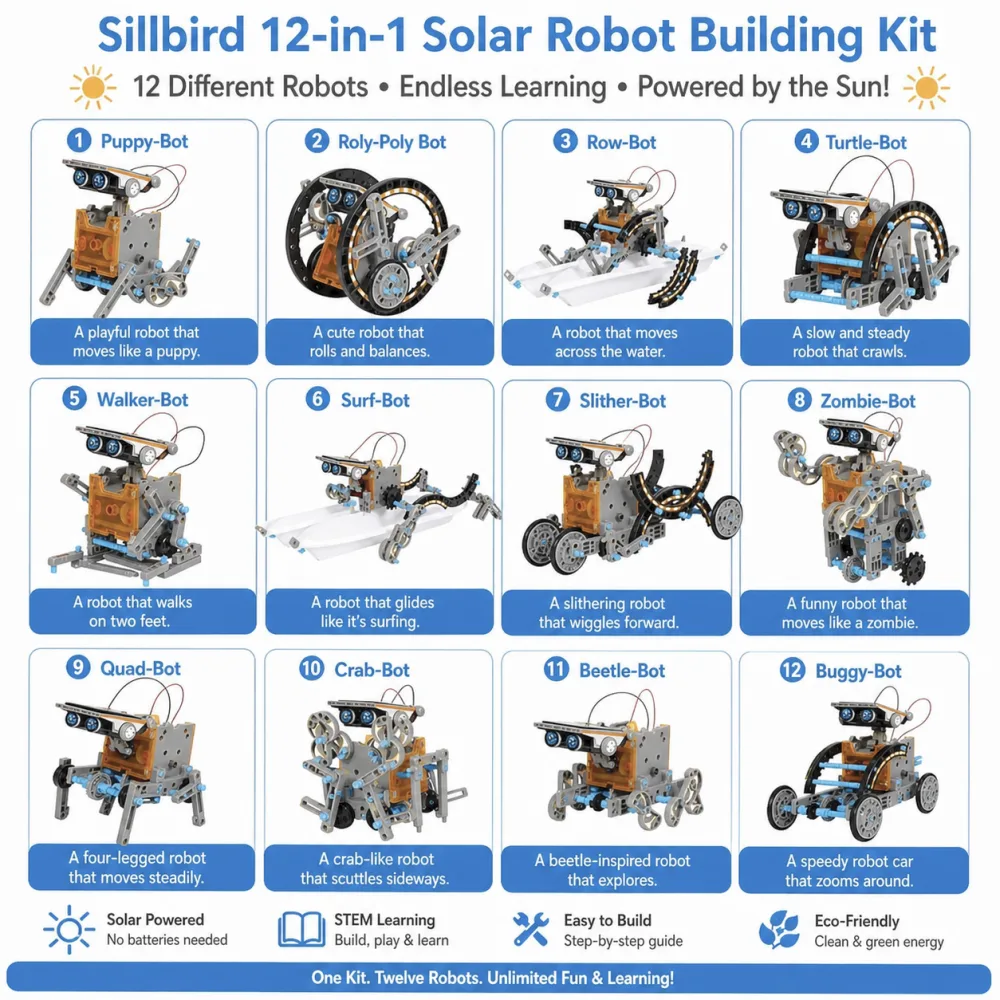
The Sillbird 12-in-1 is a snap-together robotics set that builds 12 different solar-powered robot designs from one shared bag of parts. You assemble a robot, attach the solar panel, take it into the sun, and watch the panel drive a small motor that makes it crawl, roll, or shuffle along. When your child wants something new, it comes apart and the same pieces rebuild into the next design. According to Sillbird's official store, the kit is built around progressive difficulty, from beginner up to advanced models.
Specifications at a Glance
Here are the core specs for the 190-piece kit we tested (Amazon ASIN B07T1NZD27).
| Spec | Sillbird 12-in-1 |
|---|---|
| Pieces | 190 |
| Robot designs | 12 |
| Difficulty | 2 levels (beginner to advanced) |
| Age range | 8-13 |
| Power | Solar, with flashlight as an indoor alternative |
| Material | Non-toxic ABS plastic |
| List price | $24.99 |
The one most reviews describe, and the one we tested, is the 190-piece version, listed at roughly 10.24 x 7.87 x 2.56 inches (box size); sibling SKUs carry 196 to 212 pieces.
What's in the Box
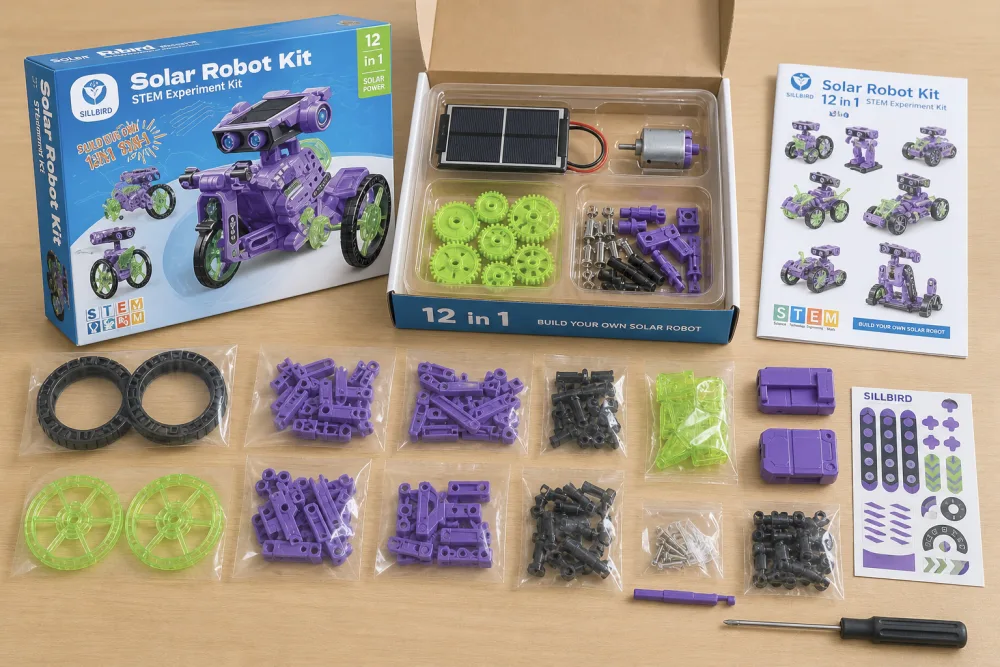
You get 190 snap-together pieces, gears, the solar panel and motor that power every build, and a step-by-step illustrated manual. The pieces are molded from non-toxic ABS plastic with smooth edges. The same 190 pieces are reused across all 12 designs, so there is no separate parts bag per robot. That keeps it reusable but means one lost or broken piece can affect several models.
Watch outThis kit contains small parts and gears and is rated for ages 8 and up. Keep it away from younger siblings, and supervise the early builds so tiny components do not go missing under the table.
Building Experience and Instructions
Assembly is where this kit shows both its charm and its rough edges. The snap-together design is satisfying, and the manual keeps each build from descending into chaos. Each finished robot lands as a small, fresh victory that kept our kid reaching for the next design.
That said, the booklet is small and not color-coded. A younger child in the 8-13 range usually cannot follow it solo and needs a parent alongside, especially once the Level 2 builds start. The most common reason a finished robot would not move was a gear too tight or misaligned, so we learned to free the gears and spin them by hand before expecting the motor to turn them.
The build is a string of small victories, but each one earns the next, and that is what keeps an eight-year-old in the chair.
Difficulty Levels (Level 1 vs Level 2 Builds)
The 12 designs span two difficulty levels. The Level 1 builds are quick early wins, simple enough that a confident nine-year-old can mostly handle them with light help. The Level 2 builds are slower, demand patience, and sometimes need a second pair of hands while gears seat correctly. Adult supervision is genuinely recommended for the younger end of the range, because the harder builds will frustrate a kid working alone.
The 12 Robot Designs
Because all 12 designs draw from the same 190 pieces, your child only ever has one robot assembled at a time, then breaks it down to build the next. We did not get through all 12 in our window, but the variety kept the novelty alive and the climb from easy to harder models gave a real sense of progression.
Solar Performance in Real Use
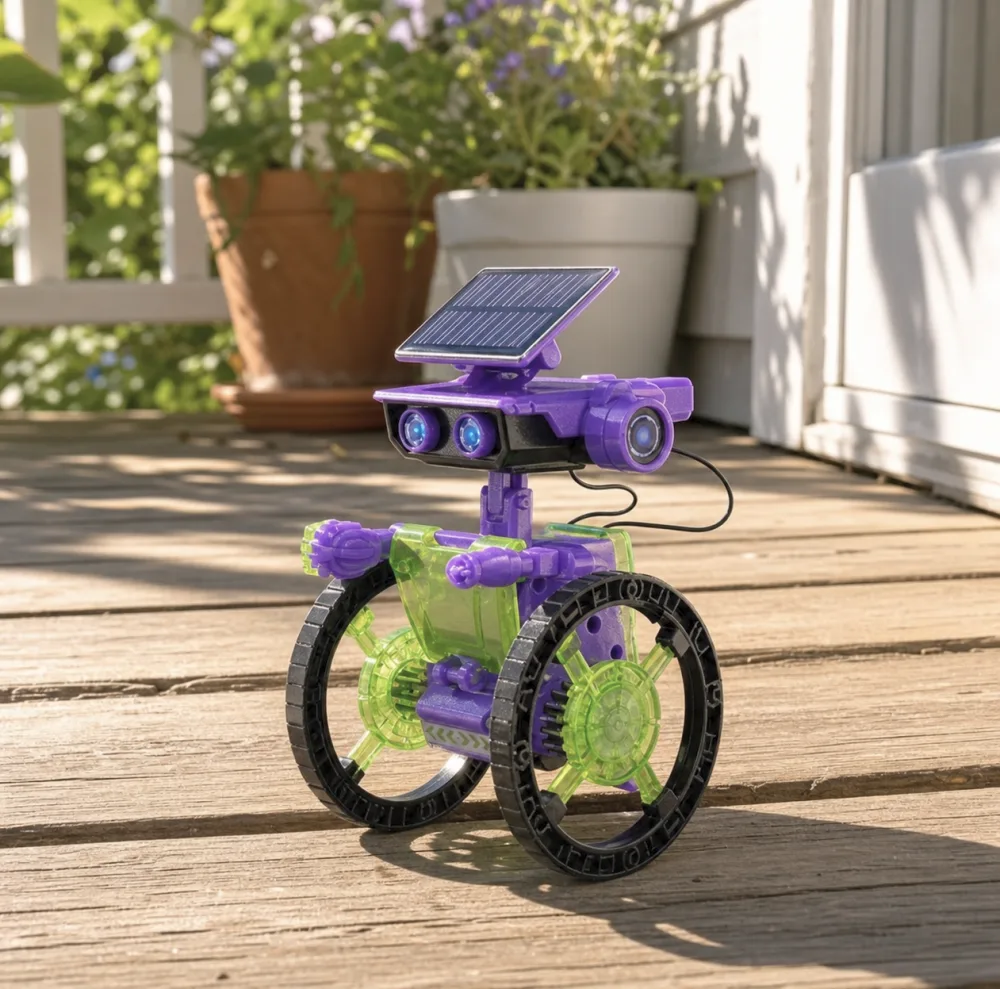
The solar panel is the whole personality of this kit, and it behaves exactly like a real one should, which is both the educational win and the practical catch. In direct, strong sunlight, the panel drove the motor confidently and our robots moved with purpose, and the upgraded, larger panel noticeably out-powered the tiny panels on cheaper solar toys. It is also a great moment to talk with kids about how solar panels generate power from light; when our kid asked why the robot stopped the second a cloud rolled over, the answer was right there.
Sunlight vs Indoor / Flashlight Power
The honest limitation: solar mode needs real, direct sunlight to drive the motor well. On cloudy days or a rainy weekend, progress stalls until the sun returns, which frustrates a kid who just wants to see their robot move. Indoors you are not entirely stuck: the robot runs off a strong artificial light, and a bright flashlight held close to the panel works as a stand-in for the sun. It is dimmer and less reliable than daylight, but it kept things moving on overcast afternoons.
NoteThe 190-piece kit we tested is the sun-powered version. Some sibling SKUs in the Sillbird 12-in-1 line add a battery or dual-drive mode for cloudy-day backup, so check the exact listing if reliable indoor power matters to you.
Educational and STEM Value
This is where the kit punches above its price. Building the robots teaches hands-on mechanical assembly, gears, and cause-and-effect troubleshooting, while the solar panel quietly introduces renewable energy in a way kids can see and feel. When a robot stops in the shade and starts in the sun, the lesson about clean energy needs no lecture. That blend of robotics and real-world energy is exactly the inquiry-driven learning that groups promoting STEM learning benefits point to, and the troubleshooting alone teaches real persistence.
Durability and Build Quality
Durability is the kit's most frequent complaint, and our testing lines up. The ABS plastic is soft enough that pieces can deform if a child forces a part, and we spent real time adjusting fit so the motor would engage. Some buyers report fragile or broken parts in the box, and build quality is the most common gripe despite the kit's popularity. On the brighter side, the parts disassemble cleanly and the 190 pieces are reusable across all 12 designs, so kids can rebuild repeatedly without the components wearing out.
Who It's Best For (Age and Skill Level)
This kit is best for a curious 8-to-13-year-old who enjoys building and does not mind trial and error. For the younger end of the range, plan to build together, especially on the Level 2 designs. It is also a strong pick for budget-conscious families and group settings: one reviewer bought it in bulk for a robotics summer camp, and every kid walked away with a working robot they had built themselves. If your child wants a fully solo experience or a robot that moves regardless of weather, this is not the right kit.
Pros and Cons
Pros
- Excellent value for a robotics and renewable-energy STEM kit
- Completely screen-free, powered by the sun
- 12 reconfigurable builds from one set of 190 reusable pieces
- Real solar lesson kids can see and feel
- Upgraded larger panel out-powers cheaper solar toys
Cons
- Needs strong, direct sunlight; weak indoors and on cloudy days
- Soft ABS plastic can deform and some parts arrive fragile
- Small, non-color-coded manual; younger kids need parent help
- Only Level 1 and Level 2 builds, no advanced tier
What Owners Are Saying
The Sillbird 12-in-1 is one of the most popular budget solar kits on the market. Amazon lists it at around 4.3 stars, and that score shows up consistently across reviews of the kit. The review total is harder to pin down: listings point to 15,000-plus ratings, but that figure almost certainly pools several of the brand's 12-in-1 SKUs and snapshots, so we treat the count as a rough signal of popularity rather than a precise tally. The pattern matches our experience: owners love the value and the screen-free, sun-powered learning, and the recurring complaint is build quality and the occasional broken piece. One reviewer who built six of the 12 configurations called the kit's popularity justified, describing it as the most battle-tested budget solar option out there.
How It Compares to Other Solar Robot Kits
The Sillbird is not the only 12-in-1 solar robot on the shelf. The Lucky Doug 12-in-1 STEM Solar Robot Kit is its closest twin: 190 pieces, 12 designs, ages 8-13, but solar-only and usually a few dollars more at around $26.30. The OWI Robotikits 14-in-1 steps up to 14 modes and about 201 parts with solid build quality, but it is a harder build at roughly $39.99.
For robotics fans, it is worth browsing a related robotics build: the Bionic Robotic Arm review and another hands-on STEM kit we tested: the Mega Cyborg Hand. If the solar angle is the draw, more solar-themed science: our Orbiting Solar System review is a natural next step.
Price and Overall Value
At a list price of $24.99, the Sillbird 12-in-1 is hard to beat on value. Amazon pricing fluctuates, sometimes well below list, so check the live price, but even at full MSRP you get 12 buildable robots and a real solar lesson for the cost of a single boxed toy. You accept soft plastic and a fiddly manual, and in return get one of the most affordable, genuinely educational robotics kits going.
Frequently Asked Questions
Does the Sillbird 12-in-1 need batteries or only sunlight?
The 190-piece kit we tested is powered by the sun, so it needs no batteries. Some sibling versions add a battery or dual-drive mode, so check the listing if you want a no-sun backup.
Will it work indoors or on cloudy days?
It works best in direct, strong sunlight. On cloudy days progress stalls, but indoors you can run it off a bright flashlight held close to the solar panel.
What age is the Sillbird 12-in-1 best for?
It is designed for ages 8-13. Younger builders in that range will need a parent's help, especially on the Level 2 designs.
Is adult supervision needed?
We recommend it. The kit has small parts, and the harder builds and gear adjustments go much more smoothly with a parent alongside the child.
Are the 190 pieces reusable across all 12 designs?
Yes. The same 190 pieces disassemble and rebuild into every one of the 12 designs, so kids can rebuild repeatedly without wearing the parts out.
Is the plastic non-toxic and safe?
The pieces are molded from non-toxic ABS plastic with smooth edges. The plastic is soft, so teach kids not to force parts together.
Final Verdict
After building several of the 12 designs and testing the solar panel in sun, shade, and flashlight, we land at a confident recommendation with clear caveats. The Sillbird 12-in-1 is a standout budget solar robot kit: screen-free, reconfigurable, and genuinely educational, with value that outclasses its price. The soft plastic, the small manual, and the solar dependence are reasonable trade-offs at $24.99. If you have a curious 8-to-13-year-old, a sunny spot, and the willingness to build together on the harder models, this kit earns its popularity and our 8/10. It is a first solar robot we would happily buy again.