Thames & Kosmos Orbiting Solar System Review: Build a Working Orrery
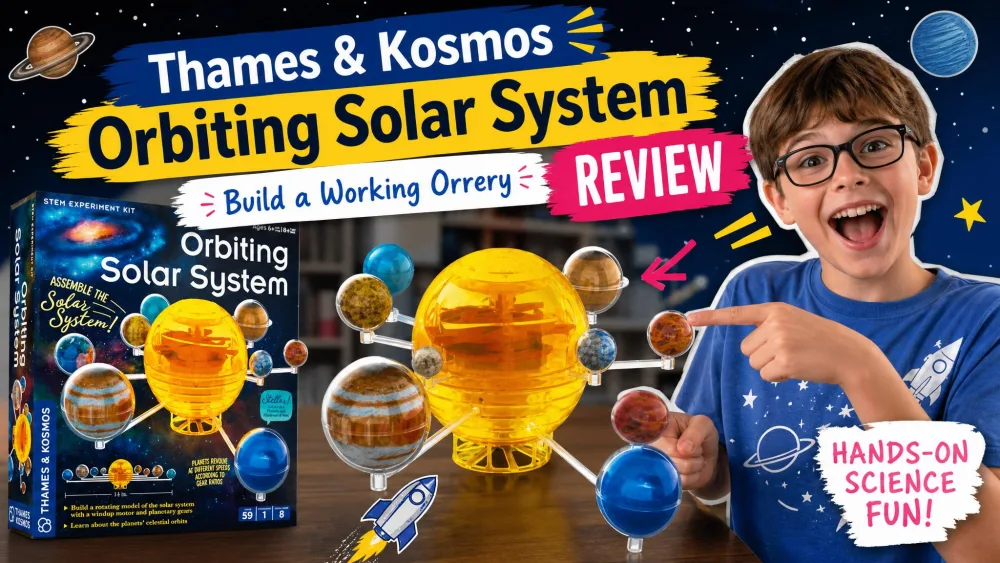
We cleared the dinner plates one evening and spread this kit across the table, expecting fiddly frustration. Instead the snap-together pieces clicked along steadily, and the moment a young hand cranked the windup motor and watched the planets sweep around the sun, the whole table leaned in. That single spin is what this kit is selling, and it mostly delivers.
Quick Verdict
The Orbiting Solar System is a charming, affordable model that turns abstract planet science into something a child can hold and crank. It teaches real gear mechanics with no batteries, and the finished piece looks lovely on a shelf. The one honest catch is the short spin time, which we'll get to.
Who it's best for
This is a strong pick for a curious kid who loves space and likes building things that move. It suits a patient builder who enjoys illustrated steps, and makes a tidy gift for a young astronomer.
What's in the box
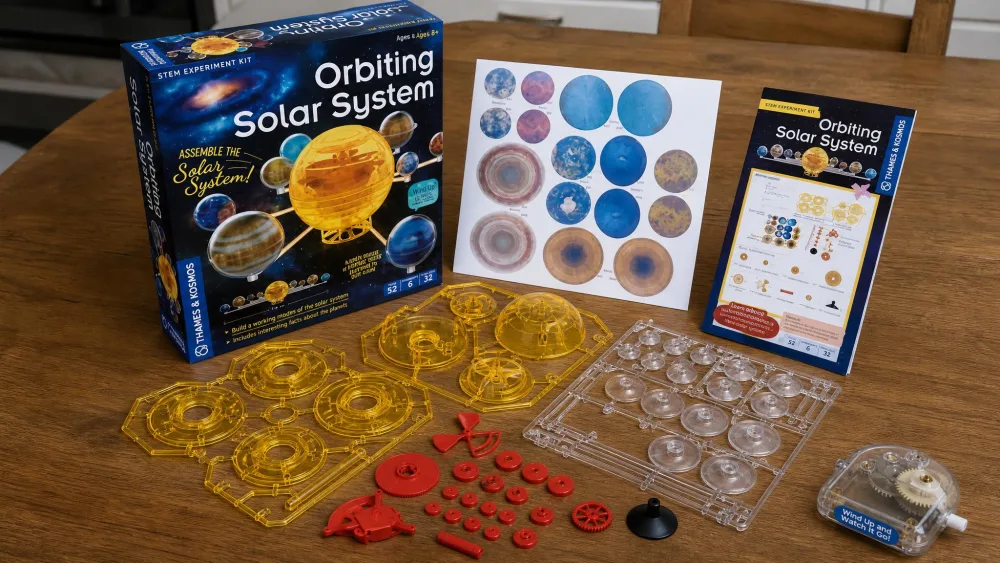
You get 59 snap-together plastic parts, a windup motor unit, printed color planet graphics, and a full-color instruction booklet. There are no batteries to buy and none included, because the motor is purely mechanical. You will want scissors or diagonal cutters on hand to free the parts from their frames.
What Is the Orbiting Solar System Kit?
The orrery concept explained
An orrery is a moving model of the solar system, with the planets circling the sun as they do in space. You can read more about what an orrery is if your kids get curious. This kit builds a small one, with the sun plus all eight planets riding on arms above a geared base.
Wind-up motor, no batteries required
The clever part is the power. You wind a small spring-driven motor by hand, let go, and the planets revolve. There are no batteries, no charging, and no app to manage.
Building the Model: Our Assembly Experience
Difficulty level and build time
Thames & Kosmos labels the build Intermediate, and that feels about right. The steps are logical and the parts are clearly numbered, but a few gear placements need a careful hand. The kit lists assembly at about one to two hours, which matched our focused session, though a younger builder may want to split it across an afternoon.
NoteWe built this one ourselves at home and found the assembly wasn't hard, just methodical. The gears want firm, deliberate pressure to seat properly, and rushing a snap is how you end up with a wobble later. Plan a calm stretch of table time rather than a quick pre-bedtime build.
Snap-together parts and the instruction booklet
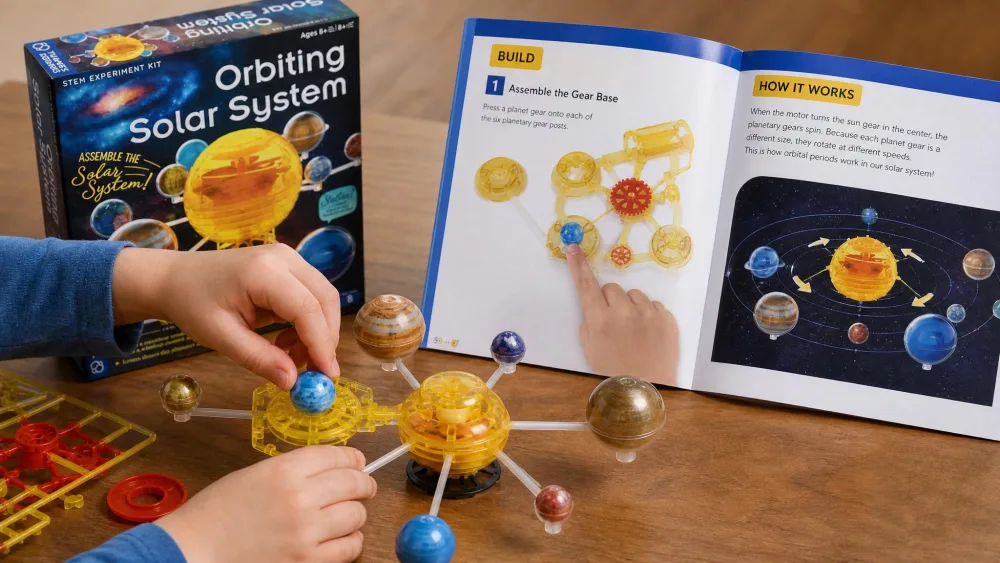
The booklet uses big, full-color illustrations rather than dense text, which is friendly for newer readers. Most steps are pure snap-together work that rewards patience over force. One step needs grown-up help: the parts come attached to plastic frames, and you'll need scissors or diagonal cutters to free them, so an adult usually handles that bit.
Parent tipPress each part firmly until you feel and hear it click fully home. Half-seated gears are the most common cause of a planet that drags once you wind the motor, and reseating them later is fiddlier than getting it right the first time.
The STEM Learning: What Kids Actually Learn
Planetary gears and gear ratios
This is where the kit quietly earns its keep. At the heart of the model is a planetary gear, an arrangement where small gears travel around a central one. If you want the grown-up version, here's a primer on planetary, or epicyclic, gearing. Building it by hand gives kids a real feel for gear ratios and why turning one part makes another spin faster.
Order, size, and orbits of the eight planets
Once it runs, the model shows the sun and eight planets revolving at different rates, with the inner planets racing around while the outer ones crawl. It's a tidy, physical way to teach planet order and relative size. We kept NASA's solar-system overview open on a phone to check facts as questions came up.
Watching a child connect "this gear spins faster" to "that's why Mercury laps Neptune" is the moment this kit stops being a toy and starts being a lesson.
The bonus Planet Nine expansion slot
A small, memorable touch: the model includes a built-in expansion slot for a future Planet Nine, in case the long-hypothesized world is ever confirmed. It sparked a great conversation about how science changes when we discover something new.
Play Value and Display
How the finished orrery looks and moves
The finished model is genuinely attractive, roughly 11 inches across, with bright printed planet graphics. Here's the honest catch we promised: once wound, the planets only orbit for about 5 to 10 seconds before slowing to a stop. Kids expecting a long, hands-off show can feel let down, so it helps to frame it as "wind, watch, wind again."
Science-fair project potential
It works nicely as a centerpiece for a classroom or school project on the planets or on gears. A child can explain how the windup motor drives the planetary gear and demonstrate the orbits live.
Specifications at a Glance
| Spec | Detail |
|---|---|
| Price (MSRP) | $29.95 (model 550037) |
| Recommended age | 6+ (realistically around 8+) |
| Build difficulty | Intermediate |
| Pieces / power | 59 parts; windup motor, no batteries |
| Box / weight | Approx. 11 x 10 x 2.6 in; under a pound |
| To scale / tools | No; scissors or diagonal cutters needed |
Age, Safety, and Supervision
Choking-hazard / small-parts warnings
This kit carries a small-parts choking-hazard warning and is not suitable for children under 3. There are several tiny gears and pegs, so younger siblings should be kept clear during and after the build, and adult supervision is sensible for the cutting step.
Watch outThis kit contains small parts and is not suitable for children under 3 due to a choking hazard. Keep loose gears and pegs away from toddlers, and have an adult handle the scissors or diagonal cutters used to free parts from their frames.
Recommended age vs. real-world fit
Here's where we'd gently set expectations. Thames & Kosmos lists the kit for ages 6 and up, but the Intermediate difficulty means a six-year-old will likely need a parent alongside them. In our experience it's a more comfortable, independent build for kids around 8 and up, with younger children enjoying it most as a shared project.
Pros and Cons
Pros
- It runs on a windup motor, so you never need batteries or charging
- It teaches real gear ratios and introduces the planetary gear hands-on
- The snap-together parts make most of the build approachable for kids
- The finished orrery displays well and works as a school-project centerpiece
- It includes a charming expansion slot for a hypothetical Planet Nine
Cons
- The Intermediate difficulty can frustrate younger builders working alone
- All the parts are plastic, which feels less premium than some kits
- The model is not built to true scale, so sizes and distances are simplified
- A child often needs adult help to cut parts free and seat the trickier gears
How It Compares to Other Thames & Kosmos STEM Kits
Versus the Orbital 3D Maze and other space/mechanics kits
If your kid loves the space theme but wants more replay than a short orbit, the Thames & Kosmos Orbital 3D Maze review is the closest sibling to weigh. For older builders chasing a bigger challenge, the Thames & Kosmos Mega Cyborg Hand STEM kit review and the Thames & Kosmos Architectural Engineering review cover meatier projects. Here's how they stack up:
| Spec | Orbiting Solar System | Orbital 3D Maze | Mega Cyborg Hand | Architectural Engineering |
|---|---|---|---|---|
| Price | $29.95 | $34.95 | ~$39.95 | ~$49.95 |
| Age | 6+ (~8+) | n/c | ~7-10+ | 8+ |
| Difficulty | Intermediate | n/c | High | Intermediate-High |
| Power | Windup | Gravity | Hydraulic | Static |
| Science fit | Yes | Lower | Yes | Yes |
The Orbiting Solar System is the most affordable of the four and the gentlest commitment, a friendly first mechanical kit before the bigger builds.
Where to Buy and Price
The kit lists at $29.95, and reviewers often call it about the most affordable orrery you'll find. Read ahead in the official assembly manual.
Frequently Asked Questions
What age is the Orbiting Solar System kit for?
Thames & Kosmos recommends ages 6 and up. Because the build is rated Intermediate, it's a more comfortable independent project around age 8 and up, while younger kids do best with a parent helping.
How long does it take to build?
The kit lists assembly at about one to two hours of focused work, though younger builders may prefer to split it across an afternoon.
Does it need batteries?
No. The planets run on a hand-wound spring motor, so there are no batteries to buy, charge, or replace.
Is the model built to scale?
No. Planet sizes and distances are simplified so the model fits on a desk. It shows order and motion, not exact scale.
What is an orrery, and what is a planetary gear?
An orrery is a moving model of the solar system with the planets circling the sun. A planetary gear is a setup where small gears travel around a central one, and it's what drives the planets here.
Is it a good school-project model?
Yes. The self-contained model makes a strong centerpiece, since a child can demonstrate the orbits live and explain how the gears work.
Final Verdict