LEGO Technic 42179 Planet Earth and Moon in Orbit Review

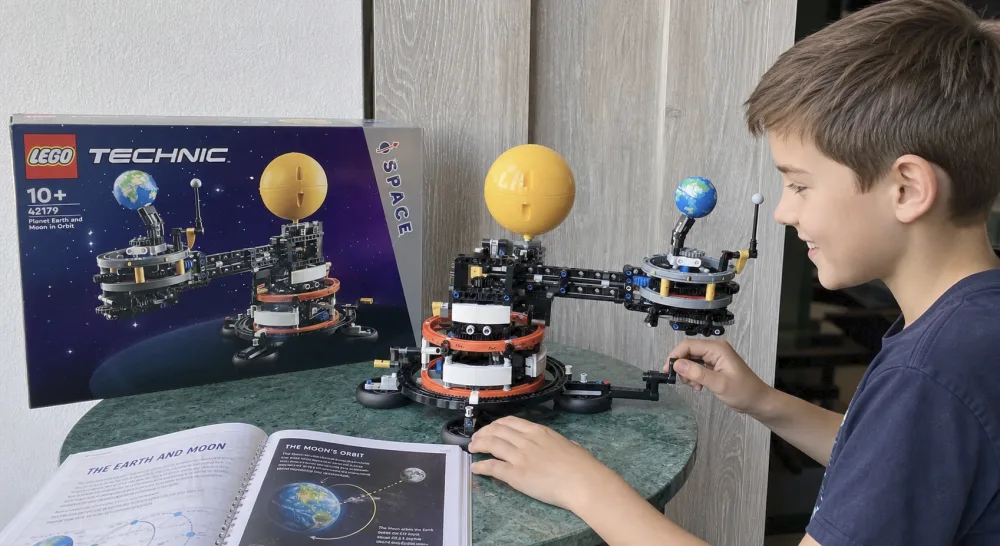
Our ten-year-old turned the little hand crank and watched the printed month ring tick past as the Moon swung around a tilted, spinning Earth. That single moment is the whole appeal of set 42179. This is the first static, non-vehicle LEGO Technic set in decades, and it trades the usual gears-and-wheels formula for a working orrery you operate by hand. We built it on the kitchen table, set it on a shelf, and cranked it for a couple of weeks to see whether the science holds up and whether a curious kid actually learns anything.
Set details and first impressions
Set 42179 stands out before you open a single bag. LEGO Technic has spent most of its life building cars and cranes that roll or lift, so a static model of Earth and the Moon is a real change of direction. Reviewers widely frame it as the first static, non-vehicle retail Technic set in 34 years, going back to 1990's Control Centre, though that framing comes from a reviewer rather than an official LEGO claim.
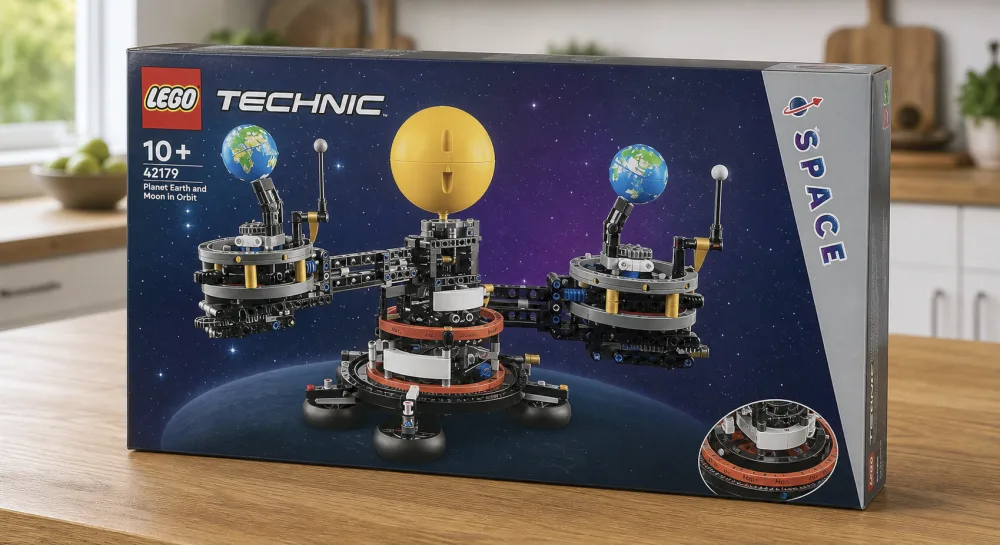
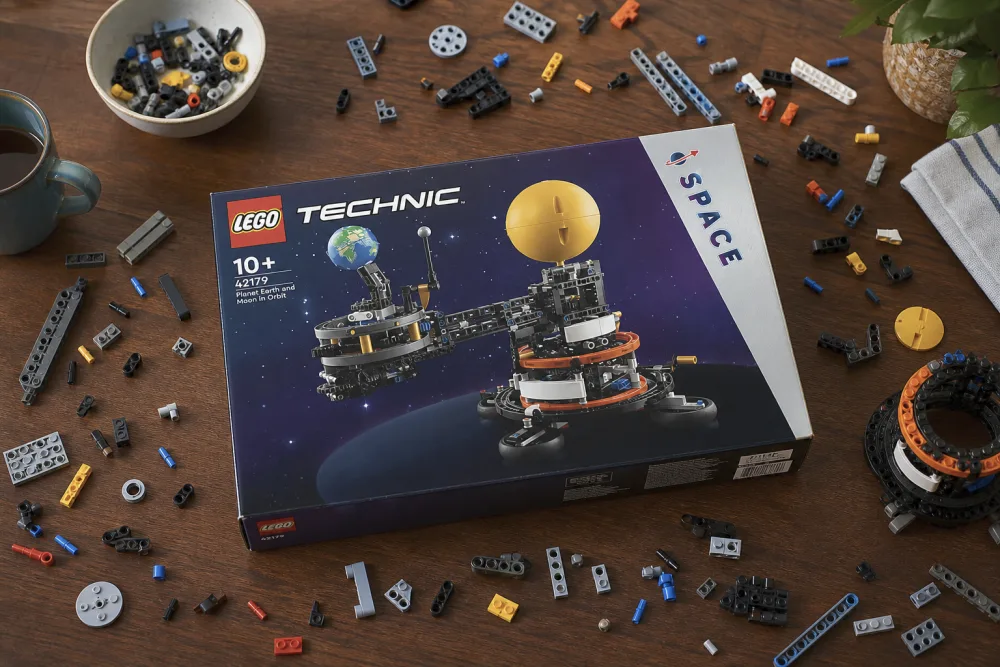
The headline number is 526 pieces, and the box pitches a working model of our planet and its Moon rather than another space playset. There are no minifigures here, which fits a set that is really a desktop machine. At $74.99 in the US, £69.99 in the UK, and €79.99 in Europe, it sits in the mid-price Technic bracket and is aimed at builders aged 10 and up.
What's in the box
Inside, the contents are organised into four numbered bags, each focused on an increasingly complex part of the gearing. You also get a printed globe with continents, two rings (one with month labels for Earth's orbit, one for the Moon's phases), and the instruction booklet.
A few genuinely new elements set this model apart. The standout is a new large Technic dome mould, a 5x5 hemisphere: here you get a pair of those hemispheres printed in blue with Earth's continents to form the globe, plus a matching Sun assembly built around the same part, left as plain yellow. The month-label ring and the Moon-phase markings are printed elements too. Because each bag builds a more involved gearbox than the last, the set reveals its mechanism in stages.
Building the orrery
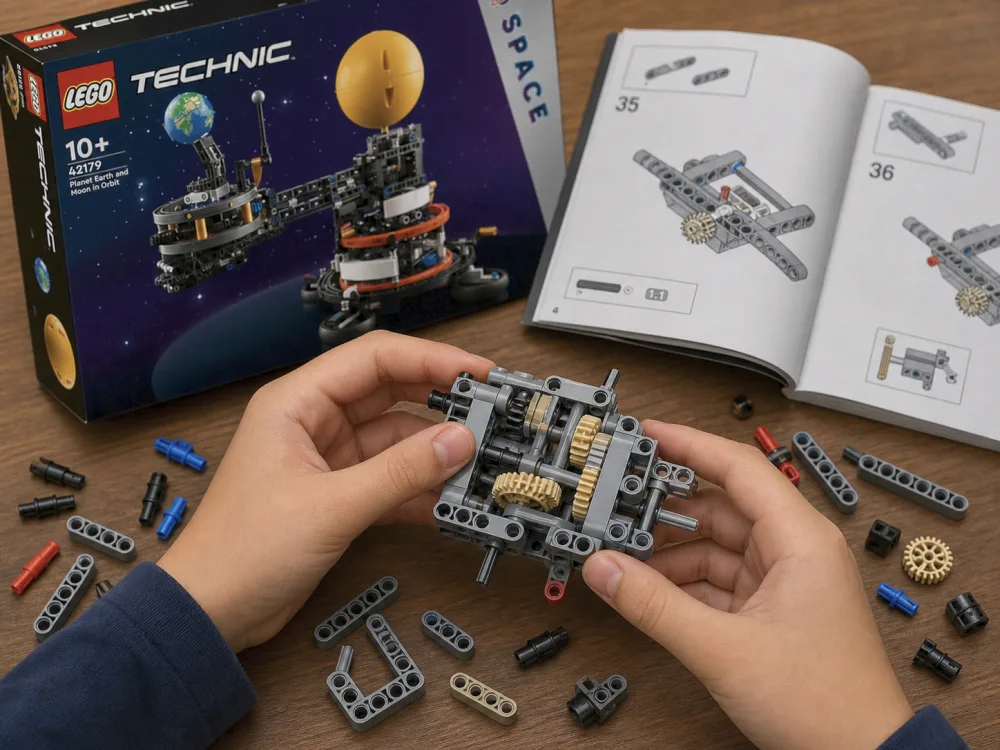
We built the model in one sitting after dinner, and it took us around an hour. One detailed reviewer timed a precise 81 minutes with a stopwatch, so plan for roughly an hour either way.
The build moves through those four bags in a logical order, and the satisfaction comes from watching the gear system assemble itself piece by piece. There are a few genuinely fiddly moments. Several steps ask you to insert four or six connector pegs at once, which takes spatial patience and a steady hand from a younger builder.
NoteWe split the build between the two of us. The support arm that holds the globe hides a surprising amount of intricate gearing inside what looks like a simple post. One thing to watch: the arm connectors can struggle to carry the model's weight once everything is assembled, though ours held together fine through daily cranking.
Build experience and difficulty
For the stated 10+ age band, this is a well-judged challenge. One reviewer described it as having "more than enough mechanics to provide an enjoyable and achievable challenge for younger builders," and that matches our experience. The difficulty ramps up gently, the gear system makes sense as you go, and a motivated ten-year-old can follow it with only occasional help.
Design and display
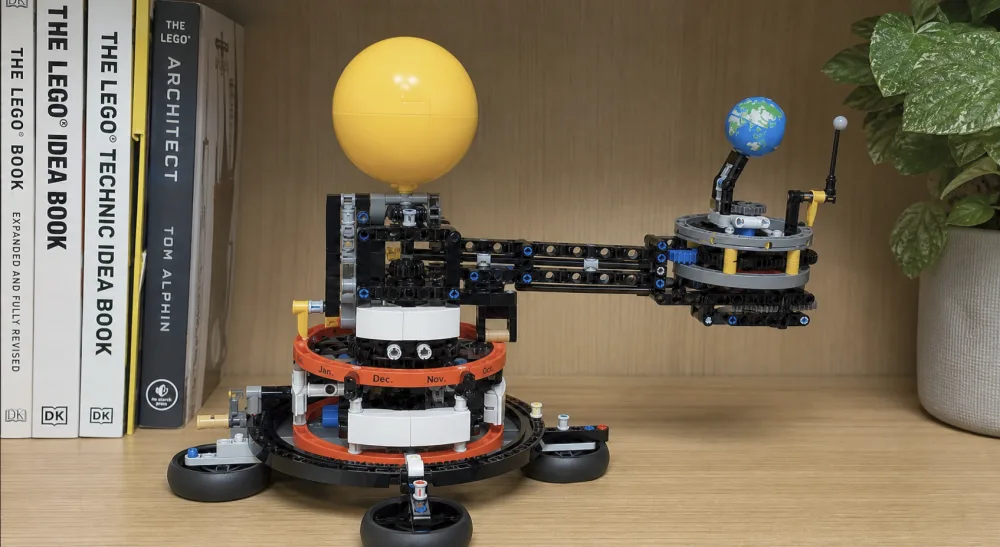
This is where opinions split. The finished model is not conventionally handsome. Exposed Technic beams and visible gearing dominate the look, and one reviewer flatly called it "a fairly ugly set that feels only partly finished." The bulky support arm that holds the globe is the main culprit, and it keeps the model from looking like a polished display piece.
Whether that bothers you depends on what you want from it. As a working machine you can pick up and operate, the visible gearing is arguably part of the charm. In our home it earned a shelf spot precisely because it looks like the science gadget it is. At 24 cm tall, it has presence without taking over a desk.
How the orrery works
An orrery is a mechanical model of the solar system that shows the planets and moons moving in their orbits, usually driven by gears. This one is hand-cranked: a single turn spins Earth on its tilted axis, swings the Moon around Earth, and drives the Sun, while the two printed rings track the year-long orbit and the Moon's phases.
NoteAn orrery is a clockwork or geared model of the solar system. The clever part of set 42179 is that one input, your hand on the crank, drives every motion at once through a chain of gears, so Earth's spin, the Moon's orbit, and the seasonal display stay locked in the correct relationship.
Cranking it is the best part. The mechanism moves surprisingly smoothly, the gearing feels elegant, and one reviewer called it "an absolute joy to use it for the first time." There is one honest quirk: noticeable gear backlash, so the parts engage in sequence rather than all at once. The planets do not all move on the very first turn, which is itself a small physics lesson.
One turn of the crank, and Earth spins, the Moon orbits, and the months tick by, all driven through a single elegant gear chain.
Earth's orbit and the seasons
Earth is mounted at a tilt of roughly 22.5 degrees, close to the real axial tilt of about 23.4 degrees. That tilt is what makes the model demonstrate the seasons correctly as Earth travels around the Sun, which is exactly the axial tilt that drives the seasons in real life. A spacecraft engineer who measured the gearing found the model turns roughly 364.5 times per orbit, only about 0.2 percent off the real 365.25 days in a year. Other reviewers round that loosely to "about 360 days," but the precise figure is impressively close.
The Moon's phases
The second ring tracks the Moon's phases as the Moon orbits Earth, and the Moon is fixed so it always keeps one face toward us, correctly modelling tidal locking. The modelled lunar month runs at around 26 to 27 days, depending on which reviewer counts it, against the real synodic month of 29.53 days. That makes the model roughly 8 to 9 percent short on the lunar cycle, the trade-off you make when everything meshes into one gear train.
Is it scientifically accurate?
For a $74.99 desktop machine, the accuracy is better than you might expect, with a couple of honest gaps. The year length is excellent, the axial tilt and seasons are right, and tidal locking is faithfully reproduced. The Moon's roughly 5-degree orbital tilt and its orbital eccentricity are omitted, which is why this model cannot show eclipses the way the real geometry would.
Watch outThe printed globe is geographically off. The equator sits about two-thirds of the way down rather than at the seam, which pushes much of Africa and South America into the southern hemisphere. It is a real flaw that knocked one reviewer's score down, so point it out to a curious kid rather than letting it teach the wrong map.
Taken together, the motion the model gets right is the motion that matters most for teaching: the tilt, the year, the phases, and the locked face of the Moon. The omissions are the finer details an advanced student would then go and explore.
Educational value (ages 10+)
This is where set 42179 earns its keep. Despite the looks, reviewers rate the learning value highly, with one calling the astronomy and gear-mechanics teaching "absolutely top notch" and the set "incredibly satisfying and impressively accurate" to operate. As a homeschooling family, we used it as a hands-on prop for a lesson on why we have seasons, and cranking through a full year made the tilt-and-orbit idea click faster than any diagram had.
There is one frustrating miss. The instruction booklet includes almost no notes about the actual astronomy. One engineer called that "a huge missed opportunity for at least a few notes about the actual motion of the planets," and we agree. The teaching potential is enormous, but you supply the lesson yourself.
NoteWe turned that gap into an advantage. Each time our ten-year-old cranked the model forward a "month," we paused and talked through what was happening to the tilt and the daylight. The omitted lunar tilt even became its own conversation about why eclipses do not happen every month.
Price and where to buy
Set 42179 carries a recommended price of $74.99 in the US, £69.99 in the UK, and €79.99 in Europe, and you can check the current listing on Amazon for live availability. On pure brick economics that works out to roughly $0.143 per piece, and one reviewer rated the value poor on that basis, suggesting it is best bought at around a 20 percent discount. We would frame it differently. You are paying for a working mechanism and a teaching tool, not just a count of bricks, and on that measure it reads as worth the price for the right buyer.
Pros and cons
Pros
- Smooth, elegant hand-cranked mechanism that is a joy to operate
- Genuinely accurate on the year length, axial tilt, seasons, and tidal locking
- Strong, hands-on educational value for ages 10+
- A novel, conversation-starting set unlike the usual Technic vehicles
Cons
- Exposed-beam, bulky-armed look is not a clean display piece
- Printed globe places the equator incorrectly
- Instruction booklet includes almost no astronomy notes
- Weak pure price-per-piece value at full retail
Alternatives to consider
If the orrery idea appeals but this set does not, a couple of on-site neighbours are worth a look. Our Thames & Kosmos Orbiting Solar System review covers the closest thematic alternative, a working solar-system model in the same hands-on spirit. For a more playful take on orbital motion, the Thames & Kosmos Orbital 3D Maze review leans into the space-and-orbit theme as a game.
You can also browse our wider STEM toys and science kits section for more working models in this vein. What sets 42179 apart from most space toys is that single-crank mechanism, so weigh any alternative on whether it actually moves and teaches.
Verdict: should you buy it?
We came away genuinely fond of this set despite its rough edges. The mechanism is the reason to buy it, and the science it gets right is the science a young learner most needs to see in motion. The looks are divisive and the booklet wastes its teaching moment, but neither flaw undoes what the model does well on the table.
Frequently asked questions
How long does it take to build set 42179?
Around an hour for an experienced builder, with one reviewer's stopwatch logging 81 minutes, so plan for roughly an hour whether you build it alone or split it with a child.
How many pieces are in Planet Earth and Moon in Orbit?
Set 42179 has 526 pieces, organised across four numbered bags that each build a more complex part of the gearing.
How big is the assembled model?
The finished model stands about 24 cm tall, roughly 33 cm long and 18 cm wide, so it has real presence on a shelf or desk.
How much does set 42179 cost?
The recommended price is $74.99 in the US, £69.99 in the UK, and €79.99 in Europe.
What age is it for?
LEGO rates set 42179 for ages 10 and up, and the build is well pitched for that band.
Is the orrery astronomically accurate?
Mostly. It nails the year length, axial tilt, seasons, and tidal locking, but it omits the Moon's roughly 5-degree orbital tilt and places the printed equator too low on the globe.