LEGO Chain Reactions Review: Hands-On With the Klutz STEM Kit
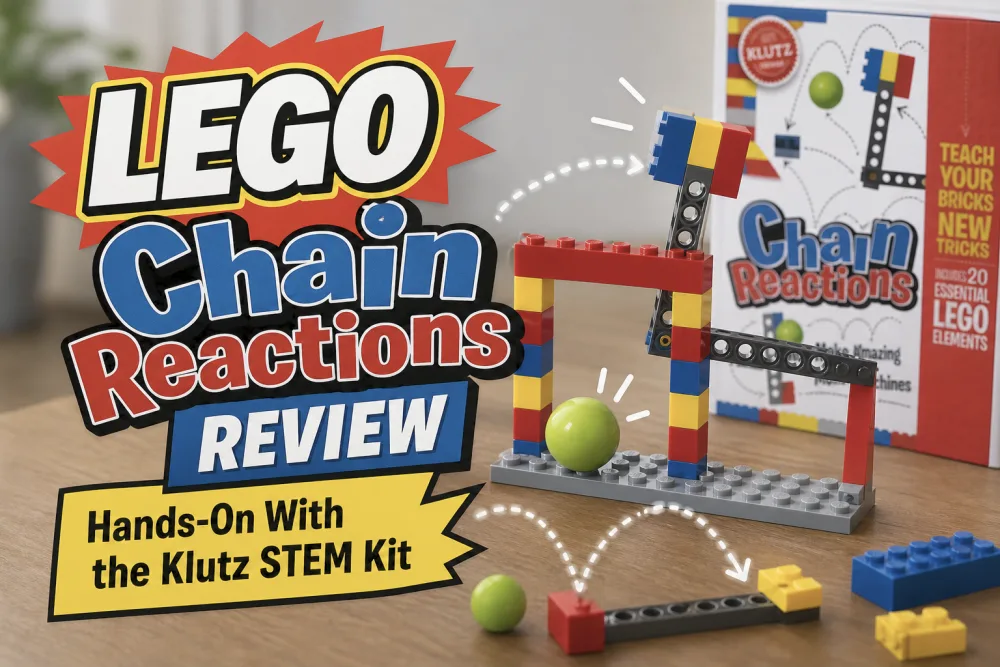
Our nine-year-old spread the spiral book open on the kitchen table after dinner and built the first machine, a little spinner, in about ten minutes flat. Then he tipped a ball down the ramp, watched it knock the next piece into motion, and grinned. That single moment is the whole pitch for LEGO Chain Reactions: a Klutz activity kit that walks kids through building ten moving LEGO machines and then linking them into one satisfying chain reaction.
NoteWe worked through the builds with our own kids over a couple of weeks, using the book, the included pieces, and a deep bin of our own LEGO. The short version: the ideas are wonderful, the science is real, and the box does not include nearly enough bricks.
How It Works
LEGO Chain Reactions hands your child a spiral-bound book and a small bag of parts, then teaches them to build simple moving contraptions one at a time. Each machine does one job, and a ball rolling off one becomes the trigger for the next. That is the Rube Goldberg machine idea in kid form, where a small step starts a bigger chain of motion.
Building the 10 moving machines (spin, swing, pivot, roll, lift, drop)
The book guides you through building 10 LEGO machines that spin, swing, pivot, roll, lift, and drop. Each one isolates a single motion, so a child learns what makes a wheel spin before they try to lift and drop a ball. The pictures are large and clear, and the spiral binding lies flat while small hands work.
Combining machines into a chain reaction (Rube Goldberg-style)
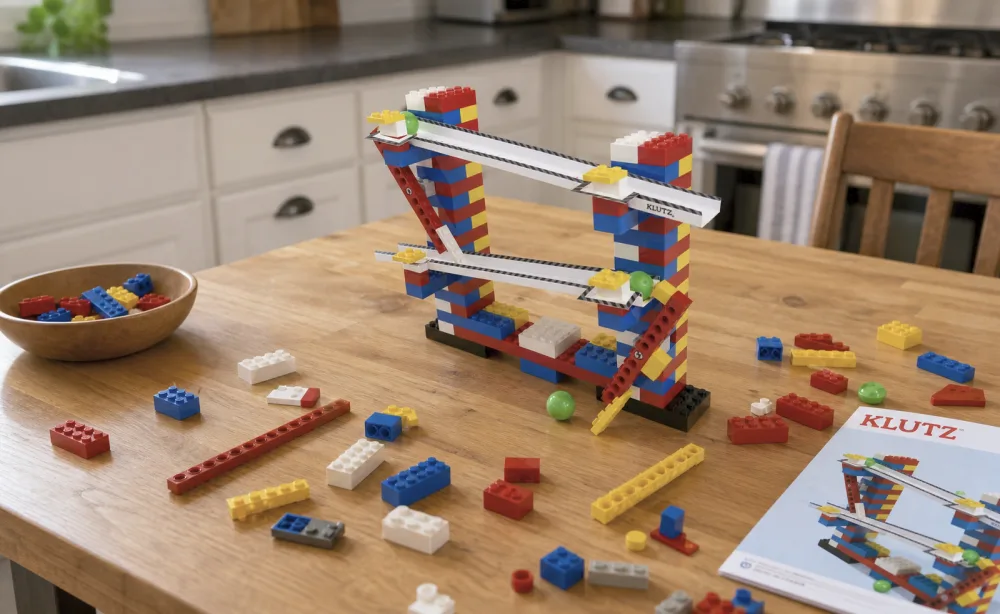
The real payoff comes when you chain the machines together. A ball drops, rolls down a paper ramp, swings a lever, and sets the next machine going. The book's structure, where small steps add up to a bigger project, is what makes that moment land. The kit also prints QR codes that play each finished machine in motion, so kids can see the goal before they build toward it. Watching our own chain finally run end to end got a genuine cheer.
What Is LEGO Chain Reactions? (Overview)
LEGO Chain Reactions is a STEM activity kit from Klutz, Scholastic's hands-on imprint, written by Pat Murphy and the scientists of Klutz Labs and first published in 2014. It is best described as a book-plus-bricks set: the book teaches, and the bricks plus a good handful of your own do the building. It is not a sealed LEGO set with one finished model, but a guided course in motion that happens to use LEGO.
What's in the box (book, ~33 LEGO elements, balls, string, paper ramps)
Open the box and you get a roughly 80-page spiral-bound book, 33 LEGO elements, 6 LEGO balls, 6 feet of string, and 8 paper ramps, plus paper pop-up signs, a funnel ramp, a flag, a bucket, and a platform. The book also includes a Brick Substitution guide, a quiet admission from Klutz that you will be reaching into your own LEGO bin.
Who it's for (age 8+ / parent-child build)
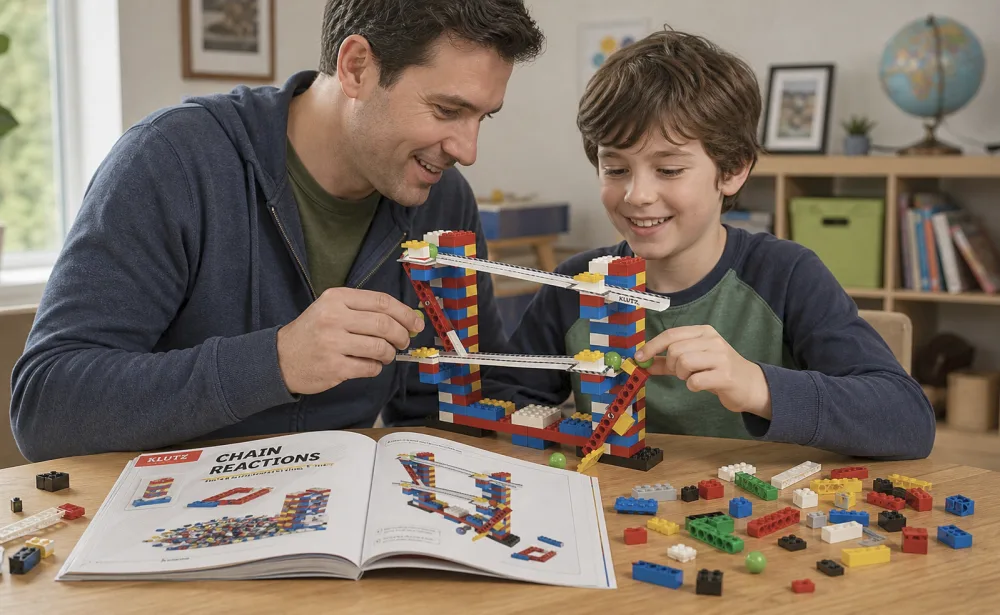
The kit is rated for ages 8 and up, with one retailer stretching that to 16. We think 8 is honest for the later builds. A focused younger child can manage the first machine or two with a parent alongside, but the difficulty climbs, and later contraptions reward a kid who can read a diagram patiently. It works beautifully as a parent-child project, which is how we used it.
Educational & STEM Value
This is where LEGO Chain Reactions earns its keep. The whole kit is built around watching cause and effect happen, then figuring out why.
Physics, simple machines & cause-and-effect concepts
Every machine is a small lesson in simple machines, force and motion, and cause-and-effect. A child learns that a lever trades distance for force, that a ramp turns a drop into a roll, and that timing is everything once machines are chained. The Rube Goldberg framing gives it all a purpose: you are not just learning a concept, you are using it to make the next thing move.
The best science here is not in the book. It is the moment a kid realizes their ball stopped rolling because the ramp was a half-inch too low, and quietly fixes it.
Skills it develops
Beyond physics, the kit builds patience, planning, and the willingness to troubleshoot. Our kids learned to test a machine, watch it fail, and adjust one thing at a time. That calm habit of fixing a build that almost works is the skill we most wanted them to take away.
Build Experience & Difficulty
The build experience splits into two halves: the parts that delighted us and the parts that frustrated us.
Instructions and design quality
The instructions are genuinely good. The pictures are simple to follow, and the spiral binding stays open and flat through a whole build session. The paper accessories are the weak point. The ramps are thin and not stiff, so lining them up is fiddly, they wear out with use, and they are not easy to replace once they curl.
Time to build
A first machine takes ten to fifteen minutes for a confident eight-year-old. The catch is difficulty: the first two builds needed almost no adult help, but the third and fourth got genuinely challenging and needed a parent at the table. Plan for one machine in an afternoon and the full chain across several sittings.
What We Liked (hands-on author note)
NoteAcross our build weeks, the wins were real. Our kids stayed engaged even when a machine fought back, and they loved building moving things they had never thought to build before. The chain-reaction payoff, when it finally ran, was the moment we set up these projects for.
Pros
- Teaches real physics through hands-on cause-and-effect, not worksheets
- Clear, simple instructions in a flat-lying spiral book
- QR codes show each finished machine in motion
- Builds progress in difficulty, so kids stay challenged
- Genuinely engaging even when a build gets hard
Cons
- Only 33 LEGO elements included, far short of what the 10 builds need
- Paper ramps are flimsy, fiddly to align, and wear out
- Difficulty jump at builds three and four can frustrate younger kids
- Verdict depends heavily on whether you already own a LEGO stash
What Could Be Better
For all its good ideas, this kit has one real problem.
The "not enough bricks" issue (only ~33 included, needs your own LEGO)
Here is the honest verdict every parent needs before buying. The 33 included bricks are only enough for the very first project. Without your own LEGO stash, you cannot complete most of the 10 builds. You need a healthy stash of your own bricks to complete all the builds, near 200 extra pieces, mostly common 2x4, 2x6, and 2x8 bricks and plates, to build all ten models.
We watched this play out. When the exact pieces were not on hand, the momentum died fast, and a younger child lost interest the moment the dominoes build stalled for want of the right bricks. Without your own bricks on hand, you cannot even build the projects it gives instructions for. That is the single biggest thing holding this kit back.
Watch outBuy this as a book-and-ideas kit, not a complete LEGO set. If your home does not already have a deep bin of standard bricks, budget for one or expect to leave several of the ten builds unfinished.
Price & Value for Money
LEGO Chain Reactions lists for around $30 and is frequently discounted, so it is worth checking the current price on Amazon before you buy. Whether that is good value depends on your brick situation. For a household that already owns plenty of LEGO, it is a smart, affordable homeschool tool for force and motion. For a family buying it as their child's main LEGO, the real cost is closer to $30 plus a bulk brick set, which changes the math. It is well-reviewed across retailers, averaging in the low-to-mid 4s out of 5.
How It Compares to Similar Klutz / STEM Kits
Klutz makes a whole shelf of these LEGO activity books, and the brick-shortfall issue is unique to this one. Its siblings include all the parts you need, which is the most useful thing to know when choosing between them. Our Klutz LEGO Gear Bots review covers the closest relative, and if your kids lean toward motorized models, our LEGO Technic NASA Mars Rover review and LEGO Technic Planet Earth and Moon review are worth a look.
| Kit | Age range | Builds | LEGO bricks included | Own bricks needed? | Price |
|---|---|---|---|---|---|
| LEGO Chain Reactions | 8+ | 10 moving machines | 33 (not enough) | Yes, lots | ~$29.99 |
| Klutz LEGO Gear Bots | 8+ | 8 kinetic creatures | 62 | No | ~$24.99 |
| Klutz LEGO Gravity Drop | 8+ | 20+ contraptions | 168 | No | ~$24.99 |
| Klutz LEGO Race Cars | 7+ | 10 race cars | 124 (all needed) | No | $24.99 |
| T&K Pinball Machine Maker | 6–12+ | 10 experiments | 88 pieces (all included) | No | $39.95 |
The comparison makes the trade clear. Gear Bots, Gravity Drop, and Race Cars all hand you every brick the projects need. Chain Reactions asks you to bring your own, and gives the most open-ended play of the bunch in return.
LEGO Chain Reactions FAQ
Is LEGO Chain Reactions worth it?
Yes, if your home already owns a good supply of standard LEGO bricks. It is a clever, hands-on physics kit with strong instructions. If you would be buying it as your child's only LEGO, factor in a separate brick set, because the 33 included pieces are not enough.
What age is it for?
It is rated for ages 8 and up, and that feels right. The first builds suit a focused younger child with a parent helping, but the later machines reward a kid who can read a diagram patiently.
How many machines can you build?
The book teaches you to build 10 moving machines that spin, swing, pivot, roll, lift, and drop, which you can then combine into a single chain reaction.
Do you need your own LEGO bricks?
Yes, and this is the most important thing to know. The kit includes only 33 LEGO elements, enough for the first project, and you will need a healthy stash of your own bricks, near 200, to finish all ten builds.
Is it a book or a building set?
Both, but lean toward thinking of it as a book. The roughly 80-page spiral guide teaches, and a small set of bricks plus your own collection does the building.
Verdict: Is LEGO Chain Reactions Worth It?